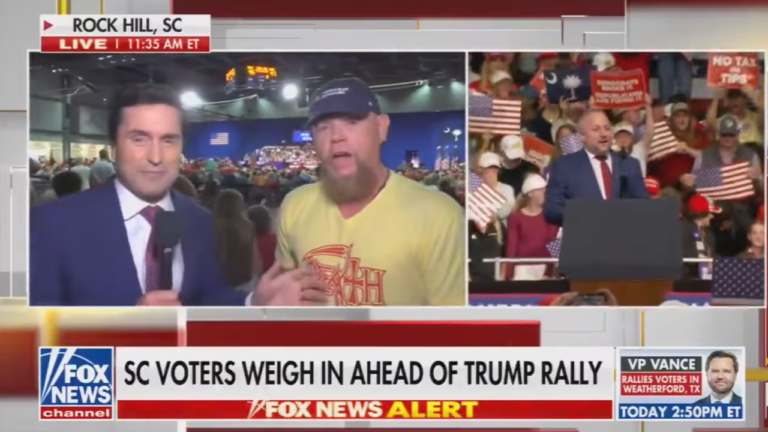
A Fox News correspondent covering Donald Trump’s rally in South Carolina got considerably more than he bargained for when he approached a man in the crowd for what appeared to be a routine interview.
The exchange began innocently enough. It ended with an extraordinary comparison that left the reporter scrambling to respond — all during a live television broadcast.
Fox News correspondent Lucas Tomlinson was reporting from Trump’s rally in Rock Hill, South Carolina, on Thursday when he approached an attendee wearing a yellow T-shirt and blue baseball cap.
The man, who identified himself only as Tom, appeared to be just another person waiting to see the president.
Tomlinson asked the kind of question reporters routinely pose to people at political rallies.
“Tom, why are you here this morning?” he asked.
The response was anything but routine.
“Well, in the late 70s,” the man began, “I was a little too young to get involved and go to South America for the Jonestown Massacre, but this is as close as I’ll ever get, so that’s why I’m here.”
It was a startling answer, particularly for a live Fox News segment at a Trump campaign event.
Tomlinson seemed momentarily unsure whether he had heard the man correctly.
“Wait, the Jonestown Massacre?” the correspondent asked.
Tom confirmed that was exactly what he meant.
“That’s right. See, there’s nothing like seeing a cult right up front, man.”
And just like that, what had started as an ordinary campaign interview turned into a blistering insult aimed at the political atmosphere surrounding Trump.
The reference was especially provocative.
The Jonestown massacre occurred in Guyana in November 1978, when more than 900 people died in a mass murder-suicide orchestrated by cult leader Jim Jones. The tragedy remains one of the most notorious examples of destructive cult leadership in modern American history.
By invoking Jonestown, Tom was making an intentionally harsh comparison between the devotion of Trump’s supporters and the unquestioning loyalty associated with Jones’s followers.
It was a political insult, not evidence that the rally itself posed a comparable danger.
But the unexpected nature of the answer made the exchange remarkable television.
Tomlinson, who had apparently expected to interview a Trump supporter, quickly recognized that the conversation had gone somewhere very different.
“All right, so maybe this is not a Trump supporter right now,” he said.
He then moved on to another attendee.
The brief exchange was captured during Fox News’ coverage of the rally and subsequently circulated online, where the contrast between the reporter’s straightforward question and the man’s deliberately provocative response attracted attention.
The moment also illustrated one of the hazards of live political reporting.
A reporter can approach someone who looks perfectly comfortable in a partisan crowd, but appearances offer no guarantee of what that person actually believes — or what they might say when handed a microphone.
Tom understood that opportunity.
Rather than immediately identifying himself as a critic of the president, he began with an unexpected historical reference, waited for the reporter to ask for clarification and then delivered his punchline.
The result was an unscripted criticism of Trump supporters broadcast on a network whose audience includes many of the president’s most enthusiastic backers.
Tomlinson’s response was relatively restrained. He did not argue with the man or attempt to prolong the confrontation. He acknowledged that the interviewee was apparently not a Trump supporter and continued his reporting.
Still, the exchange stood out because of how quickly the conversation changed.
The interview also came during the final stretch of the midterm campaign, as Trump traveled to Republican-leaning states to rally supporters and encourage turnout.
His appearances have drawn both enthusiastic supporters and outspoken critics, creating opportunities for confrontations that can quickly overshadow the intended campaign message.
Thursday’s incident was different from the shouting matches and security interventions seen at some other Trump rallies.
There was no extended confrontation with the president and no need for security personnel to remove the interviewee from the broadcast.
Instead, the entire spectacle unfolded through a simple question and an answer the reporter plainly had not anticipated.
For Tom, the encounter provided an opportunity to deliver a pointed criticism directly to a national television audience.
For Tomlinson, it was a reminder that interviewing strangers live carries risks that no amount of preparation can completely eliminate.
And for viewers watching the exchange, the most memorable moment was the reporter’s realization that the man standing in front of him had come to the rally for a very different reason than he initially appeared to expect.
One question. One unexpected answer. And a Fox News interview that went completely off script.
About the Author