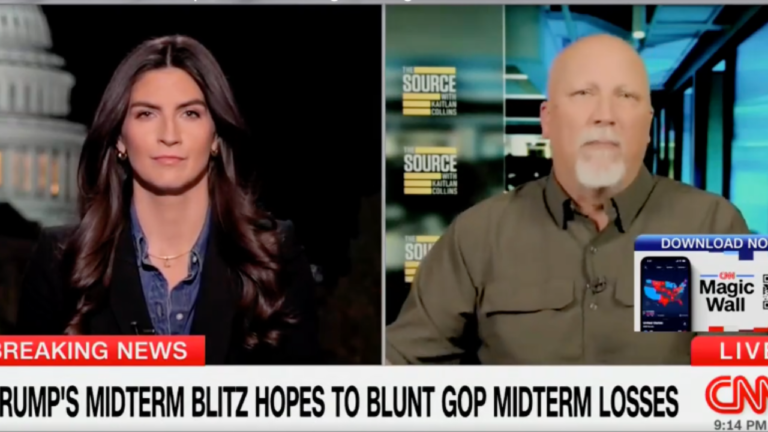
CNN anchor Kaitlan Collins confronted Republican Congressman Chip Roy over the Trump administration’s economic promises Wednesday night, then caught him repeating a campaign slogan closely associated with former President Joe Biden.
The exchange unfolded on The Source with Kaitlan Collins, less than a week before the midterm elections, as Republicans made their final arguments to voters concerned about rising prices and the cost of living.
Roy, a Texas Republican who is not seeking reelection, appeared on the program to discuss the administration’s record and what his party should be telling Americans ahead of Election Day.
Collins wanted to know why voters should trust Republicans to deliver the lower prices they had promised.
Roy argued that the administration needed to remain focused on reducing government spending and increasing domestic energy production.
“Talk about the fact we will get gas prices, diesel prices, home prices, food prices down if we cut spending, if we can increase refining capacity,” he said.
Collins immediately pointed out the problem with that argument.
“But that’s what President Trump said two years ago,” she replied.
It was a direct reference to Trump’s 2024 campaign promises, when he repeatedly pledged to bring down energy costs, reduce inflation and keep the United States out of new foreign wars.
Nearly two years into his second term, Americans were still confronting high prices.
According to AAA figures cited in the interview’s coverage, the national average for regular gasoline was approximately $4.24 per gallon Wednesday, about $1.20 higher than a year earlier.
Collins also questioned Roy about Trump’s public celebration of the profits earned by major oil companies while consumers struggled with fuel costs.
“Do you think it’s a good idea to brag about how big the profits are for Big Oil when Americans can’t afford gas?” she asked.
Roy defended the president, arguing that Trump had also criticized oil companies for failing to pass more of their profits along to consumers through lower prices.
The congressman acknowledged that Americans wanted results but insisted the administration was moving in the right direction.
“My argument would be, is that it takes time, and we’ve only been in 21 months,” Roy said.
He pointed to Republican efforts to reduce spending, change federal workforce policies and increase energy production.
Roy also argued that the administration needed to complete its objectives in Iran, framing the conflict as part of a broader effort to resolve long-running national security challenges.
But Collins continued pressing him on the gap between the administration’s promises and the economic conditions Americans were experiencing.
The conversation then took an unexpected turn.
As Roy attempted to summarize the Republican message for the final days of the campaign, he repeatedly used a phrase that had already played a prominent role in a recent presidential election.
“These are all positive steps,” Roy said. “But yes, look, I say, tell them what the truth is: Let’s finish the job.”
Collins immediately recognized the wording.
“Well, you keep saying finish the job. That was President Biden’s line,” she replied. “It didn’t work.”
The remark highlighted an awkward similarity between Roy’s proposed Republican message and the reelection pitch used by the president Trump defeated in 2024.
Biden had repeatedly used “Let’s finish the job” during his 2023 State of the Union address, turning it into a central theme of his effort to win another term.
His reelection campaign eventually ended in July 2024 after a widely criticized debate performance against Trump. Vice President Kamala Harris replaced him as the Democratic nominee and lost the November election.
Now Roy was offering a strikingly similar appeal to voters: Republicans had made progress, he argued, but needed more time to complete their agenda.
The congressman did not retreat from the message.
“Yeah, well, my view is that we’ve had now 21 months of success in pushing the direction,” he responded.
Roy continued by citing what he considered the administration’s accomplishments, including economic growth, private-sector hiring and border enforcement.
He then made his request for additional time explicit.
“Give us two more years to be able to finish the job,” Roy said.
He argued that Republicans could use that time to further reduce federal spending, lower interest rates and inflation, increase refining capacity and bring down fuel costs.
The exchange exposed a central tension in the Republican midterm message.
Trump and his allies have spent much of the campaign defending their economic record while continuing to promise improvements in affordability.
Collins’s questions focused on whether those promises should carry the same weight after Republicans had already spent 21 months in power.
Roy’s answer was that the administration’s policies required more time to produce their full effects.
Collins’s counterpoint was that voters had heard much the same argument before — both from Trump during his 2024 campaign and, in a different political context, from Biden.
The irony of a Republican congressman adopting Biden’s familiar language was particularly striking given how frequently Trump and his allies have criticized the former president’s economic record.
Roy was not suggesting that Republicans should adopt Biden’s policies. His argument concerned the continuation of Trump’s agenda, which he said was already producing positive results.
But the overlap in campaign language gave Collins an opening to challenge the effectiveness of the message itself.
The interview also underscored the importance of affordability in the closing days of the midterm campaign.
Gasoline prices, grocery bills, housing costs and inflation remain central issues for voters evaluating the administration’s performance.
For Republicans, the challenge is to persuade Americans that their policies are working and that additional time will produce the promised results.
For Collins, the question was why voters should accept another request for patience when many of the same promises had been made before.
And when Roy reached for “Let’s finish the job,” she had a particularly memorable response waiting.
It was a reminder that political slogans can outlive the campaigns that made them famous — sometimes returning in the arguments of the opposing party.
About the Author