
Donald Trump was supposed to be talking about children’s savings accounts. Instead, the president turned an Oval Office appearance into a remarkable discussion about what he could have done to three of the most prominent Democrats in America — and how much power he believes he has.
Barack Obama. Joe Biden. Hillary Clinton.
All three names came up as Trump responded to a question about the possibility of being impeached again.
And what followed was an exchange that raised an uncomfortable question about the difference between presidential authority and political retaliation.
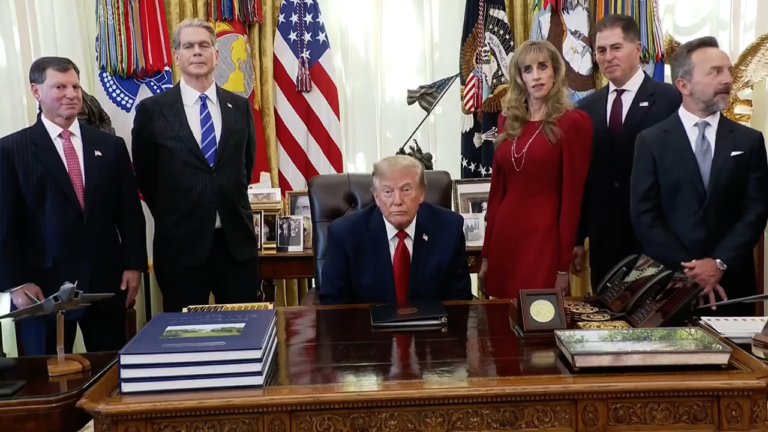
The moment unfolded Wednesday, October 7, during an Oval Office event promoting Trump Accounts, the administration’s savings initiative for children.
(WATCH THE VIDEO BELOW)
Fox News correspondent Peter Doocy asked whether Trump was concerned that Democrats might move to impeach him if they gained control of Congress in the November midterm elections.
Trump dismissed the possibility, arguing that Democrats would struggle to explain what they wanted to impeach him for.
But he didn’t stop there.
He shifted from defending his presidency to describing what he said he could have done to his political opponents.
The president named Clinton, Biden and Obama individually, claiming he had opportunities to take severe action against each of them.
He did not explain what specific actions he had in mind.
Instead, Trump insisted that he had refrained from pursuing them because he believed the presidency deserved respect.
Then came the part that made the exchange especially striking.
Trump pointed to the two impeachment proceedings he faced during his first term and declared that he still possessed the ability to act against his political opponents if he chose to do so.
“I can do whatever I want, if I want,” the president said.
The words were delivered in the Oval Office, with administration officials and invited guests standing around the Resolute Desk.
There was no formal announcement of a new prosecution, investigation or criminal charge against Obama, Biden or Clinton.
But the absence of an announced action does not erase the significance of a sitting president publicly describing his political opponents as people against whom he could still act.
Trump also alleged that his Democratic rivals had engaged in illegal conduct.
He offered no specific evidence during the exchange to substantiate those allegations.
The president’s remarks came as Republicans and Democrats were already looking toward November’s midterm elections, with control of Congress and the prospect of future investigations becoming central political questions.
Trump has repeatedly warned that Democrats could attempt to impeach him if they regain power.
Democrats, meanwhile, have criticized the administration over issues ranging from executive authority and federal law enforcement to the handling of congressional oversight.
The Constitution gives the House of Representatives the power to impeach federal officials and the Senate the responsibility to conduct impeachment trials.
Trump was impeached twice during his first presidency.
The first impeachment, in December 2019, concerned his dealings with Ukraine and allegations that he had abused his office and obstructed Congress.
The second, in January 2021, concerned his conduct surrounding the attack on the U.S. Capitol.
The Senate acquitted him in both trials.
Those proceedings form an important part of the context for his latest remarks.
Trump continues to portray the impeachments as unjustified political attacks, and he used Wednesday’s question to revisit those grievances.
But he also went further, suggesting that his own decision not to pursue certain Democrats was a matter of personal restraint.
That framing is precisely what makes the exchange consequential.
In the American system, the authority to investigate and prosecute alleged crimes is not supposed to function as a personal instrument of the president.
Federal prosecutors are expected to make decisions based on evidence, applicable law and established legal standards — not on whether the president wishes to punish a rival.
A president may establish law enforcement priorities and appoint senior officials, but those powers are not unlimited.
Nor does a president’s public accusation establish that someone committed a crime.
Trump’s statement therefore leaves two separate questions.
What, exactly, did he mean when he said he could have done severe things to Clinton, Biden and Obama?
And what did he mean when he suggested that he could still act against them whenever he wanted?
He did not provide detailed answers.
Instead, he returned to the idea that the presidency is a sacred office and should be treated with respect.
That argument created a striking tension within his own remarks.
On one hand, Trump described himself as someone who had deliberately refrained from targeting political adversaries.
On the other, he emphasized his continuing ability to do so.
He also claimed that others had encouraged him to pursue his Democratic opponents, while portraying his refusal as a matter of principle.
The contrast between those claims and his sweeping description of presidential power was central to the moment.
Trump has long made the treatment of political opponents a recurring theme of his public statements.
He has accused Democratic administrations of using federal agencies against him, while his critics have warned that his own rhetoric risks normalizing political interference in law enforcement.
Those competing accusations do not establish the truth of any particular criminal allegation.
They do, however, make presidential comments about possible retaliation especially sensitive.
The Oval Office setting added another layer.
This was not a campaign rally where Trump was responding to chants from a partisan audience.
It was an official White House appearance, initially organized around a policy initiative unrelated to criminal investigations or impeachment.
The shift in subject came from a reporter’s question, but the decision to bring up Obama, Biden and Clinton was Trump’s.
And the president did not simply criticize their policies or political records.
He described what he said he had the power to do to them.
That distinction matters.
Political disagreement is a normal feature of democracy. Public officials regularly criticize their predecessors and rivals.
Using government power to retaliate against political opponents, however, would raise much more serious legal and constitutional concerns.
Trump did not announce that he was ordering such retaliation on Wednesday.
The available remarks support reporting what he said, not claiming that a new crackdown had begun.
Still, his comments offer a revealing glimpse into the way he publicly discusses the relationship between political grievance and presidential authority.
For years, Trump has framed his own legal and political battles as evidence that powerful institutions were used against him.
Now, back in the White House, he is openly discussing the actions he says he could take against the Democrats he holds responsible.
And he is doing so while warning that another impeachment effort could be waiting after the midterms.
The broader political stakes are clear.
If Democrats gain congressional seats, oversight of the Trump administration could intensify. If impeachment proposals emerge, lawmakers would still have to identify specific grounds and navigate the constitutional process.
None of that gives the president unrestricted authority to retaliate.
The rule of law depends on the distinction between a political dispute and a criminal case — and on the principle that evidence, rather than personal grievance, determines whether prosecution is justified.
Trump’s Oval Office remarks did not resolve any of those questions.
They made them harder to ignore.
The president named three major Democratic figures, asserted that he could have acted against them, invoked the impeachments he had faced and then described his own power in extraordinarily broad terms.
For a country still debating the limits of executive authority, that sequence deserves scrutiny.
The most important part of the exchange was not a newly announced indictment or a dramatic law enforcement operation.
There was neither.
It was a sitting president’s public explanation of how he views his power over political opponents — and his insistence that his restraint, rather than any legal limit, had kept him from using it.
That is the real story behind the Oval Office video.
About the Author

“In The Final Days there will be strife iniquity and wars and rumours of wars. Such things must be and The End is not yet.” (Jesus in Matthew 24) “But woe to those through whom these terrible things come.” (Jesus in Matthew 24) God is most capable of doing “bad things” (the words of Donald Trump) to people who do evil. Trump will not really get away with anything! Amen!?