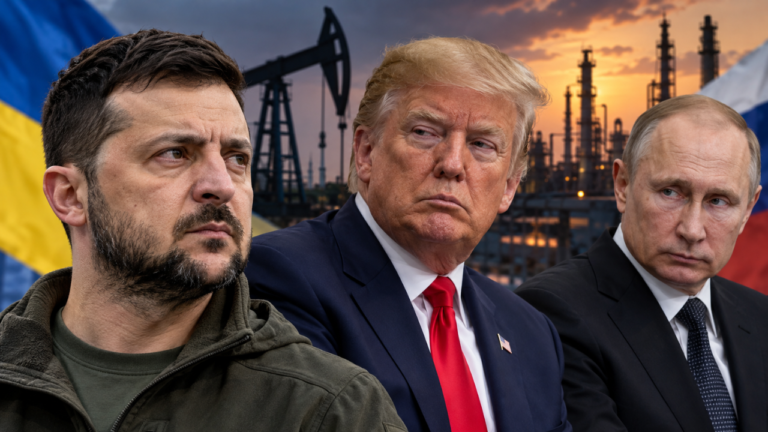
Ukrainian President Volodymyr Zelenskyy delivered a sharp public warning to Donald Trump on Friday after the American president announced a surprise agreement with Vladimir Putin that would allow Russia to sell millions of tons of diesel fuel into American and global markets.
The announcement was intended to address soaring fuel prices. Instead, it immediately opened a new dispute over whether Washington was giving Moscow economic relief while Russian forces continued attacking Ukrainian cities.
Zelenskyy did not conceal his frustration.
“Gifts to Putin will not bring peace or any benefit to the civilized world,” the Ukrainian president wrote in a statement responding to the agreement.
His criticism came just hours after Trump announced that he had spoken with Putin and reached what the American president described as a successful understanding on Russian diesel supplies.
According to Trump’s announcement, Russia agreed to immediately provide more than 300,000 tons of diesel to American and international markets, followed by another 500,000 tons in November and one million tons shortly afterward.
Trump also said Moscow could supply an additional three million tons within a relatively short period, depending on the condition of Russia’s refineries.
The administration accompanied the announcement with a temporary sanctions exemption allowing Russian diesel to enter the market.
It was a significant shift in Washington’s approach to Russian energy exports, which have faced extensive restrictions since Putin launched his full-scale invasion of Ukraine in February 2022.
For Zelenskyy, the timing was especially troubling.
Ukrainian negotiators were in the United States for discussions involving American officials and European partners about possible steps toward ending the war. Yet Washington had just announced an energy arrangement with Moscow that Kyiv feared would ease pressure on the Russian government.
Zelenskyy argued that Russia should not receive economic concessions without making meaningful commitments to stop its attacks.
“Any easing of sanctions against Russia without a clear and lasting de-escalation agreement with Russia is an obvious weakness,” he declared.
He warned that such relief could provide Moscow with additional resources to continue fighting and reduce the incentive for Putin to negotiate seriously.
The Ukrainian president’s remarks were not simply an objection to Russian fuel entering the international market. They reflected a broader disagreement over how to negotiate with a government that has continued military operations despite years of diplomatic pressure and economic sanctions.
Zelenskyy has repeatedly argued that Russia must face consequences for its invasion and that any easing of those consequences should be tied to verifiable changes in Moscow’s behavior.
Trump, by contrast, presented Friday’s announcement primarily as an economic measure.
The United States has been struggling with exceptionally high diesel prices amid disruptions associated with the war involving Iran and continuing instability in global energy markets.
Diesel is essential to American trucking, agriculture, construction and freight transportation. When its price rises, the effects spread far beyond motorists filling their tanks.
Higher transportation costs can increase the prices of groceries, manufactured goods and other everyday necessities.
According to AAA figures cited by Reuters, the average price of diesel in the United States had reached approximately $6.28 per gallon on Thursday.
With congressional elections approaching in November, the administration has faced growing pressure to bring fuel costs under control.
Trump argued that increased Russian supplies would help reduce those prices quickly, emphasizing the needs of American farmers, truckers and consumers.
But that economic rationale did not resolve the diplomatic consequences of the decision.
Russian energy revenues have long been a central concern for Ukraine and its allies because oil and petroleum exports generate income for the Russian economy.
Sanctions were designed in part to restrict those revenues and increase the financial cost of continuing the war.
Allowing additional Russian petroleum products onto the market could provide economic benefits to Moscow, although the actual impact will depend on the volume of shipments, market conditions and how the arrangement is implemented.
For Ukraine, that possibility is difficult to separate from the continuing destruction caused by Russian attacks.
In his statement, Zelenskyy described recent strikes against Ukrainian residential areas, public transportation and energy infrastructure.
He pointed to attacks affecting communities including Pryluky and Kramatorsk, as well as continuing pressure on essential infrastructure in Kyiv, Dnipro, Kharkiv and Odesa.
Those attacks, he argued, demonstrate why Moscow should not receive relief merely for participating in conversations with Washington.
Zelenskyy also claimed that Russia was attempting to compensate for difficulties on the battlefield through attacks on civilian infrastructure and diplomatic efforts to reduce sanctions pressure.
That assessment reflects Kyiv’s view of the conflict. The broader military situation remains complex, and individual battlefield claims require independent verification.
Nevertheless, the Ukrainian president’s central argument was clear: economic concessions should follow concrete steps toward reducing violence, rather than precede them without conditions.
He also offered a proposal for reciprocal restraint.
Ukraine has carried out strikes against Russian oil refineries and other energy facilities, operations Kyiv describes as a response to Russia’s sustained attacks on Ukrainian infrastructure.
Zelenskyy said Ukraine would be prepared to stop targeting Russian refineries if Russia stopped attacking Ukraine’s energy system.
That proposal, he argued, could provide the basis for a practical agreement backed by American diplomatic pressure.
It would also establish a direct connection between sanctions relief and measurable changes on the ground.
The dispute grew sharper later Friday when Zelenskyy spoke with Axios.
In that interview, he described Trump’s decision as “not fair and not honest,” reflecting frustration that Washington had reached an arrangement with Moscow while Ukrainian and European representatives were engaged in peace discussions.
According to Axios, American envoys Steve Witkoff and Jared Kushner were meeting in Miami with Ukrainian negotiators and representatives from Germany, France, the United Kingdom, the European Union and NATO.
The discussions were intended to develop new proposals for ending the conflict.
Trump’s announcement introduced an unexpected complication into those talks.
Ukraine’s concern is not merely that Russia could benefit financially from diesel sales. It is that Moscow could interpret unilateral sanctions relief as evidence that Western pressure can be reduced without first agreeing to meaningful concessions.
The administration has a different immediate priority: increasing energy supplies and reducing costs for American consumers.
Those objectives are not necessarily incompatible with diplomatic efforts to end the war, but Friday’s announcement exposed how difficult it can be to pursue both simultaneously.
The United States wants cheaper fuel. Ukraine wants sustained economic pressure on Russia. Putin has an interest in restoring access to markets that sanctions have restricted.
Those competing priorities now sit at the center of an increasingly delicate negotiation.
The announcement also raises questions about the longer-term direction of American sanctions policy.
Just weeks earlier, Trump had signed legislation intended to increase economic pressure on Russia’s energy sector. The new exemption creates a significant exception to that approach.
The Treasury Department’s authorization is temporary, rather than a complete removal of all sanctions against Russian energy companies. But it permits transactions that otherwise would face restrictions.
That distinction matters legally, even as Ukraine questions the political message the exemption sends.
Zelenskyy has not argued that diplomacy with Russia should end. On the contrary, his statement called for a negotiated reduction in attacks and emphasized that Ukraine was ready to take reciprocal steps.
What he rejected was the idea of easing pressure on Moscow without securing a comparable commitment in return.
His criticism therefore went beyond a disagreement over diesel shipments.
It challenged the sequence of Trump’s approach: whether the United States should provide economic relief first and hope for progress afterward, or demand concrete de-escalation before making concessions.
For a country still enduring Russian bombardment, that distinction carries enormous consequences.
There is also an important uncertainty surrounding Trump’s announcement.
The promised quantities of Russian diesel have not yet been shown to have entered the market in full, and it remains unclear how quickly the shipments could affect prices.
The condition of Russian refineries, international shipping arrangements and commercial demand could all influence the outcome.
Trump’s prediction that fuel prices will fall rapidly is therefore a projection, not an established result.
Similarly, Zelenskyy’s warning that sanctions relief could prolong the war is a serious assessment of the likely consequences, not proof that the agreement has already produced that effect.
What is established is that Washington has authorized a temporary opening for Russian diesel and that Ukraine’s president has publicly objected.
The confrontation comes at a moment when the United States remains central to both Ukraine’s military support and efforts to negotiate an end to the conflict.
Kyiv depends on American cooperation, but Zelenskyy has shown that he is prepared to challenge decisions he believes undermine Ukraine’s security.
Trump faces a different set of pressures, including an energy crisis that is affecting American households and businesses.
Putin, meanwhile, stands to benefit if restrictions on Russian petroleum exports are relaxed.
The question now is whether the administration can demonstrate that its energy agreement advances a broader diplomatic strategy, rather than simply providing Moscow with a commercial opportunity while the fighting continues.
Zelenskyy ended his statement by calling for a stronger American approach to Russia and reaffirming Ukraine’s expectation of fair support from Washington.
His message was unmistakable: any lasting settlement must involve reciprocal commitments, not economic concessions that leave Russia’s military campaign unchanged.
Friday’s announcement may eventually bring additional diesel into international markets.
But it has already created a new diplomatic dispute between Washington and Kyiv — one that goes directly to the question of how much leverage the United States is prepared to use against Vladimir Putin while attempting to end the war.
About the Author