
Donald Trump has spent years arguing that he deserves the Nobel Peace Prize. On Friday, the award went to someone else — and the woman who received it wasted little time bringing the American president into the celebration.
The moment was captured on video, and the audience’s reaction said plenty.
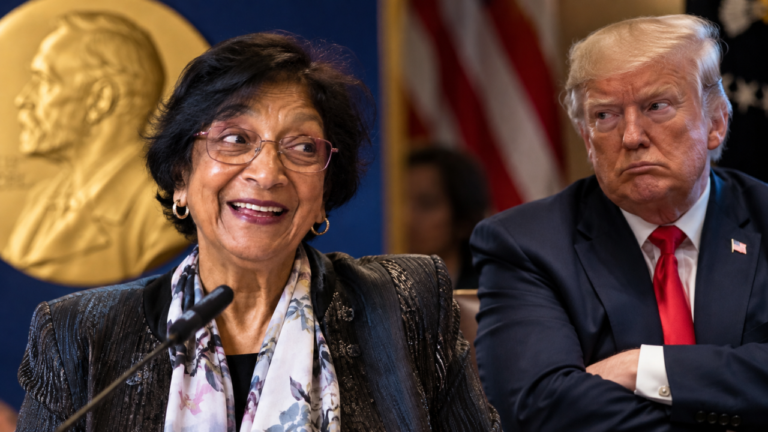
Navanethem “Navi” Pillay, the 85-year-old South African human rights lawyer and former United Nations human rights chief, was attending an event at the historic Nuremberg courthouse in Germany when she learned that she had been awarded the 2026 Nobel Peace Prize.
The room erupted in applause as colleagues and fellow human rights advocates celebrated the announcement.
Pillay, visibly surprised by the recognition, initially struggled to believe the news. But as the applause continued, she found an unexpected way to acknowledge another prominent figure who had been talking about the prize.
“If you clap a little bit more, I may share this prize with Trump,” she joked.
The room burst into laughter.
It was a brief, playful remark, but its political significance was unmistakable. Trump has repeatedly complained about not receiving the Nobel Peace Prize, arguing that his diplomatic efforts and claims of ending multiple wars should have earned him the honor.
Now the actual winner had turned that very public ambition into a joke.
The exchange was recorded by Amnesty International Secretary General Agnès Callamard, who was present at the courthouse and shared footage of the celebration.
The location added a remarkable historical dimension to the moment.
Pillay was standing at the Palace of Justice in Nuremberg, where leading figures of Nazi Germany were prosecuted after World War II. Those trials helped establish principles of international accountability that would influence the development of modern human rights law.
And international justice has been the defining cause of Pillay’s professional life.
Born in Durban during South Africa’s apartheid era, Pillay overcame racial and gender discrimination to become a pioneering lawyer. She represented opponents of apartheid and later served as a judge on international tribunals examining some of the world’s gravest atrocities.
Her work at the International Criminal Tribunal for Rwanda helped advance the recognition of sexual violence as a crime that could constitute genocide.
She subsequently served as a judge at the International Criminal Court and as the United Nations High Commissioner for Human Rights from 2008 to 2014.
In announcing its decision Friday, the Norwegian Nobel Committee recognized Pillay for her efforts to promote peace and international law, emphasizing her role in strengthening accountability for war crimes, crimes against humanity, and genocide.
The committee’s decision came at a time when international legal institutions are facing intense political pressure, including from the Trump administration.
Pillay herself has been outspoken about the importance of independent courts and the rule of law. Following the announcement, she dedicated the award to survivors of international crimes and those working to secure justice for them.
Her reaction stood in sharp contrast to Trump’s long-running public campaign for Nobel recognition.
The president has repeatedly argued that he deserves the prize because of his role in resolving international conflicts. He has claimed to have ended eight wars, although that sweeping characterization has been challenged by independent reporting and experts who distinguish between temporary ceasefires, diplomatic interventions, and fully resolved conflicts.
Trump has also frequently invoked former President Barack Obama, who received the Nobel Peace Prize in 2009, questioning why Obama was honored while he has not been.
The comparison has become a recurring theme in Trump’s remarks about his foreign policy record.
Just days before this year’s announcement, Trump again discussed the possibility that the committee would deny him the award despite what he considers his achievements.
The committee ultimately selected Pillay, whose career has focused on legal accountability rather than presidential diplomacy.
There was another irony surrounding her joke.
In January, Venezuelan opposition leader María Corina Machado, the 2025 Nobel Peace Prize laureate, presented her medal to Trump during a White House visit.
The gesture attracted international attention because Nobel Peace Prizes cannot formally be transferred to another person. A recipient may give away a physical medal, but the official distinction remains with the individual selected by the committee.
That distinction made Pillay’s joke about sharing her own award especially timely.
There is no evidence that she intended the remark as a serious proposal. It was delivered as a joke during an emotional celebration, and the audience responded accordingly.
Nor has any verified public response from Trump to Pillay’s specific comment been established.
But the moment nevertheless captured a striking contrast between two very different relationships with the Nobel Peace Prize.
For Trump, the award has become a recurring subject of public grievance and a symbol of the international recognition he believes his presidency deserves.
For Pillay, Friday’s announcement appeared to arrive as a genuine surprise.
She was not standing before the cameras demanding an honor. She was attending a gathering devoted to international justice when the news reached her.
Her first reaction was disbelief, followed by gratitude, laughter, and a reaffirmation of the legal principles that have shaped her career.
The Nobel Committee’s recognition was not based on a single diplomatic agreement or a recent political accomplishment. It reflected decades of work confronting apartheid, prosecuting atrocities, and defending the institutions intended to hold powerful individuals accountable.
Those institutions have themselves become a source of political conflict.
The Trump administration has criticized the International Criminal Court and pursued sanctions against its officials, arguing that the court has exceeded its authority and threatened American and allied interests.
Supporters of the court counter that international accountability mechanisms are essential when national governments fail to address serious crimes.
Pillay has consistently defended the importance of those mechanisms.
That broader disagreement gives the award significance well beyond the brief joke about Trump.
The Nobel Committee chose to recognize a figure closely associated with international courts at a moment when those institutions are under pressure from some of the world’s most powerful governments.
Pillay’s remarks after receiving the news emphasized that connection, warning about attacks on international law and the institutions responsible for enforcing it.
Yet it was her spontaneous comment about Trump that quickly attracted attention online.
In just a few words, she acknowledged the president’s well-known pursuit of the prize and gave the audience a reason to laugh.
It was not a formal political speech, a personal confrontation, or an official rebuke from the Nobel Committee.
It was something considerably simpler: an unexpected joke from a woman who had just received the recognition Trump has so often discussed.
The audience laughed, the cameras captured the moment, and the newly announced laureate returned to the much larger purpose of her work.
Donald Trump did not receive the 2026 Nobel Peace Prize.
Navi Pillay did.
And on the day she learned of that achievement, she found a memorable way to mention the president who had made winning it such a public ambition.
About the Author


Trump is a disgrace to America. He is an anathema to human rights, a bully and a buffoon.