
Pete Hegseth’s plan to broadcast the execution of a convicted mass murderer has sparked an extraordinary confrontation with one of America’s most influential religious institutions — and the criticism is now reaching deep into Republican circles.
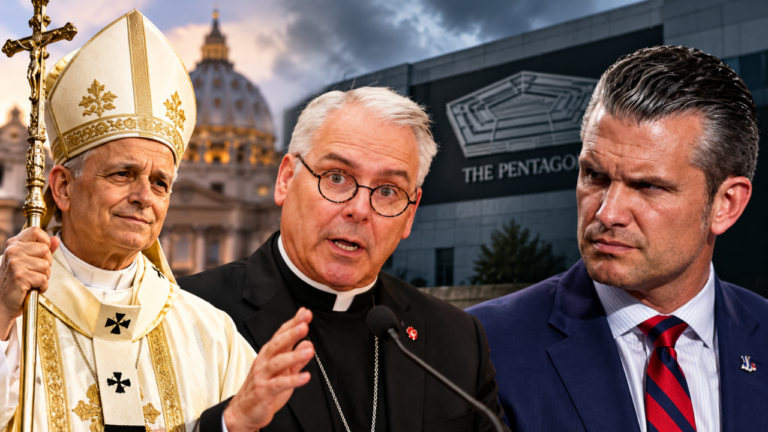
The president of the U.S. Conference of Catholic Bishops issued a forceful public condemnation Friday, calling the Pentagon’s proposed livestream of Nidal Malik Hasan’s execution a barbaric promotion of a culture of death.
Archbishop Paul S. Coakley of Oklahoma City did not dispute the horror of Hasan’s crimes. Instead, he challenged the government’s decision to turn the execution into an event that could be watched by the public.
His statement drew a distinction that has become central to the growing controversy: condemning an act of mass murder does not require endorsing the public broadcasting of the killer’s death.
Hasan, a former Army psychiatrist, was convicted for the November 2009 shooting at Fort Hood, Texas, that killed 13 people and wounded 32 others.
He was sentenced to death by a military jury in 2013.
Now, more than a decade later, the Trump administration is preparing to carry out that sentence by firing squad on December 3.
But it is the Pentagon’s decision to livestream the execution that has generated an expanding backlash.
Defense Secretary Pete Hegseth confirmed the broadcasting plan Thursday, explaining in an interview with conservative outlet Real America’s Voice that the public should understand the serious consequences of such crimes.
The announcement immediately raised questions about the purpose of making an execution available for public viewing, the treatment of victims’ families, the longstanding rules governing military executions and the potential international consequences.
Then came the response from the Catholic bishops.
Coakley, who leads the national conference representing the country’s Catholic bishops, said he had received news of the decision with shock and sorrow.
“Our God is the God of life,” he declared.
The archbishop emphasized that Hasan’s actions could not be condoned. But he argued that publicly broadcasting the execution would further damage the nation’s moral fabric.
He called on the government to reconsider the decision and invoked a biblical warning against responding to evil with evil.
The statement reflects the Catholic Church’s established opposition to capital punishment, a position that was strengthened under Pope Francis.
In 2018, the Vatican revised the Catechism of the Catholic Church to describe the death penalty as inadmissible because it violates the dignity of the human person.
The Church’s opposition does not depend on whether a convicted person committed a particularly horrific crime. It rests on a broader teaching about the value of human life and the limits of state punishment.
That distinction has particular relevance in Hasan’s case.
There is no dispute about the gravity of the 2009 attack, one of the deadliest mass shootings at an American military installation.
The victims were soldiers and civilians whose lives were cut short in an act of devastating violence.
The debate now unfolding in Washington is not about minimizing their suffering.
It is about whether the government should transform an execution into a publicly distributed spectacle.
And Coakley is far from the only prominent figure raising objections.
Republican Senator Thom Tillis of North Carolina condemned the proposed livestream in unusually direct language.
“Beyond disgusting,” Tillis said.
He argued that public executions are associated with oppressive governments and should not be part of American practice.
Tillis made clear that his objection to broadcasting the event did not mean he opposed Hasan receiving the death penalty.
That distinction is important because it shows the controversy extends beyond the traditional political divide over capital punishment itself.
Republican Representative Austin Scott of Georgia also opposed the livestream while expressing support for the death sentence.
Democratic lawmakers were similarly critical.
Senator Chris Murphy described public executions as medieval and questioned the implications of broadcasting a killing carried out by the American government.
Senator Jack Reed, the ranking Democrat on the Senate Armed Services Committee, warned that the broadcast could become propaganda for extremist organizations seeking to recruit supporters.
The objections have not been limited to Congress.
The United Nations human rights office also criticized the proposal, raising concerns about the prohibition against torture and the international legal implications of broadcasting an execution.
The growing controversy took another turn Friday when Vice President JD Vance publicly questioned whether the Pentagon would ultimately proceed with the livestream.
Vance told reporters he was uncertain that the broadcast would actually happen.
He also said that if it did go ahead, he would not watch it.
The vice president emphasized the seriousness of Hasan’s crimes and the importance of remembering the victims, but his comments introduced uncertainty about a plan that Pentagon officials had presented as a settled decision.
Vance is himself Catholic, making his response particularly noteworthy amid the Church’s public criticism.
President Donald Trump also stopped short of firmly endorsing the livestream when questioned Friday.
Trump had already approved Hasan’s execution by firing squad, and he reiterated his support for carrying out the death sentence.
But when asked specifically about broadcasting the event, the president said officials were still making a determination.
That response left an important question unanswered: whether the Pentagon’s announcement would become the administration’s final policy.
Under existing Army rules, military executions are not generally open to an unrestricted public audience.
Witnesses may include victims’ relatives, attorneys, designated officials and members of the news media, subject to specific requirements.
A livestream accessible to the broader public would represent a substantial departure from the usual approach.
Lawmakers have questioned whether additional authorization would be required to permit such a broadcast.
There is also a practical obstacle.
Major streaming platforms maintain restrictions on graphic violence and depictions of death.
After the Pentagon’s announcement, technology publications sought clarification from leading platforms about whether they would carry a government-produced execution livestream.
Some companies declined to explain how they would handle such a request. Others indicated that broadcasting the moment of death would violate their policies.
The uncertainty illustrates how far the Pentagon’s proposal extends beyond the ordinary administration of a criminal sentence.
The United States has not carried out a military execution since 1961, when Army Private John Bennett was hanged.
An execution by firing squad would be an even rarer event in modern military history.
Hegseth’s proposal would add another unprecedented element by potentially distributing the event to viewers far beyond the execution site.
Supporters of the death penalty have argued that the most serious crimes can warrant the most severe punishment.
Some defenders of public access to executions also contend that government actions should be subject to public scrutiny, including the carrying out of capital sentences.
But critics of the Pentagon’s specific plan argue that transparency does not require turning a person’s death into a broadcast.
For the Catholic bishops, the concern is more fundamental.
Their objection rests on the belief that the state has a moral obligation to respect human dignity even when punishing someone responsible for grave harm.
That principle is being tested in a case where public anger over the original crime remains understandable and profound.
The families of the Fort Hood victims have already endured years of grief, legal proceedings and uncertainty.
The question of how their loved ones should be remembered is distinct from whether the government should distribute footage of Hasan’s death.
Republican Representative Rob Bresnahan argued that the focus should remain on justice for the victims and respect for their families, rather than a public show.
The issue has also prompted debate about how the United States presents itself internationally.
American officials routinely criticize governments that use public executions as instruments of intimidation or political theater.
Critics of the livestream proposal warn that broadcasting an execution could complicate that message and provide hostile organizations with material for propaganda.
Those concerns are not proof that such consequences will occur, but they explain why lawmakers from both parties have urged the Pentagon to reconsider.
Hegseth has defended the idea as a way of demonstrating the consequences of a mass killing.
His critics are questioning whether that objective can be achieved without creating a spectacle that carries its own moral and security risks.
The dispute has also exposed differences within the administration.
Trump supports the firing squad. Hegseth has publicly backed the livestream. Vance has expressed doubt that the broadcast will happen and says he would not watch.
Those positions are not identical.
And until the administration clarifies the final arrangements, the proposed broadcast remains uncertain.
What is not uncertain is the Catholic leadership’s position.
Coakley has placed the Church’s moral objection directly before the White House and the Pentagon, arguing that even the punishment of a person responsible for terrible violence must be governed by principles that protect human dignity.
The archbishop concluded his statement with a prayer that the country would choose life even under the most difficult circumstances.
That message arrives as the administration faces mounting questions from religious leaders, lawmakers, human rights advocates and members of its own party.
Hasan’s crimes were horrific. The suffering of his victims and their families remains central to the case.
But the argument now confronting Washington is about something different: what kind of public act the government should make of a criminal execution.
With December 3 approaching, the Pentagon must decide whether to proceed with a plan that has drawn condemnation from across the political and religious spectrum.
For America’s Catholic bishops, the answer has already been made clear.
They are calling on the government to reconsider — and warning that broadcasting a death in the name of justice risks crossing a moral line that no punishment can erase.
About the Author

Kudos to The U.S.A. Conference of Catholic Bishops for its opposition to Public Executions by Firing Squad. But Public Executions by Drone Strikes are being carried out every week by The Chump Administration in The Caribbean Sea The Eastern Pacific Ocean and in Iran and recently by gunfire in Minneapolis Minnesota! What does Senator Thom Tillis of North Carolina have to say about THOSE acts of Mass Murder committed by Armed Soldiers working for Satan Incarnate in The White House?