Donald Trump’s first major public appearance following the November 3 midterm elections took an unexpected turn when he devoted much of his remarks to an ambitious White House construction project rather than opening with a detailed assessment of the Republican Party’s electoral setbacks.
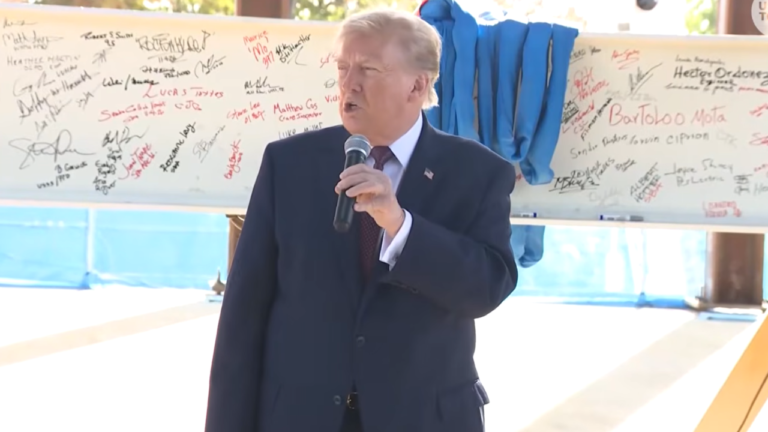
Standing near the construction site of his planned White House ballroom on November 4, Trump enthusiastically described the building’s enormous ceilings, elaborate interior design, underground kitchen and private financing arrangements.
The timing was striking.
Just hours earlier, Democrats had celebrated major election victories that threatened to reshape the balance of power in Washington.
WATCH THE VIDEO BELOW
The results created significant questions about the direction of Trump’s presidency and how his administration would work with a newly elected Congress.
But at the White House, the president was eager to talk about architecture.
“The ceilings are over 50 feet high. That’s like a five-story building. I don’t think there’s any ballroom. I doubt there’s a ballroom in the country with a 50-foot ceiling,” Trump told reporters.
He then explained why the project would allow the White House to host substantially larger gatherings.
“You’ll be able to have dinners for as many people as you want. We had King Charles here, and we were very restricted. He said, could we have about 350 of our people? He said, we don’t hold 350. We hold about 98. So having 350 is a little tough.”
The president’s remarks continued with a detailed explanation of where the kitchen would be located and how that decision would affect the available space.
“And the kitchen is underneath because if I put the kitchen on top, we have large staircases coming from the kitchen. If I put the kitchen on top, you would lose three walls because the kitchen takes about 30 percent of the space.”
He continued:
“So the kitchen is all the space that you have right underneath. And it’s going to be top of the line. So there has never been anything built like this. And it’s for the country and it’s free. You got it free of charge. Thank you very much.”
Trump’s attention to the kitchen layout stood in contrast to the political questions surrounding his administration after the midterms.
The president also emphasized his claim that the ballroom would be financed through private contributions rather than taxpayer money.
“And some great patriots have devoted a lot of money, given a lot of money to get it built. And so we didn’t use taxpayers’ money to build this ballroom. And it’s going to be, when it’s completed, it’ll be the best anywhere in the world.”
That assertion was Trump’s description of the project’s financing. It does not, by itself, independently establish the complete public cost of construction, security or related government work.
The White House ballroom project has been a prominent feature of Trump’s second term.
Supporters have described it as an opportunity to expand the White House’s capacity to host major diplomatic and ceremonial events.
Critics have raised questions about the project’s scale, its impact on the historic White House complex and the transparency of its financing.
Trump has repeatedly defended the undertaking as an improvement that would benefit future administrations.
During Wednesday’s remarks, he made another ambitious comparison.
Recalling a visit to China, Trump suggested that the new White House facility would surpass one of the country’s best-known ceremonial buildings.
“You know, when I was in China, we went to the Great Hall. It’s called the Great Hall of China. And it’s, you know, it’s incredble. But this is actually larger. This is larger.”
He continued:
“And it will be — it’ll be the most magnificent. When you see what we’re doing between the marbles and the bronzes and all the different things that we’re doing is top of the line. architects are top architects.”
The comparison reflected Trump’s enthusiasm for the project, although the specific dimensions and spaces being compared were not established by the remarks alone.
The president’s description of the planned materials also reinforced the lavish character of the undertaking.
He spoke about marble, bronze and architectural details as evidence of the project’s quality.
But the surrounding political context made the appearance especially notable.
The November 3 elections had produced major Democratic gains, with the party celebrating victories that would alter congressional leadership and create new challenges for the White House.
The outcome also intensified scrutiny of Republican campaign messaging, economic policy and the administration’s handling of domestic and international affairs.
A Democratic-controlled House would have the ability to establish new committee leadership and pursue investigations into administration decisions.
Changes in Senate control would affect the legislative agenda and the confirmation process for presidential nominees.
Those developments could complicate Trump’s efforts to advance his priorities during the remaining years of his presidency.
The president’s political position was therefore a major subject of interest when he appeared before reporters.
Instead, the opening portion of his appearance focused heavily on the construction project.
That did not mean Trump avoided the election results entirely.
During the broader event, he also responded to questions about the midterms and other matters, including the conflict involving Iran and the possibility of impeachment proceedings.
The distinction is important: the appearance was not exclusively about the ballroom, even though the project dominated a substantial portion of his remarks.
Trump has argued that the new ballroom will provide a permanent benefit to the White House and the country.
He has also maintained that private donors are paying for the construction.
Questions about the project’s financing, preservation implications and associated government costs remain separate from the president’s promotional statements.
For critics, the post-election timing provided an obvious contrast between the president’s focus on the White House building project and the issues voters had just considered at the ballot box.
For supporters, the appearance reflected his continued commitment to a major infrastructure addition to the executive residence.
What made the event distinctive was the extraordinary level of detail Trump offered about the ballroom while the political consequences of the election were still unfolding.
He described ceiling heights, guest capacity, kitchen placement, marble finishes and the generosity of donors.
And as Washington began preparing for a new congressional balance of power, the president was still explaining why putting the kitchen beneath the ballroom would preserve more room upstairs.
About the Author