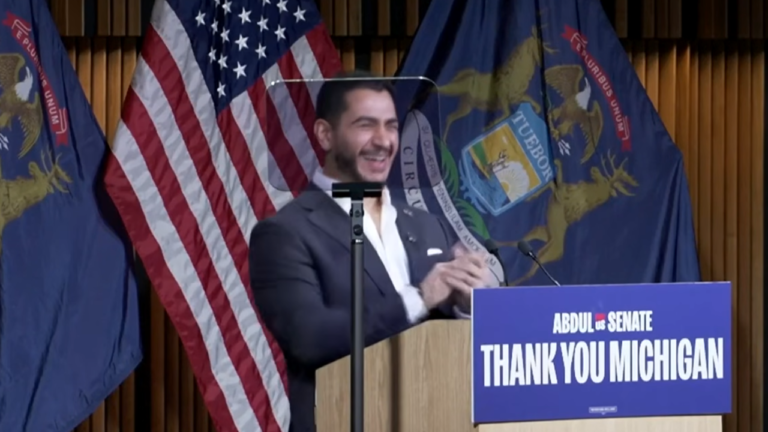
Democratic Senator-elect Abdul El-Sayed delivered an emotional and sharply worded victory speech in Michigan, directly confronting President Donald Trump, Vice President JD Vance and defeated Republican opponent Mike Rogers after winning one of the country’s closely watched Senate races.
Speaking to supporters in Detroit following the November 3 election, El-Sayed celebrated a historic milestone: becoming the first Muslim elected to the United States Senate.
But the evening was about more than making history.
After a bitter campaign in which his name, religion and political views became frequent targets of Republican attacks, El-Sayed used the victory stage to respond to his critics.
He began by thanking the volunteers and supporters who had helped build his campaign, describing his victory as proof that ordinary voters could overcome enormous political spending.
“We showed that in a battle between the money and the many that the many really can win,” he told the crowd.
El-Sayed then turned to families who had watched the personal attacks against him throughout the campaign.
He spoke about the difficulty of explaining those attacks to children, particularly when they came from the president himself.
“To all the kids who watched this last month, to all the parents who struggled to explain why the president openly mocked someone for their name or how they pray, let them know tomorrow that the bad guys lost!”
The remarks were met with cheers from his supporters.
During the campaign, Trump had publicly attacked El-Sayed using language that drew attention to his Muslim identity. Vice President Vance had also made highly critical statements about the Democratic candidate.
El-Sayed argued that those attacks were intended to divide voters rather than address the issues affecting their lives.
His campaign emphasized reducing the influence of money in politics, improving household finances and expanding access to healthcare through Medicare for All.
He also criticized the role of wealthy donors and outside political organizations in the Senate contest.
For El-Sayed, the election result was an opportunity to argue that voters had rejected the campaign attacks and supported a different political agenda.
Then he turned to the Republican candidate he had just defeated.
Addressing former Congressman Mike Rogers directly, El-Sayed told him to enjoy retirement and accused him of choosing division over hope.
He referenced Rogers’ alleged property holdings and delivered a pointed farewell.
“See, you chose hate and Michigan chose hope,” El-Sayed said.
He added that he hoped Michigan would not see another campaign like Rogers’ again.
The comments reflected El-Sayed’s characterization of the campaign. They were not a legal finding about Rogers or his conduct.
But the senator-elect was far from finished.
His next target was Vice President JD Vance, with whom he had exchanged criticism during the campaign.
El-Sayed pointed to the vice president’s constitutional role as president of the Senate and the tradition of administering the oath to incoming senators.
He joked about the prospect of being sworn in by one of his most prominent political critics.
“JD, habibi, there is this delicious irony in the fact that you’re constitutionally obligated to swear me in in January,” El-Sayed said.
The Arabic word habibi is commonly used as an affectionate expression, often translated as “my dear.”
El-Sayed then added a joke about the longstanding rivalry between the University of Michigan and Ohio State University, which Vance attended.
“Wolverine 1, Buckeye 0.”
The sports reference brought humor into a speech that had already included serious accusations about the tone of the election campaign.
El-Sayed then directed his attention to Trump.
The president had repeatedly mocked or misrepresented the Democratic candidate’s name during the race, prompting El-Sayed to offer a pointed response.
“Donald, look, I know you struggled with my name, so after JD swears me in in January, you can just go on and call me Senator,” he said.
It was a memorable line because it turned a personal attack into a reference to the office El-Sayed had just won.
Trump had backed Rogers in the Michigan race, while Vance had campaigned against El-Sayed.
The result therefore carried significance beyond the individual candidates.
Michigan voters had chosen a Democrat who openly challenged both the president and vice president, despite a campaign marked by intense criticism of his identity, policy positions and political associations.
El-Sayed also used the speech to confront the role of political action committees and special-interest spending.
He argued that the scale of outside spending demonstrated how difficult it had become for candidates to compete without wealthy financial backers.
His victory, he told supporters, showed that political organizing and grassroots participation could still overcome those obstacles.
The senator-elect also addressed U.S. foreign policy, criticizing American support for Israeli military operations and calling for federal resources to be directed toward domestic needs.
His remarks reflected positions that had generated considerable debate throughout the campaign, including disagreements over Israel, Gaza and the role of American military power abroad.
Those issues are likely to remain central to his political identity when he enters the Senate.
El-Sayed’s victory will also bring a new perspective to a chamber that has never previously included a Muslim member.
His election represents a milestone in religious representation in federal government.
But his speech suggested that he intends to define his Senate career through a broader political agenda as well.
Throughout the campaign, El-Sayed emphasized affordability, healthcare, the influence of corporate money and opposition to policies he considers discriminatory.
His victory-night remarks brought those issues together with an argument about political belonging.
He described his supporters as people who had refused to accept the idea that a candidate with his name and background could not win statewide office.
He thanked Michigan voters for placing their confidence in him and promised to carry their concerns to Washington.
The incoming senator will still face the practical challenges of serving in a closely divided and politically contentious Congress.
Passing legislation will require negotiation, coalition-building and cooperation with other lawmakers.
His campaign promises will also face the realities of Senate procedure and competing policy priorities.
But on election night, El-Sayed focused on the significance of the victory and the message he believed voters had delivered.
After months of personal attacks and an expensive campaign, he stood before supporters as Michigan’s senator-elect.
And he made certain that Trump, Vance and Rogers were all part of his victory-night remarks.
About the Author