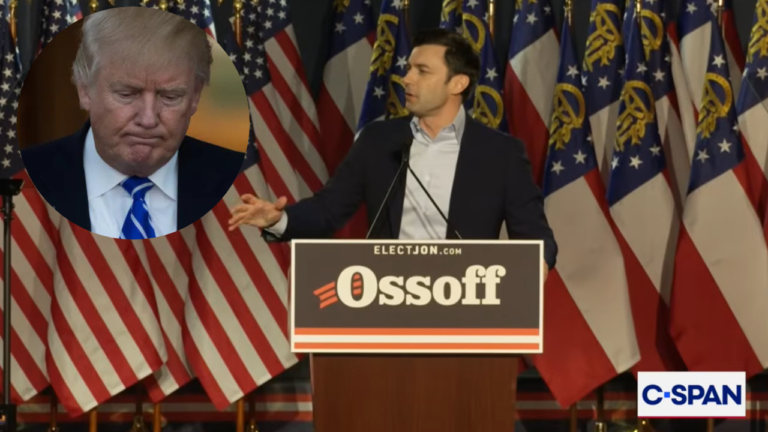
Democratic Senator Jon Ossoff used his election-night victory speech in Georgia to deliver a sharp rebuke of President Donald Trump, portraying the results as a rejection of the administration’s leadership while calling on Americans to find renewed hope in the country’s future.
Speaking to supporters after his reelection on November 3, 2026, Ossoff moved beyond celebrating his own victory to address the broader political moment.
His remarks combined criticism of the president with an emotional appeal for national unity, drawing on the legacy of the late civil rights leader and Georgia Congressman John Lewis.
Ossoff opened one of the speech’s most pointed passages with an unmistakable assessment of Trump.
“In sweeping and decisive victories, the American people have rebuked the depravity, corruption and incompetence of the failed lame duck president Donald J. Trump,” Ossoff declared.
The statement reflected Ossoff’s interpretation of the election results, rather than a formal finding about the president’s conduct.
The senator then turned to Americans who had become discouraged by the political climate.
“And if at times these last two years, amidst the ceaseless onslaught of brutality and indecency, you doubted whether our republic would survive, let tonight’s results give you courage that the first light of dawn is on the horizon.”
His message was intended to connect the election to a larger sense of political renewal.
But Ossoff did not limit his speech to criticism of Trump.
He invoked John Lewis, the longtime Georgia congressman and civil rights icon whose commitment to voting rights and equality continues to influence Democratic politics.
“Even in his final months, Congressman Lewis always reminded us that we all live in one American house. Do you remember? In one world house.”
Ossoff continued:
“He called it the inevitable truth that we’re all members of one human family.”
The reference to Lewis introduced a different theme into the speech: the idea that political victories should ultimately serve people beyond any single party or campaign.
Ossoff acknowledged that many of his supporters had been motivated by concerns much larger than his own reelection.
“And I know many of you have poured yourselves into this campaign not for my sake or for the sake of a democratic party but because you’re so deeply troubled by the pain our fellow human beings are enduring right now.”
He then described two examples of the human suffering that he said had motivated his supporters.
“The terror of a child watching ICE take away her mother. The despair of a cancer patient losing coverage mid-treatment.”
The examples brought immigration enforcement and access to healthcare into the center of his victory-night message.
They also illustrated the contrast Ossoff sought to draw between political celebrations and the struggles he believes government should address.
The senator ended the passage by urging his audience to see compassion as a shared national responsibility.
“But that ache in your heart, that pit in your stomach, that feeling is what reminds us we’re all in this together. That we’re not just one United States, we’re one united people. E pluribus unum, out of many, one.”
The Latin phrase E pluribus unum, meaning “out of many, one,” is a traditional motto of the United States.
By closing with those words, Ossoff connected his criticism of the administration to a broader argument about shared citizenship and national identity.
The speech came as the November 2026 midterm elections reshaped the political landscape and prompted competing interpretations of the results.
Ossoff presented the Democratic victories as evidence of public dissatisfaction with Trump.
However, election results across different states and districts reflect a range of local candidates, issues and voter priorities. They cannot, by themselves, establish a single motivation shared by every voter.
Ossoff’s victory speech nevertheless provided a clear account of how he wanted supporters to understand the moment.
Rather than treating his reelection as the conclusion of a campaign, he described it as an opportunity to confront the problems he had highlighted throughout his remarks.
His address combined an unusually direct criticism of a sitting president with references to civil rights history, family hardship and the responsibilities of elected officials.
And in its final passages, the speech returned to a theme that extended beyond party politics: the belief that Americans remain connected by a common future, even amid deep political divisions.
About the Author