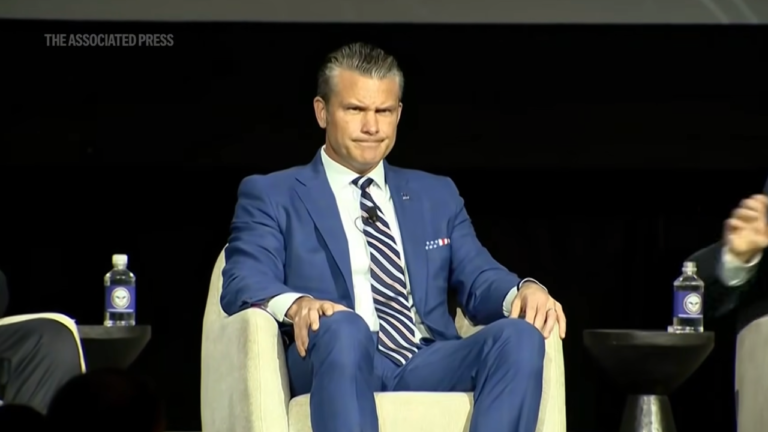
Defense Secretary Pete Hegseth faced a wave of angry anti-war protesters Wednesday as six people repeatedly interrupted his appearance at a major U.S. Army conference in Washington, D.C.
The disruptions began just moments into a panel discussion on autonomous warfare at the Association of the United States Army’s annual meeting. What was supposed to be a conversation about drones and military technology quickly became a confrontation over the Trump administration’s war in Iran.
One protester accused Hegseth of being a war criminal. Another shouted about children suffering in Gaza. Others condemned the administration’s military operations as security personnel rushed to remove them from the ballroom.
“You’re not a warrior, you’re a coward!” one demonstrator yelled.
Another shouted, “You’re killing my family!”
Hegseth initially tried to laugh off the interruptions.
“She thinks highly of me,” he joked after one protester was escorted away, drawing applause from parts of the audience.
But the demonstrations kept coming.
Four protesters interrupted the panel within its opening minutes, according to Stars and Stripes. Two more followed shortly afterward, forcing repeated pauses as security personnel moved through the crowd.
At one point, Hegseth acknowledged the pattern.
“Appears we have a bit of a tactic,” he remarked.
The final demonstrator delivered one of the loudest confrontations, shouting that the world hated Hegseth and accusing him of being a Nazi and a war criminal.
“We’ll see you at the goddamn Hague,” the protester yelled as security removed him.
The accusations reflected the protesters’ anger over American military operations and civilian suffering. They were not findings by a court that Hegseth had committed war crimes.
The panel eventually continued, with Hegseth and other senior defense officials discussing Project Agincourt, an initiative aimed at accelerating the Pentagon’s development and deployment of autonomous military systems.
Hegseth also defended the administration’s military priorities, including its position on Iran and calls for greater defense spending.
But the interruptions repeatedly pulled attention away from the presentation.
Some audience members applauded as demonstrators were removed, while others briefly chanted “USA.”
The conference’s organizers said they supported First Amendment rights while expecting attendees to behave respectfully.
For Hegseth, the event became an unusually public encounter with opposition to the administration’s military policies — with six separate protesters making sure their objections were heard before the discussion could proceed.
About the Author