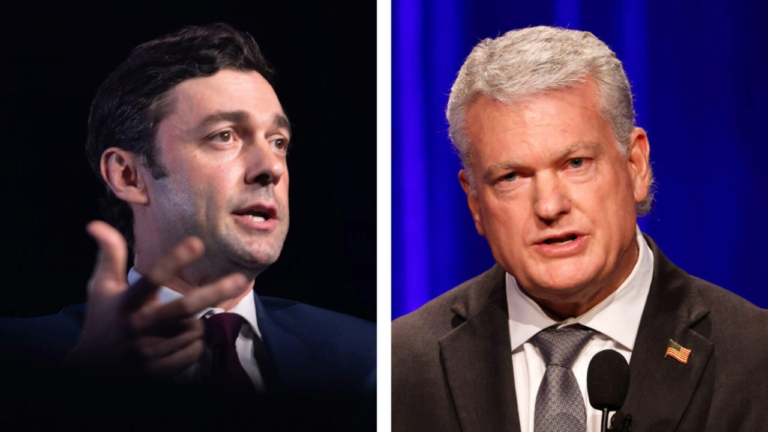
Republican Congressman Mike Collins brought Jeffrey Epstein into his second Senate debate against Democrat Jon Ossoff on Tuesday night, hoping to put the incumbent senator on the defensive over a wealthy political donor.
But the exchange quickly shifted to a different subject: Collins’ own voting record in Congress.
The confrontation unfolded during the October 13 debate in Georgia, where the two candidates were already trading accusations over their political associations, their records in Washington, and their competing visions for the state.
Collins raised the relationship between billionaire technology investor Reid Hoffman and Jeffrey Epstein, the late convicted sex offender whose connections to influential figures have remained the subject of extensive public scrutiny.
Hoffman, a major Democratic donor, has acknowledged meeting Epstein and has said he regrets the association.
His political donations have become a point of contention in the Georgia Senate race.
Collins argued that Ossoff could not credibly criticize powerful political insiders while accepting support from a donor with documented connections to Epstein.
He pressed Ossoff to condemn Hoffman and apologize for what he characterized as hypocrisy.
The accusation was pointed. But Ossoff did not respond by defending the donor’s relationship with Epstein.
Instead, he questioned why Collins had chosen to raise the subject at all.
“Mike, who on your team advised you to raise the Epstein files?”
Ossoff then accused Collins of voting against an earlier congressional effort to compel the release of government records related to Epstein.
The senator argued that the public deserved an explanation for that vote, particularly given the seriousness of Epstein’s crimes and the demands for transparency from survivors.
“You voted to cover up the evidence, Mike!” Ossoff declared.
He went on to challenge Collins over whether he had met with Epstein’s victims and how he would explain his congressional record to them.
The exchange placed two separate controversies at the center of the debate: Hoffman’s documented association with Epstein and Collins’ position during congressional efforts to release government files.
Both subjects have generated political criticism. But neither can be evaluated accurately without distinguishing allegations from established facts.
Hoffman has acknowledged his past meetings with Epstein, explaining that the relationship arose through fundraising efforts connected to the Massachusetts Institute of Technology.
He has expressed regret over those contacts.
There is no public finding that Hoffman participated in Epstein’s trafficking crimes.
His financial support for Democratic political causes, including Ossoff’s campaign and an allied political committee, has nevertheless provided Collins with a line of political criticism.
According to Fox News, Hoffman contributed $7,000 directly to Ossoff’s campaign and $1 million to New Engagement PAC, a political committee supporting Ossoff.
Collins used those connections to argue that Ossoff was applying different standards to wealthy figures associated with Epstein.
Ossoff’s response focused instead on congressional votes.
In July 2025, Collins voted against an earlier procedural effort that would have advanced the release of Epstein-related records.
That vote later became a point of criticism as demands for disclosure intensified.
But the congressional record also contains an important subsequent development.
On November 18, 2025, the House passed the Epstein Files Transparency Act by an overwhelming bipartisan vote of 427 to 1.
Collins voted in favor of the legislation.
The bill required the Justice Department to make extensive Epstein-related records public, subject to applicable legal protections.
That later vote matters because Collins did not consistently oppose disclosure throughout the entire legislative process.
The two candidates therefore presented different parts of the same congressional history.
Ossoff emphasized the earlier vote against advancing disclosure.
Collins emphasized his later vote supporting the release legislation.
When Ossoff accused him of covering up evidence, Collins rejected the characterization and insisted that he had voted to release the files.
His response was factually supported by the November roll call, although it did not eliminate questions about his earlier position.
Ossoff also invoked Donald Trump during the confrontation.
He alleged that Collins had opposed the earlier effort because Trump wanted Republicans to resist disclosure at the time.
That was Ossoff’s interpretation of Collins’ political motives, not a finding established by the congressional voting record.
Trump initially opposed the legislation before reversing course and supporting its passage.
Ossoff also referred to Trump’s name appearing repeatedly in Epstein-related records.
Trump and Epstein were previously acquainted, and their relationship has been the subject of extensive reporting.
But appearing in records associated with Epstein does not establish participation in criminal activity. Trump has denied wrongdoing in connection with Epstein.
Those distinctions are particularly important in a debate involving accusations about sexual exploitation, criminal conduct, and the responsibilities of elected officials.
Collins continued to press Ossoff over Hoffman, arguing that the senator had avoided answering his original question.
That criticism also deserves attention.
Rather than directly condemning Hoffman or addressing whether the donor’s contributions should be returned, Ossoff redirected the exchange toward Collins’ congressional record.
The senator’s response challenged his opponent’s consistency on transparency, but it did not fully resolve the questions Collins had raised about campaign financing.
The debate therefore produced a confrontation in which both candidates highlighted politically uncomfortable facts about the other while defending their own positions.
For Collins, the issue was whether Ossoff’s criticism of powerful elites was consistent with his acceptance of support connected to Hoffman.
For Ossoff, the issue was whether Collins could credibly invoke Epstein while having opposed an earlier effort to advance disclosure.
Neither argument established that the other candidate participated in Epstein’s crimes.
And the debate did not provide evidence that Collins personally concealed documents or engaged in a criminal cover-up.
What it did expose was a dispute over transparency, political accountability, and the use of Epstein’s connections as campaign material.
The controversy has extended far beyond Georgia.
Epstein’s association with wealthy donors, politicians, business leaders, and other prominent figures has generated scrutiny across party lines.
Congressional battles over the disclosure of government records have also produced unusual divisions within the Republican Party, particularly as some lawmakers demanded more transparency while others resisted earlier proposals.
The November 2025 passage of the Epstein Files Transparency Act represented a significant change in that legislative fight.
Yet the earlier votes remain part of the public record, allowing political opponents to question why individual lawmakers took different positions at different stages.
In Georgia, that history became the centerpiece of Tuesday’s confrontation.
The exchange was particularly sharp because Collins had introduced Epstein while challenging Ossoff’s credibility.
Ossoff responded by pointing to a vote Collins had cast before ultimately supporting the disclosure legislation.
Collins then accused Ossoff of evading the donor question and reiterated his own later vote in favor of releasing the records.
It was a revealing moment in a debate that also covered the economy, immigration, foreign policy, and the candidates’ broader political records.
With the November 3 midterm election approaching, both campaigns are seeking to define what accountability should mean for voters.
The Epstein controversy has become part of that contest.
But the underlying facts remain more complicated than either candidate’s most forceful accusations.
Collins opposed an earlier procedural effort and later supported the final disclosure bill.
Hoffman acknowledged his association with Epstein and expressed regret, while continuing to support Democratic political causes.
Ossoff challenged Collins’ earlier vote without directly answering every question about Hoffman.
And the allegations exchanged on the debate stage did not establish criminal wrongdoing by either candidate.
The most consequential moment may have been the question that redirected the entire discussion.
Collins brought up Epstein to challenge Ossoff.
Ossoff responded by asking why Collins had decided to bring up the files in the first place.
The resulting confrontation showed how an issue that has troubled Washington for years can become a direct test of the public records and political arguments of candidates seeking office today.
About the Author