
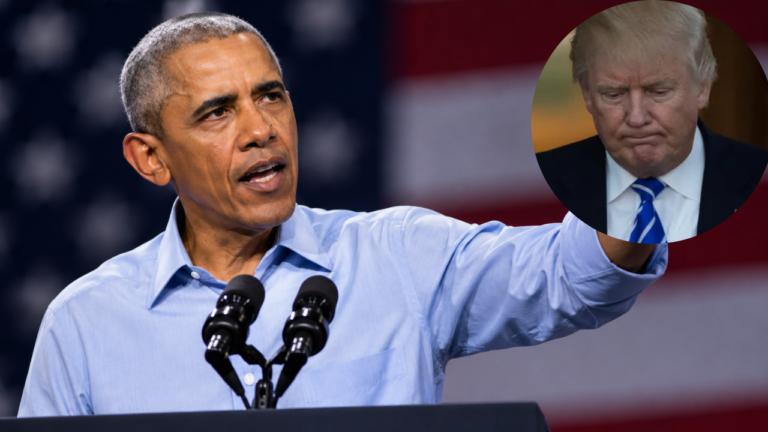
Barack Obama delivered a blistering criticism of Donald Trump’s war with Iran during a campaign rally in Cleveland on Saturday, contrasting his own diplomatic approach to Tehran’s nuclear program with the military conflict launched under his successor.
And then the former president asked a question that went straight to the heart of Trump’s repeated declarations of victory.
“How’s that war going?”
Obama made the remarks while campaigning alongside Ohio Democratic gubernatorial nominee Amy Acton and former Senator Sherrod Brown, who is seeking to return to the Senate.
The former president accused Trump’s administration of pursuing an unnecessary conflict that has left American troops dead, disrupted global energy markets and contributed to higher costs for families.
“He decided to start an unnecessary war that nobody asked for and nobody voted for,” Obama told the crowd.
Obama then turned to the nuclear agreement his administration negotiated with Iran in 2015.
“This is something I know a little about,” he said.
“The original rationale was we’re going to go in there and get them to give up their nuclear program, their nuclear weapons.”
Obama argued that the agreement had already addressed the threat without military intervention.
“Now, the thing was Iran didn’t have nuclear weapons because I had put a deal in place that everybody acknowledged kept them from getting nukes.”
Then came his sharpest comparison.
“And I didn’t have to fire a missile to do it. I just had to engage in diplomacy.”
The 2015 agreement, formally known as the Joint Comprehensive Plan of Action, placed restrictions on Iran’s nuclear activities in exchange for sanctions relief and established international monitoring requirements.
Trump withdrew the United States from the agreement in May 2018, arguing that its restrictions were insufficient and that it failed to address other threats posed by Iran.
Obama’s assertion that everyone agreed the deal prevented Iran from obtaining nuclear weapons was broader than the actual political consensus. Critics disputed whether the agreement’s restrictions were strong or lasting enough.
But Obama maintained that abandoning diplomacy had led to a far more dangerous situation.
“He pulled out of it, starts this war,” Obama said, before ridiculing the administration’s earlier claims that its military campaign had been a decisive success.
“Because remember, they said, well, this is the best war ever. It’s going great.”
Then he delivered the question that drew attention to the administration’s record.
“So seven months later, how’s that war going?”
Obama pointed to attacks on American allies and military installations, U.S. casualties and the depletion of missile stockpiles.
He also argued that the conflict had given Iran greater leverage over shipping through the Strait of Hormuz, a crucial passage for the world’s energy supplies.
According to Obama, disruptions to the strait had helped drive up the price of oil, diesel and other products.
Those consequences, he argued, were being felt far beyond the battlefield.
The Pentagon’s official death toll from operations against Iran had reached 21 American service members earlier in October, according to reporting by The Washington Post.
The conflict began with U.S. strikes on February 28. The White House subsequently announced a ceasefire in April and portrayed the operation as a major military success, although fighting resumed in July after attacks on commercial shipping.
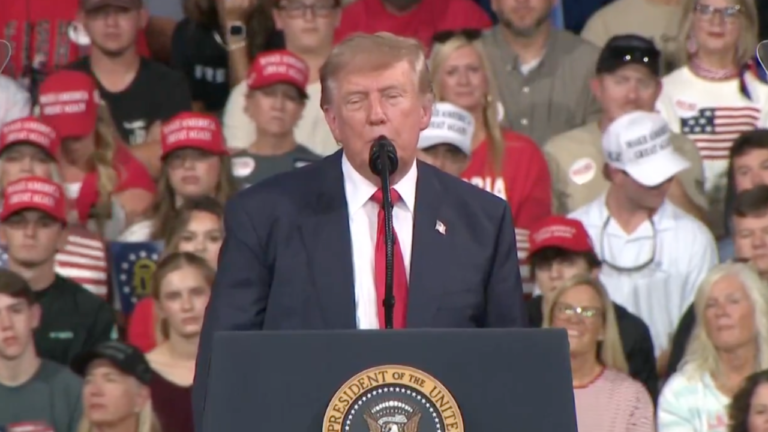
Trump, meanwhile, offered a very different account of the conflict at a rally in Perry, Georgia, later Saturday.
“I terminated one of the worst deals ever made, Barack Hussein Obama’s JCPOA,” Trump told supporters, again arguing that the agreement had provided Iran with a path toward nuclear weapons.
He also claimed that American military operations had destroyed Iran’s nuclear enrichment capacity and defeated the country militarily and financially.
Those assertions reflect the administration’s position. The full extent of the damage to Iran’s nuclear infrastructure, and the durability of the claimed victory, remain matters requiring independent assessment.
It was not clear whether Trump’s remarks were intended as a direct response to Obama’s Cleveland speech.
The disagreement between the two presidents, however, could hardly be sharper.
Trump argues that military force accomplished what diplomacy could not.
Obama argues that abandoning the nuclear agreement helped produce a costly conflict whose consequences are still being felt by Americans.
And with energy prices, military casualties and the security of international shipping all part of the debate, Obama’s question carried a challenge that went beyond campaign rhetoric.
Trump has repeatedly declared success in Iran.
Obama wants Americans to look at what happened afterward.
About the Author

Does Iran have Nuclear Weapons? Did they ever have Nuclear Weapons? Will they in the future have Nuclear Weapons? The U.S.A. has Nuclear Weapons. The U.S.A. invented Nuclear Weapons. The U.S.A. at the end of WW2 used Nuclear Weapons – something that no other Nation on Earth has done yet. So what logical or moral right does The U.S.A. have to tell other nations that they cannot have Nuclear Weapons? The U.S.A. should meditate on what Jesus said about Nuclear Proliferation 2000 years ago: “You hypocrite! First take the plank out of your own eye before attempting to remove the speck from someone else’s eye.” (Matthew 7:5) The PLANK in this passage from The Bible represents the UNDENIABLE possession and use of Nuclear Weapons by The U.S.A. The SPECK in this passage from The Bible represents the ALLEGED past present and/or future possession (but not the use) of Nuclear Weapons by Iran. Amen?