Former Republican Representative Marjorie Taylor Greene has launched a new round of public criticism against Donald Trump and two figures associated with his political circle, Laura Loomer and Natalie Harp, following the November 3 midterm elections.
In a November 4 social-media post, Greene ridiculed Loomer and accused Harp of helping the conservative activist gain influence with the president.
In a separate interview with TMZ, Greene blamed Trump for the Republican Party’s election losses and described his leadership style as resembling that of a cult leader.
The two interventions highlight Greene’s increasingly public break with a president she once defended enthusiastically.
Greene’s social-media message began with a pointed greeting:
“Good morning everyone. Except Laura Loomer.”
Good morning everyone. Except Laura Loomer. An insane woman, two time congressional loser, who has zero real life experience yet Natalie Harp somehow helped Laura become Trump’s crazy train late night advisor. Make her the press secretary! Make her chief of staff! Give Laura something! Please entertain me!
— Marjorie Taylor Greene 🇺🇸 (@mtgreenee) November 4, 2026
She then attacked Loomer’s political experience, referred to her two unsuccessful congressional campaigns and criticized what she characterized as Loomer’s access to Trump.
Greene also accused Natalie Harp, a White House aide, of facilitating that relationship.
The post concluded with sarcastic suggestions that Loomer should be given a senior administration position, including press secretary or chief of staff.
Greene’s comments were an expression of her hostility toward Loomer. Her assertion about Harp’s role in arranging access to Trump has not been independently established by the reporting.
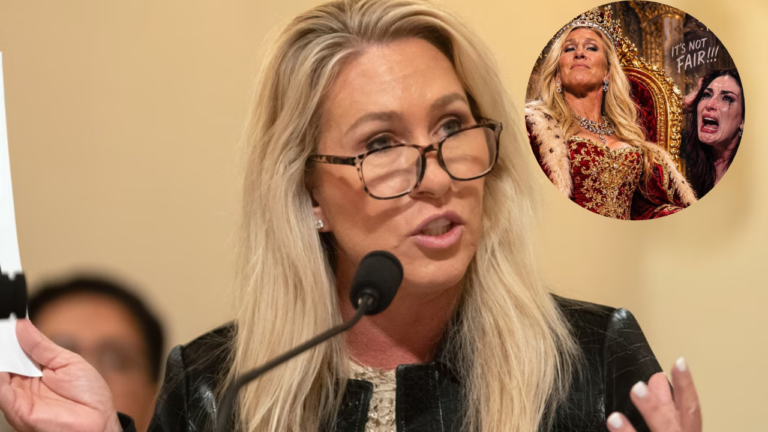
The former congresswoman also shared a mocking meme portraying herself on a golden throne and Loomer in a distressed, jealous pose.
The exchange added another chapter to an already contentious relationship between Greene and Loomer.
The two have previously clashed over Loomer’s rhetoric, including her remarks about Democratic politicians.
In August, Greene publicly condemned Loomer’s attacks on Florida Democratic politician Angie Nixon and criticized Trump and Republican leaders for continuing to associate with Loomer.
The latest dispute unfolded against a dramatically different political backdrop.
Republicans had suffered major losses in the midterm elections, and questions about Trump’s leadership were becoming central to the party’s post-election debate.
Greene addressed that issue directly in her TMZ interview.
She argued that the election results reflected dissatisfaction with Trump’s presidency rather than merely the performance of individual Republican candidates.
Greene also said she had repeatedly urged Republican lawmakers to focus on everyday economic concerns and avoid policies she believed were unpopular with voters.
She identified healthcare costs, the cost of living and the administration’s foreign military commitments as examples.
According to Greene, Republican lawmakers had instead spent too much time supporting Trump’s decisions without sufficient scrutiny.
The former congresswoman was particularly critical of what she described as the pressure on Republicans to demonstrate personal loyalty to the president.
She argued that members of Congress should be more concerned with the priorities of their constituents than with receiving invitations to White House events or maintaining access to Trump’s private Mar-a-Lago club.
That criticism culminated in her description of Trump as a “cult leader.”
Greene accused him of demanding loyalty and publicly attacking people who refuse to support him.
The characterization was Greene’s political judgment about Trump’s leadership style, not a clinical or independently established description.
It was also a striking remark from someone who spent years as one of Trump’s most recognizable congressional supporters.
Greene rose to national prominence as an outspoken defender of the MAGA movement and frequently aligned herself with Trump’s political priorities.
But her relationship with the president deteriorated over a series of disputes.
Among the issues were the handling of documents connected to Jeffrey Epstein, the administration’s military policy toward Iran and disagreements over healthcare and government spending.
Greene resigned from Congress earlier in 2026 following her increasingly public disagreements with Trump and Republican leaders.
Her criticism of the president has continued since her departure.
During the TMZ interview, Greene maintained that the election results demonstrated the political consequences of Republicans failing to challenge the administration.
She argued that the party had lost sight of the policy commitments that initially attracted voters to the America First movement.
That interpretation is not the only possible explanation for the election results.
Voting patterns can reflect economic conditions, national policy, local candidates, turnout and numerous other factors.
But Greene’s comments are noteworthy because they came from a former Republican lawmaker who once played a prominent role in defending Trump.
Her attack on Loomer and Harp also exposed a separate disagreement over the influence of political personalities and informal advisers.
Loomer has remained a controversial figure within Trump’s orbit, with critics questioning her rhetoric and influence.
She has defended her political activism and maintains a public presence as a Trump supporter.
Harp, meanwhile, has served as a close aide to Trump.
Greene’s suggestion that Harp helped Loomer become a late-night adviser was not accompanied by independently verified evidence establishing the nature of any such arrangement.
The distinction matters because political access, informal advice and formal government appointments are different things.
Loomer’s relationship with Trump does not establish that she holds an official White House position.
For Greene, however, the argument was part of a broader complaint about the political culture surrounding the president.
She suggested that Republican lawmakers and activists had become too focused on pleasing Trump and too reluctant to question his decisions.
Her post mocking Loomer and Harp, followed by her interview criticizing Trump, presented two sides of the same dispute.
One was a personal clash over who has influence in the president’s political circle.
The other was a wider disagreement over whether Republican leaders had adequately represented voters’ priorities.
The timing gave both messages additional attention.
With the midterm results fresh and the parties preparing for a changed congressional balance of power, Greene’s criticism became part of a larger discussion about the future of the Republican Party.
She has not become a supporter of Democratic policies simply because she has broken with Trump.
Indeed, Greene has continued to describe herself as committed to conservative principles and the America First agenda as she understands it.
But her increasingly pointed criticism illustrates how former allies can reach very different conclusions about the direction of the same political movement.
For Trump, the latest comments add another public dispute with a once-prominent supporter.
For Loomer and Harp, they bring renewed attention to questions about their roles and relationships within his political circle.
And for Greene, they represent another step in her public separation from the president she once championed.
Her message to Republicans was that the party should reconsider its priorities after the election.
Her message about Trump’s leadership was considerably sharper.
About the Author