Donald Trump is once again fueling controversy with comments about expanding the United States—this time reportedly setting his sights on Venezuela.
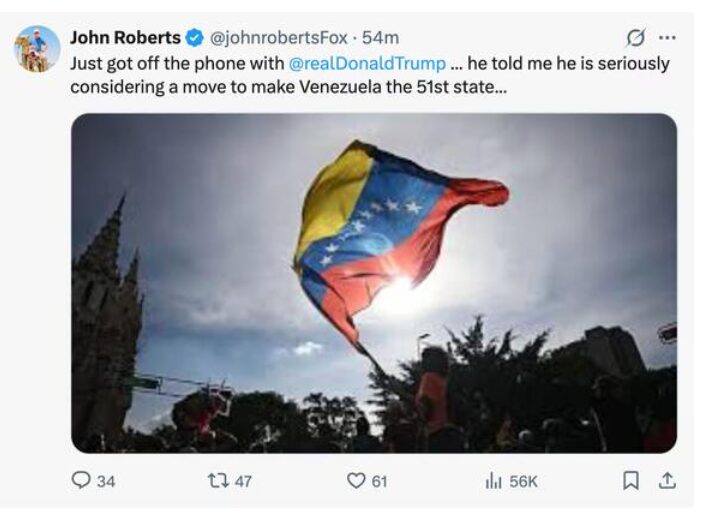
According to John Roberts, Trump told him during a phone call that he is “seriously considering” making Venezuela the 51st state.
Roberts shared the claim Monday morning on X, while fellow Fox News reporter Bill Melugin added that Trump pointed to Venezuela’s enormous oil reserves, reportedly saying the country has “$40 trillion in oil” and that “Venezuela loves Trump.”
The remarks are the latest chapter in Trump’s increasingly aggressive rhetoric surrounding Venezuela following the dramatic U.S. operation earlier this year that targeted the government of Nicolás Maduro.
Back in January, Trump announced that U.S. forces had carried out a large-scale overnight strike in Caracas that resulted in Maduro and First Lady Cilia Flores being captured and removed from the country.
Trump celebrated the operation in a Truth Social post published around 4 a.m., describing it as a joint effort with U.S. law enforcement and framing it as part of a mission to “make Venezuela great again.”
As international backlash mounted, Trump defended the move by invoking the Monroe Doctrine—though he jokingly referred to it as the “Donroe Doctrine”—while insisting that American dominance in the Western Hemisphere “will never be questioned again.”
At a January press conference, Trump said the United States would oversee Venezuela temporarily “until such time as we can do a safe, proper and judicious transition.”
Since then, the administration has faced criticism from lawmakers in both parties, many of whom accuse Trump of treating Venezuela less like a foreign policy issue and more like an economic acquisition.
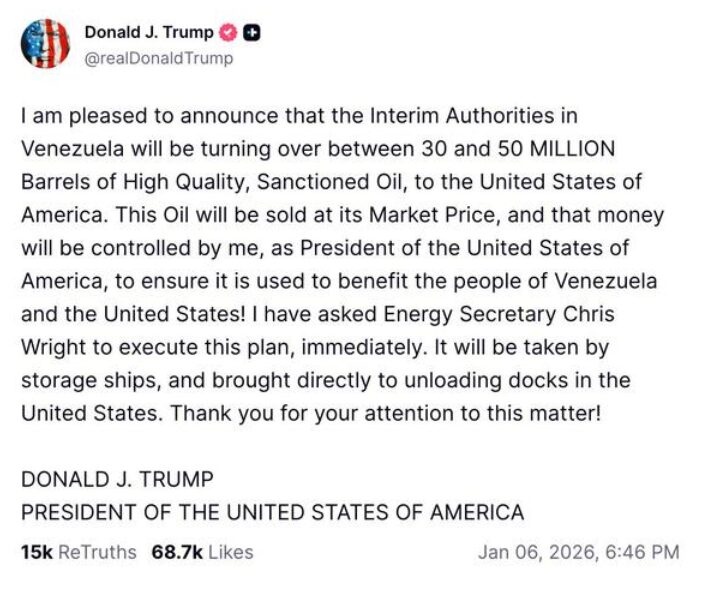
Those accusations intensified after Trump announced that “interim authorities” in Venezuela would transfer tens of millions of barrels of oil to the United States, with proceeds being managed directly by his administration.
Later, Trump also revealed that more than $100 million in gold had been removed from Venezuela, further fueling claims that the intervention was motivated by access to natural resources.
Despite the controversy, the White House has continued to portray the relationship between the two countries as a success story. Spokeswoman Olivia Wales said ties between the U.S. and Venezuela had become “extraordinary” under Trump and hinted at a long-term partnership, though she avoided directly addressing the idea of statehood.
Venezuelan officials, however, rejected the concept outright.
Acting President Delcy Rodríguez said Venezuela would continue defending its “sovereignty” and insisted the country was “not a colony.”
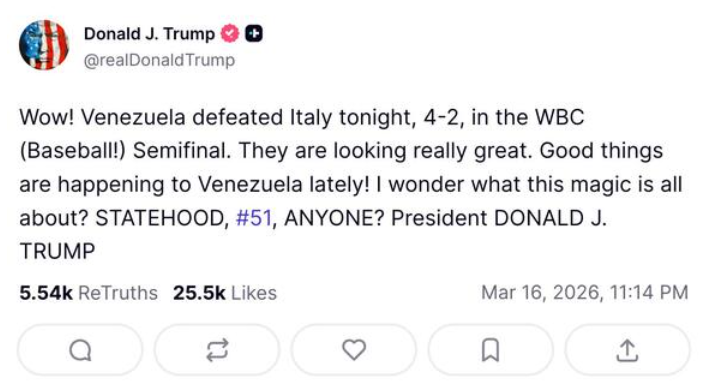
Even if Trump seriously pursued the idea, making Venezuela a U.S. state would require approval from Congress and, realistically, the cooperation of Venezuela itself.
Still, the comments fit a broader pattern. Throughout his presidency, Trump has repeatedly floated controversial territorial ambitions involving places like Greenland, Canada, the Panama Canal, Gaza Strip, and Cuba.
Whether the Venezuela remarks were serious policy discussion, political theater, or simply another example of Trump freelancing in public remains unclear—but they once again put the spotlight on how unconventional and unpredictable his approach to foreign policy continues to be.
About the Author