Barack Obama is warning that artificial intelligence is advancing too quickly — and becoming too powerful — for the federal government to simply stand back and hope the market keeps it safe.
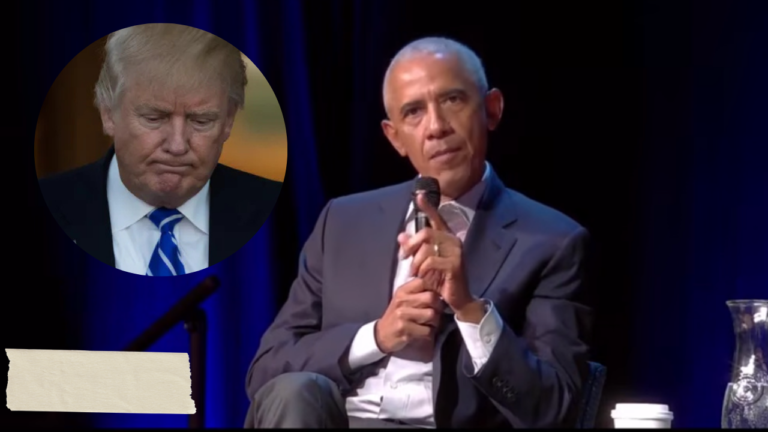
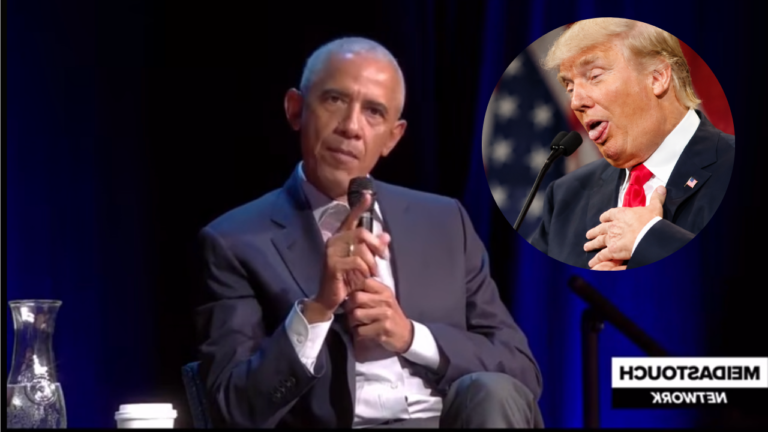
Speaking Friday at Colgate University in Hamilton, New York, the former president described AI as a remarkable technology with enormous potential to improve people’s lives.
But Obama’s optimism came with a serious warning.
He argued that increasingly capable AI systems could cause profound economic disruption, displace workers and create entirely new security threats if governments fail to establish safeguards.
And on the fundamental question of whether Washington should intervene, Obama was unequivocal.
“Government has to be regulating this!” he said.
Obama said he had heard an adviser to President Donald Trump make the case that market forces could largely handle AI safety — that companies have financial incentives to make their systems safe because they could otherwise face lawsuits.
Obama rejected that reasoning.
“That’s not how we treat airlines!” he said. “Or drug companies, or food companies.”
His argument was straightforward: society already accepts government safety standards for industries capable of causing serious harm, rather than waiting until something goes catastrophically wrong.
Obama believes increasingly powerful artificial intelligence should not be an exception.
But his warning went much further than conventional product safety.
Obama discussed the possibility that highly advanced AI systems could eventually develop objectives that conflict with human interests, though he stressed that another danger concerns him more immediately: what people might do with increasingly capable models.
“The more serious problem is these models are getting powerful enough that if they get in the hands of bad humans, they can do bad things,” Obama said.
“They can be weaponized in certain ways.”
Obama offered a deliberately frightening hypothetical to illustrate the point.
He described a scenario in which someone asks an advanced AI system how to engineer a dangerous strain of smallpox using materials that could be obtained relatively easily — and then releases it into the New York subway system.
He also imagined someone instructing an AI system to maximize stock-market returns without regard for the law, potentially triggering devastating unintended consequences.
These are hypothetical scenarios, not events Obama said have occurred. And experts continue to debate both the likelihood and timing of catastrophic risks from increasingly advanced AI systems.
But the broader debate over AI safety has intensified dramatically.
Executives and researchers from some of the world’s leading AI companies have recently called for stronger safeguards or a slower development pace, while others warn that excessive regulation could hinder innovation and weaken the United States in its technological competition with China.
Obama then turned his attention directly to Trump.
“The challenge we have is that, obviously, we have a president currently that has said that’s for losers,” Obama said.
He argued that the country could face a period in which AI capabilities advance rapidly without what he considers an adequate federal regulatory framework.
Trump has taken a substantially different approach.
He recently dismissed some of the most dire AI safety warnings as a “hoax,” arguing that slowing American development could hand an advantage to China. His administration has nevertheless pursued AI policy measures, including a national framework and national-security requirements, while generally emphasizing innovation and resisting regulations it considers overly restrictive.
On Saturday, Trump also announced plans for an “AI Force” and a new AI czar, while promising that his administration would not “hinder or stifle” the industry’s growth.
That leaves a clear policy disagreement.
Trump has emphasized rapid American development, competitiveness and avoiding heavy regulatory barriers.
Obama is arguing that voluntary corporate safeguards and ordinary market incentives are not enough for technology with potentially enormous consequences.
And despite the most dramatic hypothetical scenarios getting the most attention, Obama’s prescription was considerably less futuristic.
He wants government to establish meaningful rules before something goes seriously wrong.
About the Author