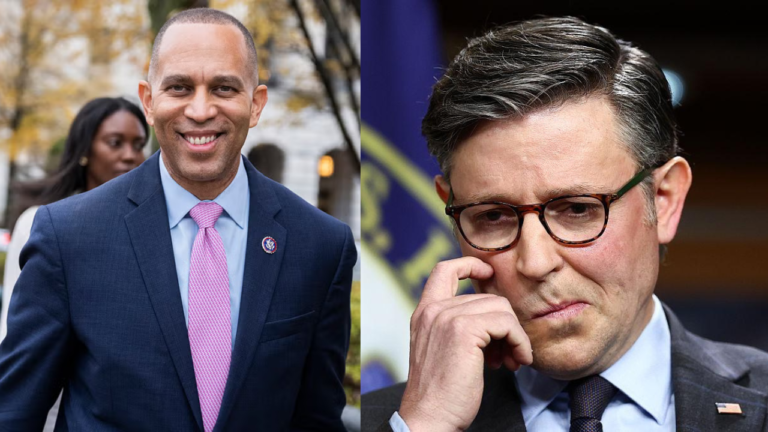
House Democratic leader Hakeem Jeffries delivered a pointed response to Republican Speaker Mike Johnson following the November 3 midterm elections, turning Johnson’s own pre-election confidence into the centerpiece of a sharp political taunt.
Speaking at a press conference after Democrats’ reported election victories, Jeffries seized on Johnson’s repeated insistence that political polling had underestimated Republican support.
His response was unmistakably sarcastic.
“Mike Johnson was correct. The polls were wrong. It wasn’t simply a blue wave; it was an American tsunami!”
The remark was a direct reference to the political expectations Johnson had promoted in the closing days of the campaign.
Republican leaders had argued that their candidates would outperform surveys and that the party’s electoral position was stronger than many analysts believed.
Jeffries used the results to make the opposite argument, presenting Democratic gains as evidence that voters wanted a significant change in Washington.
The exchange also highlighted the rapidly changing political circumstances facing both House leaders.
Johnson, who had served as Speaker under the Republican majority, faced the prospect of losing the gavel when the new Congress convened in January.
Jeffries, meanwhile, was positioning House Democrats to take control of the chamber’s legislative agenda and committee leadership.
But the Democratic leader’s remarks were not limited to celebrating his party’s performance.
He framed the election as a response to the economic pressures facing American families.
“The American people have chosen the economy over extremism,” Jeffries declared.
“The American people have chosen House Democrats because they want to see a dramatic change in direction, and that’s exactly what House Democrats will deliver on Day One.”
The comments reflected Jeffries’ interpretation of the results. Individual voters may have supported candidates for different reasons, including economic conditions, local issues, government policy and the candidates themselves.
Nevertheless, affordability was central to the message Jeffries delivered after Election Day.
He described rising household costs and access to healthcare as major priorities for the incoming Democratic majority.
Among the proposals he highlighted were measures intended to address the affordability crisis, extend enhanced Affordable Care Act subsidies and reverse reductions in Medicaid funding.
Jeffries also identified President Donald Trump’s tariff policies as an area where Democrats wanted to pursue changes.
Tariffs had become a prominent point of disagreement between the parties, with critics arguing that import duties increased costs for consumers and businesses.
The Trump administration, by contrast, has defended tariffs as a means of protecting American industries, strengthening domestic production and negotiating with trading partners.
Jeffries’ agenda also included opposition to the administration’s conduct of the war involving Iran.
He argued that Democrats had received a mandate to change the direction of federal policy, including on issues involving the economy and overseas military commitments.
“Democrats promised a new path forward, and last night, the voters delivered a mandate for it,” he said.
The word mandate was central to Jeffries’ argument.
By using it, he sought to present the election results not merely as a change in party control but as public support for the policies Democrats had campaigned on.
That interpretation will be contested by Republicans, who can point to individual races, regional differences and the limits of congressional election results as measures of national opinion.
Still, a change in House control carries significant practical consequences.
The majority party determines the Speaker, controls most committee chairmanships and generally sets the chamber’s legislative schedule.
Democrats would also gain new opportunities to conduct oversight of the Trump administration, including hearings and investigations into federal agencies and government spending.
Those powers would not give the House authority to independently prosecute administration officials or overturn presidential decisions without following constitutional and statutory procedures.
But they could create a more confrontational relationship between Congress and the White House.
For Johnson, the election results also raised questions about his leadership future.
Following the Republican defeat, Johnson indicated that he would not seek the position of House Minority Leader.
That decision would leave House Republicans facing a leadership transition as they prepared for the next congressional term.
It also added another dimension to Jeffries’ public criticism.
The Democratic leader was not simply mocking a failed election prediction. He was speaking at a moment when the balance of power in the House, and Johnson’s own position within Republican leadership, were changing.
Johnson had previously attracted attention for joking about the possibility of leaving Washington and pursuing a lawn-care business.
That remark was not a confirmed retirement announcement or evidence that he had made plans to establish such a business.
The distinction matters because the consequences of the election were already substantial without speculation about his future occupation.
Jeffries’ press conference offered a preview of the political arguments likely to dominate the next Congress.
Democrats will seek to connect their election gains to their proposals on healthcare, household expenses, tariffs and federal oversight.
Republicans will continue to defend their policy priorities and challenge Democratic proposals.
The White House will remain an important participant in those disputes.
Even with Democratic majorities in Congress, Trump would retain the power to veto legislation, meaning that major policy changes could require negotiations across party lines or sufficient votes to override a veto.
For Jeffries, however, the immediate focus was the election result and the message he wanted to attach to it.
Johnson had argued that the polls were wrong.
Jeffries took that prediction and turned it into a memorable line about the scale of Democratic gains.
“It wasn’t simply a blue wave; it was an American tsunami!”
The remark captured the confrontational tone of the post-election debate and offered an early indication of how Jeffries intends to approach the next phase of congressional politics.
About the Author