Donald Trump’s Truth Social account has become a familiar source of political attacks, campaign boasts, and presidential announcements. But on Tuesday, the president shared something entirely different — and deeply disturbing.
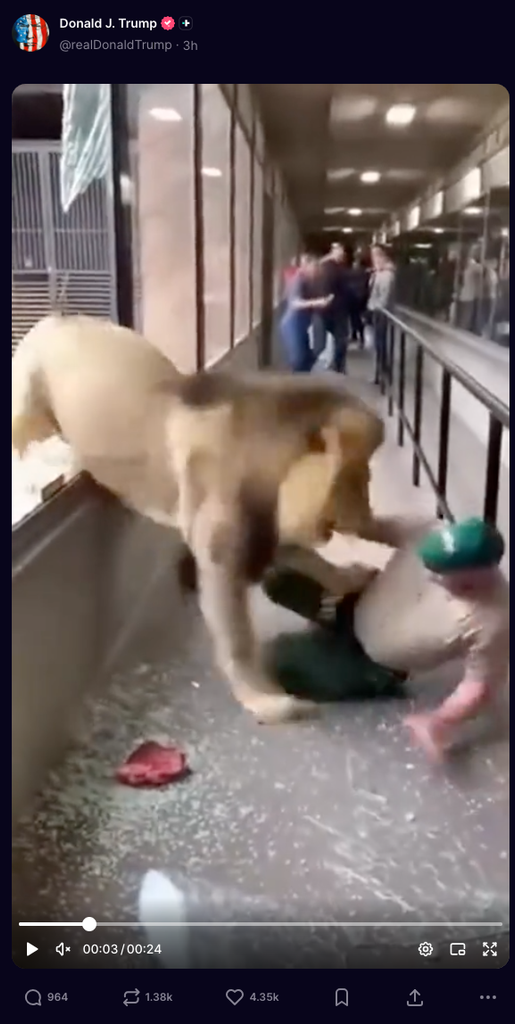
It was footage of a real person being violently attacked by a tiger.
The man in the video was William Chapman, a young British man who died Saturday after entering a tiger enclosure at Yorkshire Wildlife Park in Doncaster, England.
His family was already struggling with an unimaginable loss. The circulation of graphic footage from the incident had made that suffering even worse.
Then the president of the United States shared a recording of the attack with his millions of social media followers.
And the message accompanying it was startlingly brief.
“Don’t ever mess with nature! President DJT,” Trump wrote.
There was no expression of sympathy for Chapman’s family in the post. No acknowledgment that a young man had lost his life. No explanation of why the president believed his followers needed to see footage of the attack.
Instead, the graphic recording appeared on the president’s account as a warning about the dangers of confronting wild animals.
According to The Washington Post, Trump shared a silent video lasting approximately 41 seconds. It showed a Siberian tiger attacking Chapman inside the enclosure, including moments when the animal pinned him down and bit him.
The recording did not show the moment of his death, but it depicted part of the fatal encounter.
The attack itself occurred on Saturday, October 10, after Chapman entered the enclosure of a tiger named Altai.
Emergency services responded to the wildlife park, but Chapman was pronounced dead at the scene.
The circumstances surrounding his decision to enter the enclosure remain under investigation.
Chapman’s family subsequently disclosed that he had experienced significant mental illness over several years and had received medication.
They described him as a bright, warm, and engaging young man who was deeply loved.
Their statement also addressed the distress caused by the spread of graphic material online.
“The publication and circulation of deeply offensive media content is causing them severe distress at an exceptionally vulnerable time,” the family said.
They asked people to stop circulating the material.
The family also urged the public to respect the investigative process and allow authorities to establish the circumstances of Chapman’s death.
Those requests make the wider circulation of the footage particularly troubling.
The president was not reporting on an emerging public-safety emergency or explaining a new government policy. His post contained a brief warning about nature, attached to footage of a young man’s fatal encounter with an animal.
The decision raised an obvious question: Why was the president sharing such disturbing material in the first place?
The Washington Post reported that Trump’s motivation was unclear.
And the unusual activity did not end with the tiger video.
Approximately one minute later, Trump posted another recording — a compilation apparently showing lions attacking people.
This second video was accompanied by upbeat music.
The Washington Post noted that it was not immediately clear whether every clip in the compilation depicted an authentic event or whether some footage had been artificially generated.
Trump provided no accompanying explanation for the second post.
The two recordings appeared amid a broader series of Truth Social posts involving political commentary and other subjects.
But the videos attracted attention precisely because they were so different from the material ordinarily expected from a presidential account.
The New Republic reported that commentators questioned the purpose of the posts.
Ron Filipkowski, a former federal prosecutor and editor at MeidasTouch, publicly questioned why Trump’s account was sharing multiple videos of people being attacked by animals.
The Bulwark’s Andrew Egger similarly questioned the decision to distribute the graphic material.
Neither commentator could establish the president’s reason for posting it.
And that remains an important distinction: The videos were published on Trump’s account, but his private reasoning cannot be established from the posts themselves.
What is documented is the decision to circulate the footage, the message attached to it, and the existence of a grieving family’s public request for the disturbing material to stop spreading.
The tragedy has also prompted questions about safety at Yorkshire Wildlife Park.
Local authorities have opened a health and safety investigation into the incident. The park was evacuated following the attack, and officials have been examining how Chapman was able to enter the tiger enclosure.
The animal involved will not be euthanized, according to the wildlife park.
Those are serious questions for investigators, the facility, and the people responsible for visitor safety.
But none of them required the president to circulate footage of the attack.
Chapman’s death was not an internet spectacle to his family. It was the loss of a son whose life extended far beyond the final moments recorded by bystanders.
He had previously worked as a child actor, appearing in British television productions, and his former performing arts school remembered him with affection after his death.
Those details offer a fuller picture of the person behind the headlines — one that cannot be captured in a short, violent recording.
The controversy surrounding Trump’s post ultimately concerns a choice about public communication.
A president commands an audience of millions. When he shares a video, he can dramatically expand its reach, including to people who would never otherwise have encountered it.
That influence carries consequences, especially when the material involves a real person’s death and a family asking for privacy.
Trump’s warning about nature may have been intended as a cautionary message. But the post offered no explanation of its purpose beyond that short statement.
And following it almost immediately with another compilation of animal attacks set to music made the episode even more unusual.
The family of William Chapman has asked the public to stop circulating distressing material connected to his death.
Their appeal deserves to be heard.
The president’s decision to share the footage is now part of the public record. So is the family’s request for dignity and privacy.
And that contrast, more than the shocking images themselves, is what makes this episode worthy of scrutiny.
About the Author