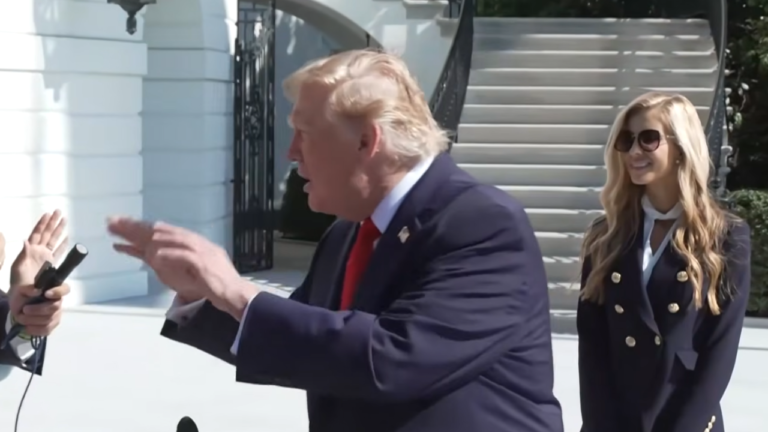
Donald Trump was standing outside the White House on Tuesday when a reporter asked him about Iran. It was a straightforward question about one of the most serious foreign-policy issues facing his administration.
What followed was anything but a straightforward exchange.
With Washington weighing its next steps toward Tehran, reporters were looking for clarity about whether the United States was moving toward renewed military action, further negotiations, or some other response.
Instead, the exchange briefly became a spectacle of gestures, expressions, and verbal sparring.
As the reporter attempted to ask about Iran, Trump raised both hands and moved them in an exaggerated fashion, appearing to mimic or mock the journalist rather than immediately address the question. His movements drew attention because they were so unusual for an exchange about a potential military confrontation.
A report published Tuesday by the Turkish outlet Haberler described Trump using hand gestures to imitate the reporter as cameras captured the interaction outside the White House.
The reporter persisted.
According to the published transcript of the October 13 press exchange, Trump responded at one point with the words “Always Iran.”
The journalist then asked what the administration’s next step would be and whether Trump remained hopeful for peace.
Eventually, the president offered an answer.
He described Iran as a failed country and asserted that its economy was in severe distress. He claimed inflation had reached 300 percent and said the government was struggling to pay its troops and other personnel.
Then came the announcement that offered remarkably little clarity about what Washington intended to do next.
Trump said the United States would make a decision on Iran very soon.
He did not explain what kind of decision he was considering, what options remained on the table, or when Americans should expect a definitive announcement.
That omission matters far more than the president’s unusual hand movements.
The United States and Iran have already endured months of confrontation, and the possibility of renewed military action carries enormous consequences for American service members, civilians across the Middle East, international energy markets, and diplomatic efforts to prevent another escalation.
Questions about the administration’s intentions are not distractions. They are among the most consequential questions a president can face.
Yet the October 13 exchange left the central issue unresolved.
Trump’s assertion that Iran was economically devastated also came without supporting evidence during the exchange. His specific claim of 300 percent inflation was not independently established by the remarks themselves.
The broader economic difficulties facing Iran are real, shaped by sanctions, currency instability, and the consequences of regional conflict. But those conditions do not automatically establish the precise figures or conclusions presented by the president.
And economic weakness does not eliminate the risks associated with military escalation.
The latest exchange also highlights the difficulty of interpreting Trump’s repeated promises of imminent decisions.
The Times of Israel reported Tuesday that Trump had made similar statements before without proceeding with renewed strikes.
Last week, he said the United States would not attack Iran before the November 3 midterm elections.
Now, with the elections approaching, the president is again saying that a decision is coming soon.
Whether that means a diplomatic initiative, a change in sanctions policy, a military operation, or simply another postponement remains unclear.
That uncertainty was precisely what the reporter was trying to address.
The video of Trump’s gestures is likely to attract attention because of its unusual appearance. But a brief public exchange cannot establish a medical diagnosis, and there is no factual basis for treating hand movements or facial expressions alone as proof of dementia.
The more substantial issue is what the president actually communicated.
He was asked about peace and the next steps toward Iran. He offered a bleak description of the Iranian economy and repeated a promise that a decision would come soon.
For Americans seeking to understand whether their country is moving toward another round of fighting, that leaves significant questions unanswered.
And for a president who has repeatedly presented himself as a decisive leader capable of resolving international conflicts, the contrast between that image and the lack of a concrete answer is politically significant.
The exchange began with a reporter asking about Iran.
It ended with an unusual scene caught on camera and another promise of an approaching decision.
What it did not produce was a clear explanation of what the United States intends to do next.
About the Author