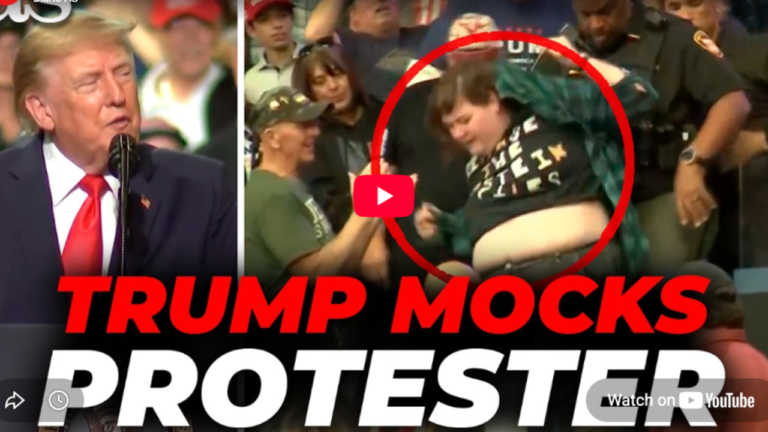
A woman wearing a T-shirt demanding the release of the Jeffrey Epstein files was punched in the face, grabbed by the hair, and forced out of Donald Trump’s Ohio rally Monday night. And as the disturbing confrontation unfolded, the president’s response was not a call for calm or a condemnation of the violence.
Instead, Trump mocked the protester, insulted her weight, and accused her of being paid by his political opponents.
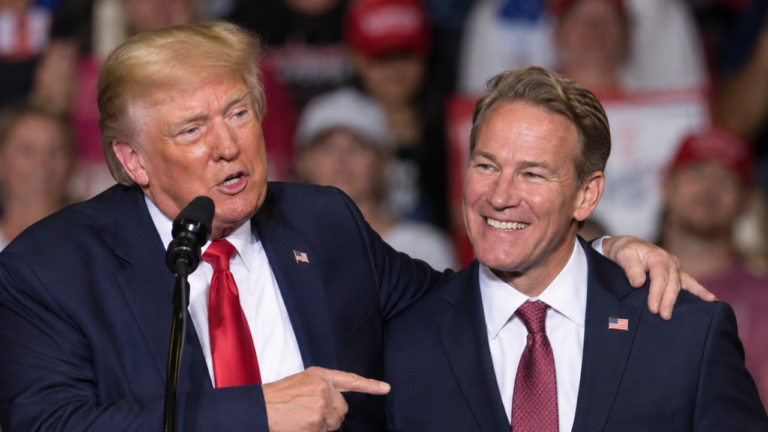
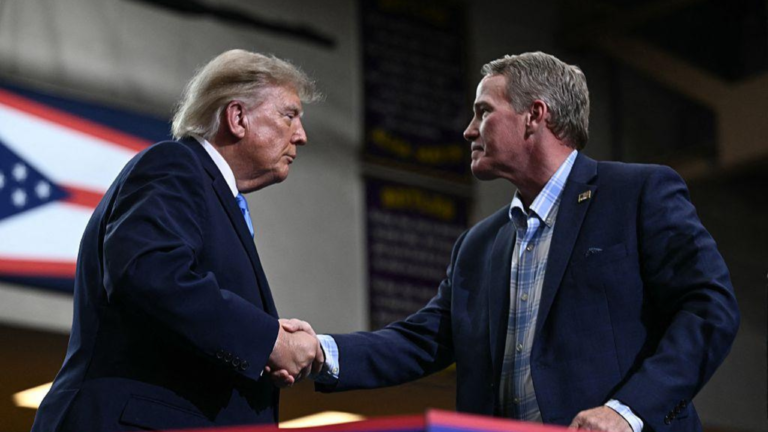
The incident unfolded in Youngstown, Ohio, where Trump was campaigning for Republican Sen. Jon Husted ahead of the November midterm elections. The president was attacking Democratic Senate candidate Sherrod Brown when a disturbance erupted among the spectators.
The woman had been wearing a shirt bearing a straightforward political demand: “Release the Epstein Files.”
What followed was captured by television cameras.
Footage aired by Newsmax showed a man who appeared to support Trump aggressively confronting the woman, shoving her backward and striking her in the face. The confrontation escalated as the man grabbed her hair and appeared to attempt to force her head toward the ground.
Other attendees became involved as the crowd chanted “USA!”
It was an extraordinary scene at a presidential campaign event: a woman publicly calling for the release of records connected to one of America’s most notorious sex-trafficking scandals was being physically assaulted in the stands.
But what happened next made the incident even more troubling.
As law enforcement officers moved into the crowd, they separated the people involved and escorted the woman out of the arena.
The man seen striking her, however, remained inside. Television footage showed him exchanging high-fives with other attendees after the confrontation.
Meanwhile, Trump had noticed the disruption.
Rather than addressing the violence directly, the president launched into an attack on the person being removed.
“He’s a paid protester,” Trump declared, apparently unaware that the protester was a woman.
Trump offered no evidence that the woman had received money to attend the rally.
He continued by accusing political opponents of financing demonstrators to disrupt his events and undermine the country.
“They’re scum,” he told the crowd.
Then the president turned his attention to the protester’s physical appearance.
“Oh, he’s gotta go on a diet!” Trump exclaimed.
“He’s a fat guy,” he added, before continuing to joke about the person’s weight.
The remarks were broadcast as the woman who had just been assaulted was being removed from the venue.
That contrast is difficult to ignore.
A woman had been struck in the face. A man had grabbed her hair. Officers were removing her from the building. And the president was using the moment to ridicule her appearance.
The incident was documented by multiple news organizations, including Fox News and Mediaite, which published accounts of the confrontation and Trump’s comments.
The Daily Beast subsequently reported additional details, including an online account from a person claiming to be the woman involved.
That individual alleged that she had been hospitalized after the assault and had lost a substantial amount of hair during the confrontation.
Those claims have not been independently verified, and the identity of the person behind the online account has not been conclusively established.
There has also been no verified announcement establishing that the man seen striking the woman was arrested or charged.
But the central facts of the confrontation do not depend on those unresolved questions.
The assault was captured on video. Trump’s remarks were recorded. And the footage showed the woman being escorted away while the man who struck her remained among the spectators.
The woman’s demand for the Epstein files adds another layer of political significance.
The Trump administration has faced questions about its handling of records connected to Jeffrey Epstein, whose crimes and powerful associations have generated years of public scrutiny.
Calls for transparency have come from people across the political spectrum, including some of Trump’s own supporters.
The words printed on the woman’s shirt were not an accusation of guilt against any particular individual. They were a demand for the release of records.
That is a form of political expression Americans have every right to engage in, regardless of their views about the president.
And whatever disagreements existed between the protester and the people surrounding her, those disagreements did not justify a physical attack.
The Ohio incident also followed another confrontation at a Trump rally in San Antonio, Texas, where footage showed a man wearing a MAGA hat grabbing a protester by the hair and pulling him toward the ground.
The two episodes raise questions about the treatment of dissenters at political rallies and the responsibilities of event organizers and law enforcement when confrontations become violent.
There is no verified evidence that Trump ordered the assault in Youngstown or instructed his supporters to attack the woman.
But the president’s own words are a matter of public record.
He did not use the moment to condemn the violence visible in the broadcast. Instead, he accused the protester of being paid, called protesters “scum,” and mocked the woman’s body.
That reaction is particularly striking from a president who frequently presents himself as a champion of free speech and a defender of ordinary Americans.
Free expression does not mean that every audience must welcome every protest. Event organizers can enforce lawful rules, and disruptive attendees can be removed when appropriate.
But none of that makes punching someone in the face an acceptable response to a political message.
And none of it explains why the president chose ridicule rather than a clear denunciation of the assault.
Trump traveled to Ohio to campaign for a Republican senator. Yet one of the most widely discussed moments from the rally was not a policy proposal, a campaign promise, or an argument about the election.
It was the sight of a woman being attacked for displaying a political message — followed by the president publicly mocking her as she was escorted away.
The footage speaks for itself.
And the questions it raises about political violence, accountability, and the treatment of dissent deserve answers.
About the Author