Rep. Thomas Massie (R-Ky.) cautioned on Tuesday that President Donald Trump’s policies are set to increase the budget deficit this year, and that the growing interest payments on the national debt will surpass federal spending.
Increase in Budget Deficit
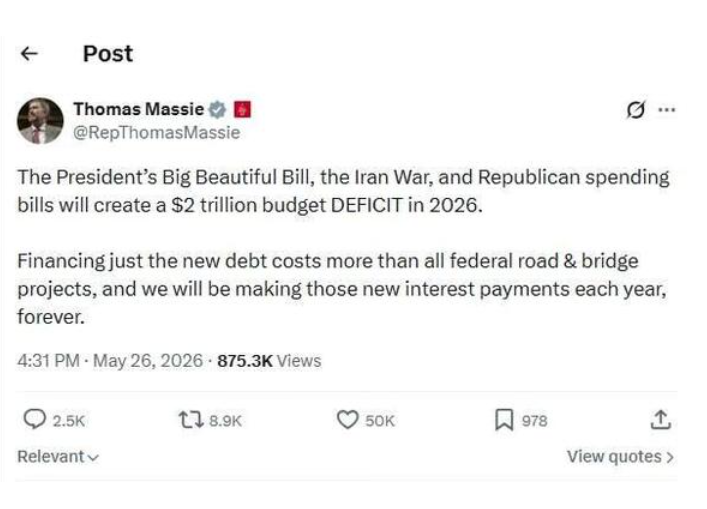
In a message on X, Massie mentioned, “The President’s Big Beautiful Bill, the Iran War, and Republican spending bills will lead to a $2 trillion budget DEFICIT in 2026.”
The Office of Management and Budget predicted a $2.065 trillion deficit for the fiscal year 2026, while the Congressional Budget Office (CBO) estimated it to be lower at $1.853 trillion.
Recent CBO data showed that the “One Big Beautiful Bill Act,” which was signed into law on July 4, 2025, would increase the federal deficit by $3.8 trillion.
A study from the Brookings Institution recently indicated that the bill could add between $3.7 trillion and $5.1 trillion to federal deficits over the next ten years.
Senator Rand Paul (R-Ky.) previously pointed out that the conflict with Iran costs the U.S. around “$1 to $2 billion a day.”
Senator Bernie Sanders (I-Vt.) mentioned that the war could go beyond $1 trillion, which is much higher than Trump’s estimate of $25 billion, greatly affecting American families.
Read Also: Economist Justin Wolfers Warns We Will Be Paying ‘Iran Tax’ For Months If Not Years And The ‘Hit’ To Family Budgets Will be ‘Very Real’
Rising debt levels would lead to higher interest rates, which would increase borrowing costs throughout the economy.
Higher Financing Costs
Massie argued that the government will spend more on debt financing than on infrastructure projects like roads and bridges.
He noted that these increasing costs would be evident in new funding rules in the coming years.
“Financing just the new debt costs more than all federal road & bridge projects, and we will be making these new interest payments each year, forever,” he stated.
Federal student loan interest rates are expected to rise slightly for the 2026-27 academic year.
Undergraduate federal student loan rates might increase to 6.52% from 6.39%, while graduate student loan rates could go up to 8.07% from 7.94%. Parent PLUS loan rates may also rise to 9.07% from 8.94%, according to a recent analysis by higher education expert Mark Kantrowitz.
About the Author