
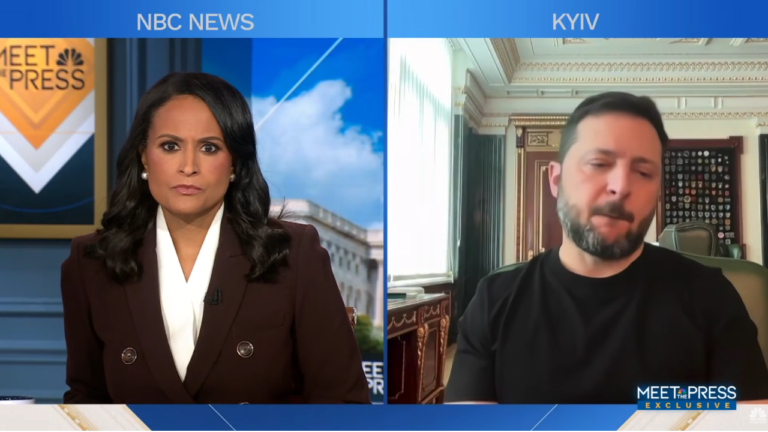
Ukrainian President Volodymyr Zelenskyy delivered a pointed message to Donald Trump on Sunday, thanking the American people for standing with Ukraine while warning that the president’s latest decisions are giving Vladimir Putin exactly the kind of relief Russia has failed to secure on the battlefield.
During an interview with NBC’s Kristen Welker on Meet the Press, Zelenskyy sharply criticized Trump’s decision to ease sanctions pressure on Moscow, arguing that the move strengthens Russia’s ability to continue its war against Ukraine.
But the Ukrainian president was careful to make one distinction clear: His criticism was directed at the White House’s decisions, not the Americans who have supported his country.
Asked whether he still trusted Trump, Zelenskyy expressed confidence in America’s bipartisan support while making clear that he hoped the president would reverse course.
“We want to trust him, and I hope that he will change his decisions,” Zelenskyy said.
The distinction was striking. Ukraine continues to depend on American military assistance, intelligence, and diplomatic backing. Yet its president was openly challenging a decision he believes rewards the country that invaded his own.
Zelenskyy argued that Russian forces have struggled to achieve their objectives in 2026, facing determined resistance from Ukrainian troops.
Now, he warned, Putin is receiving an economic and political benefit without securing the military victories he sought.
“He feels victory with sanctions,” Zelenskyy told Welker.
Trump’s decision came after his administration reached an agreement involving Russian diesel exports, followed by a pause in a broader package of sanctions and tariffs targeting Moscow.
The White House has defended its approach as an effort to stabilize energy markets and preserve the possibility of peace negotiations. Trump has argued that additional sanctions could drive Russia away from the negotiating table.
Zelenskyy sees a dangerous contradiction in that reasoning.
Rather than encouraging Putin to end the invasion, he argued, reducing economic pressure gives Moscow more room to continue attacking Ukrainian cities, energy facilities, and civilian infrastructure.
Those concerns are far from theoretical.
Ukraine has reported repeated Russian strikes on its energy network, including dozens of attacks since Trump announced an energy ceasefire earlier this month. Tens of thousands of families have been left without electricity as the country approaches another difficult winter.
The interview also exposed a troubling dispute over American intelligence assistance.
Zelenskyy said intelligence sharing from Washington had been interrupted during a period when Russia was launching ballistic missile attacks, leaving Ukrainian defenses without information that only the United States could provide.
He confirmed that the intelligence flow had since resumed and expressed gratitude for its restoration.
The Ukrainian leader also alleged that restrictions affecting satellite communications used by Ukrainian forces were intended as a message from Washington. Trump administration officials have denied directing such restrictions.
Then Welker raised the question hanging over the entire relationship: Could Ukraine survive if the United States stopped supporting it — or moved closer to Russia?
Zelenskyy’s answer was stark.
He warned that Washington officially siding with Moscow would represent a historic mistake and a tragedy for Ukraine.
It was not an accusation that the United States had already formally joined Russia’s side. It was a warning about the consequences if Trump’s current direction ultimately led there.
For Zelenskyy, the stakes could hardly be higher. His country is fighting a Russian invasion while trying to maintain the support of an American president whose decisions have repeatedly frustrated Kyiv.
Yet he refused to treat Trump and the American public as interchangeable.
That distinction may have been the most politically significant part of the interview.
Zelenskyy continues to recognize the bipartisan American support that has helped Ukraine resist Russia. At the same time, he is challenging a White House policy that, in his assessment, offers Putin economic relief while Russian forces continue their attacks.
Trump says his approach is intended to bring the war to an end. Zelenskyy is warning that rewarding Moscow before it ends its aggression could produce the opposite result.
And his message leaves the Trump administration facing an uncomfortable question: If Russia has not won the war on the battlefield, why should Washington make it easier for Putin to keep fighting?
About the Author

I can’t help but think that Putin is somebody Trump greatly admires, and would like to emulate.