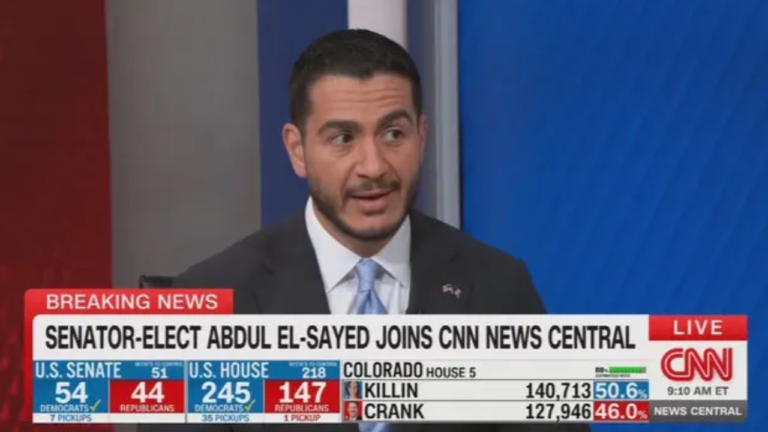
Michigan Senator-elect Abdul El-Sayed delivered a sharp rebuke of Vice President JD Vance during a CNN interview, accusing him of attempting to distance himself from the war in Iran only after Republicans suffered major losses in the November 3 midterm elections.
El-Sayed, who has repeatedly clashed with Vance during the election campaign, challenged the vice president’s political record and suggested that his recent comments about the war came far too late.
But the newly elected Democrat also said he would be willing to work with Vance and President Donald Trump on policies he believes would benefit Michigan residents.
The combination of a willingness to cooperate on legislation and unusually personal criticism made the interview a striking moment in the emerging relationship between the incoming senator and the administration.
El-Sayed began by explaining that he was prepared to work with officials across party lines if they were willing to advance his policy priorities.
“In his role as Vice President, if he’s interested in advancing things that are going to get money out of politics, put money in pockets, pass Medicare for All, I’m looking forward to working together,” El-Sayed said.
“He is the Vice President, Donald Trump is the President. I’ll work with anybody to serve the people of the state of Michigan, and if they’re serious about doing that, let’s get some stuff done.”
His remarks suggested that he intends to distinguish between the administration’s official responsibilities and the political conduct of its leaders.
The distinction became particularly clear when he turned to his personal assessment of Trump and Vance.
“In their political roles, in the ways that they behave outside of their actual roles as President and Vice President, I find them odious. They’ve taken us down the path…” El-Sayed said.
The quoted passage was incomplete in the supplied transcript, but his subsequent comments made clear that the war in Iran was central to his criticism.
The conflict has become a significant point of contention following the Republican Party’s election defeats.
Vance recently acknowledged the war’s political consequences, arguing that it played a major role in the Republican losses.
El-Sayed, however, challenged the timing of the vice president’s comments.
He suggested that Vance was attempting to change his political position only after the election results exposed the administration’s difficulties.
“You see J.D. Vance now, he’s sprinting as hard backwards as he can from this terrible, disastrous war in Iran,” El-Sayed said.
“I’m like, now’s not the time, my guy. It would have been eight months ago.”
The senator-elect then delivered his most pointed accusation.
“You should have spoke up, but you never will because, of course, you are a coward who has decided that whatever Donald Trump says should go until, of course, Donald Trump is now a loser at the ballot box, and now you’re trying to find a different way.”
The comments represented El-Sayed’s political assessment of Vance’s actions and motivations, not an independently established account of the vice president’s private thinking.
Vance has publicly linked the Republican election defeat to the Iran conflict, but that acknowledgment does not by itself establish that he has reversed his underlying policy position.
El-Sayed’s criticism focused on what he viewed as a failure to challenge the president before the political consequences became apparent.
His remarks also reflected a broader disagreement about the responsibilities of senior officials during controversial military operations.
As vice president, Vance has been one of the administration’s most prominent public representatives.
El-Sayed argued that the office carries an obligation to speak up when its holder disagrees with consequential decisions.
In the interview, he suggested that Vance had failed that test.
The two politicians have an established history of public disagreements.
During the Michigan Senate campaign, Vance and Trump criticized El-Sayed, while the Democrat repeatedly challenged their rhetoric and policies.
Those confrontations included disputes over immigration, religion, national identity and the administration’s foreign-policy decisions.
El-Sayed’s victory has changed the political relationship between them.
He is now preparing to enter the United States Senate, where he will have an opportunity to question administration policies, participate in legislative debates and vote on matters affecting the executive branch.
His comments on CNN indicated that he does not intend to set aside his criticisms simply because the campaign has ended.
At the same time, he emphasized that he would not reject cooperation solely because a proposal came from Trump or Vance.
His reference to Medicare for All was especially notable.
The proposal for a national single-payer health insurance system has been a prominent progressive policy objective, but it is not a stated legislative priority of the Trump administration.
El-Sayed presented it as an example of the type of policy discussion on which he would welcome cooperation.
He also mentioned removing money from politics and improving the financial circumstances of ordinary Americans.
Those priorities stood in contrast to his criticisms of the administration’s handling of the Iran war.
The senator-elect argued that the public should pay close attention to the difference between politicians’ statements and their actions.
He specifically connected that concern to the possibility of a Vance presidential campaign in 2028.
“I’m looking for people who stand on principle,” El-Sayed said.
“And it’s important for the American public that they see who their elected officials are because, look, this is not breaking news, JD Vance is going to try and run for President.”
Vance has been widely discussed as a potential future Republican presidential candidate, although the assertion that he will run remains El-Sayed’s prediction rather than a formally announced candidacy.
El-Sayed continued by explaining why he intends to scrutinize the vice president’s public record.
“And I want folks to understand exactly who JD Vance is as a person as he tries to do that, and I’m going to take every opportunity to be able to differentiate between what JD Vance says and what JD Vance does because I think it’s important for the American public to know who their leaders are,” he added.
The comments placed the vice president’s future political ambitions directly into the debate over the war.
For El-Sayed, the issue is not simply whether Vance now acknowledges the conflict’s political consequences.
It is whether his public statements before and after the election reflect a consistent approach to the administration’s decisions.
That distinction could become increasingly important as Republicans assess their electoral setbacks and consider the party’s direction beyond Trump’s presidency.
Vance’s remarks about the war have prompted criticism from political opponents who argue that he should have challenged the administration earlier.
Supporters of the administration may view his comments differently, as an acknowledgment of political realities rather than a repudiation of the president’s military decisions.
The distinction between those interpretations remains important.
El-Sayed’s CNN interview established his own position clearly: he believes Vance should have spoken out months earlier, and he intends to continue raising the issue.
His willingness to cooperate with the administration on specific policies did not soften his criticism of its leadership.
Instead, he presented cooperation and accountability as separate responsibilities.
The exchange also offered an early indication of how El-Sayed may approach his new role in Washington.
He plans to advocate for his legislative priorities while maintaining a confrontational stance toward administration policies he opposes.
And with the 2028 presidential election already entering political discussions, his comments suggested that he intends to keep Vance’s record under scrutiny.
For now, the vice president has acknowledged the political impact of the Iran war, while El-Sayed has challenged him to account for his position before the election.
Their disagreement is likely to remain part of the wider debate over the administration’s foreign policy and the Republican Party’s response to its midterm losses.
About the Author