Barack Obama’s joke about Donald Trump’s gold-covered White House was already causing a political uproar. Now, a newly reported financial connection has added an unexpected twist to the whole affair.
According to financial disclosures reviewed by The Daily Beast, Trump bought and sold shares in The Cheesecake Factory during 2025 — the very restaurant chain Obama invoked while mocking the president’s elaborate White House renovations.
And the timing makes the discovery particularly amusing.
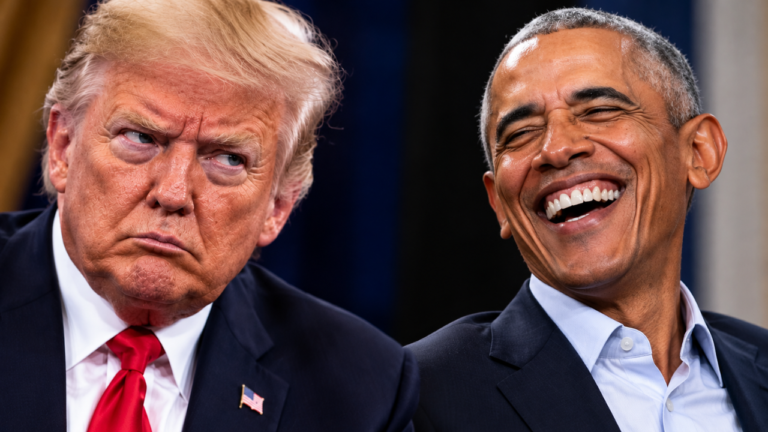
The controversy began Saturday, when Obama took the stage at a Democratic campaign rally in Ohio and turned his attention to Trump’s increasingly lavish changes to the White House.
After joking that Trump seemed more interested in home improvement projects than governing, Obama delivered the line that quickly spread across social media.
“He’s got the White House looking like Saddam Hussein opened a Cheesecake Factory,” Obama told the crowd.
The joke targeted Trump’s fondness for gold-colored decorations and the elaborate aesthetic associated with his renovations, including the controversial White House ballroom project.
Trump did not find it funny.
Speaking to reporters Monday, the president attacked Obama as unintelligent and defended his work on the White House, insisting that the historic building had needed extensive repairs.
Later, during a campaign rally in Corinth, Mississippi, Trump spent several minutes revisiting the subject.
He described the Cheesecake Factory as “a very successful company” and accused Obama of failing to appreciate successful businesses.
But what Trump did not mention was his own financial connection to the restaurant chain.
The Daily Beast reported Wednesday that Trump’s financial disclosures show he purchased between $35,007 and $175,000 worth of Cheesecake Factory stock during 2025.
The transactions began in January, shortly after Trump returned to the White House.
He purchased shares on January 30, February 3, February 4 and February 13, with each transaction valued between $1,001 and $15,000.
Additional purchases followed on March 5 and April 8, each falling within the $15,001-to-$50,000 reporting range, before another smaller purchase on April 10.
Trump also reported selling Cheesecake Factory shares in May and November.
And the connection did not end there.
According to a financial disclosure filed in June, Trump still held between $15,001 and $50,000 worth of the company’s shares as of December 31, 2025.
He also reported receiving a dividend of up to $2,000.
Those figures reflect disclosure ranges rather than precise transaction amounts, and the December holding does not establish how many shares Trump owns today.
Still, the revelation creates an extraordinary coincidence.
Obama mocked the White House for resembling a restaurant chain known for its ornate interiors.
Trump responded by defending both his renovations and the restaurant’s commercial success.
And now the public knows that the president’s reported investment portfolio included shares in that very company.
The Cheesecake Factory is famous for its sprawling menu, enormous portions and theatrical interior design, which often features decorative columns, elaborate lighting and bold color combinations.
That aesthetic was the point of Obama’s comparison.
His joke was aimed at the appearance of the White House, not at the restaurant’s customers or the people who work there.
Some conservatives nevertheless interpreted the remark as an insult to ordinary Americans who enjoy dining at the chain.
Treasury Secretary Scott Bessent even visited a Cheesecake Factory restaurant in Washington and publicly praised his meal while criticizing Obama.
The restaurant itself has also been doing remarkably well financially.
The company reported record quarterly revenue of approximately $1.03 billion this week, with comparable restaurant sales rising sharply.
But the political question is not whether the Cheesecake Factory is a successful business.
It is why a joke about the White House’s appearance generated such an extended response from the president and his allies.
The newly reported financial disclosures add another dimension to that question, although they do not establish Trump’s personal motivation.
There is also an important qualification.
White House spokesman Davis Ingle told The Daily Beast that Trump’s stock and bond portfolio is managed independently by third-party financial institutions.
According to Ingle, neither Trump nor his family directs individual investment decisions or determines when securities are bought or sold.
The White House maintains that the arrangement eliminates conflicts of interest.
That explanation means the financial disclosures should not be taken as proof that Trump personally selected Cheesecake Factory shares because he admired the restaurant, or that he defended the company to protect his investment.
There is no established evidence for either claim.
What is documented is the sequence of events: Obama’s joke, Trump’s angry response, his public praise of the restaurant chain and the subsequent reporting about his financial holdings.
For Democrats, the episode has become an opportunity to contrast the president’s attention to White House renovations with voters’ concerns about everyday expenses.
Trump’s critics argue that the administration has devoted too much energy to defending elaborate decorative projects while families struggle with the cost of groceries, fuel and housing.
The White House disputes that characterization and says the renovations are intended to preserve and improve an important national landmark.
But the political optics remain difficult to ignore.
Obama made a joke about the president’s taste in decorating.
Trump spent days defending himself.
And the restaurant at the center of the punchline turned out to have a place in his disclosed investment portfolio.
It is an unexpected detail in an already unusual political feud — and one that has given Obama’s joke an entirely new life.
About the Author