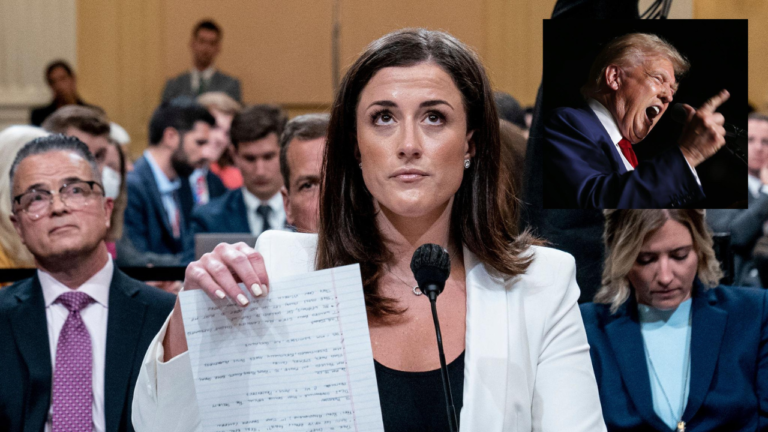
Donald Trump’s Justice Department suffered a striking legal defeat Tuesday when a federal grand jury in Washington, D.C., refused to indict Cassidy Hutchinson, the former White House aide whose explosive testimony helped expose the president’s conduct surrounding the January 6 Capitol attack.
The rejection marks another extraordinary setback for federal prosecutors pursuing cases involving people Trump and his allies have publicly targeted.
According to The Washington Post, a Justice Department attorney appeared before a federal magistrate judge Tuesday afternoon and disclosed that the grand jury had not approved a proposed indictment.
The attorney, Neville S. Hedley, identified himself as acting senior litigation counsel in the Justice Department’s Civil Rights Division.
He did not publicly name the person involved, but two people familiar with the proceedings told the newspaper that the rejected indictment concerned Hutchinson.
The Associated Press independently confirmed the failed attempt to secure charges.
The outcome is particularly remarkable because grand juries rarely reject prosecutors’ requests for indictments.
Unlike a criminal trial, prosecutors do not have to establish guilt beyond a reasonable doubt. They must persuade enough grand jurors that probable cause exists to believe a crime occurred.
That relatively low legal threshold makes a refusal especially unusual.
Yet that is precisely what happened in Hutchinson’s case.
The investigation followed years of Republican accusations that Hutchinson had lied during her testimony to the House committee investigating the January 6, 2021, attack on the Capitol.
Republican Representatives Jim Jordan of Ohio and Barry Loudermilk of Georgia referred her to the Justice Department earlier this year for potential prosecution.
Both lawmakers have challenged her credibility and questioned parts of her testimony.
Hutchinson, who worked as a special assistant to former White House Chief of Staff Mark Meadows, became one of the most recognizable witnesses in the January 6 investigation.
She was just 25 years old when she appeared before the committee in June 2022.
Her nationally televised testimony attracted approximately 13 million viewers and provided a dramatic account of what she witnessed inside the Trump White House as the Capitol attack unfolded.
Among her most consequential claims was that Trump knew some supporters were armed before urging the crowd to march toward the Capitol.
She also described his anger when he was told he could not accompany the crowd to the building.
One account became particularly controversial.
Hutchinson testified that another White House official, Anthony Ornato, had told her Trump tried to grab the steering wheel of the presidential vehicle and lunged toward a member of his security detail after being informed he would not be taken to the Capitol.
Hutchinson made clear that she was recounting what she had been told, rather than describing something she personally witnessed.
That distinction became central to the Republican campaign against her credibility.
The Secret Service driver later disputed the account, saying he had not witnessed Trump grab the steering wheel or lunge toward the front of the vehicle.
Other witnesses did not corroborate the alleged physical confrontation, although testimony supported the broader account that Trump was angry and wanted to go to the Capitol.
Trump himself has repeatedly attacked Hutchinson and rejected her allegations.
Those disputes eventually became part of the Justice Department’s investigation.
But the decision to pursue the case through the department’s Civil Rights Division raised additional questions.
That division ordinarily handles matters involving discrimination, constitutional rights and related federal civil rights laws.
A case centered on alleged false statements to Congress would more typically be handled elsewhere within the department.
The Washington Post reported that the unusual assignment was one of several notable features of the investigation.
And Hutchinson’s case is not the first time grand jurors have resisted prosecutors in a politically sensitive matter.
Earlier this year, another federal grand jury in Washington refused to indict six Democratic lawmakers over a video in which they reminded members of the military that unlawful orders must not be followed.
The repeated failures have intensified scrutiny of the Justice Department’s handling of investigations involving Trump’s perceived political adversaries.
Critics have described those efforts as politically motivated attempts at retaliation, while the administration has maintained that its law enforcement actions are legitimate.
In Hutchinson’s case, the grand jury’s refusal does not amount to a judicial declaration that every statement she made was accurate.
Nor does it necessarily prevent prosecutors from pursuing additional investigative steps or attempting to present a case again.
It does mean that, at this stage, the Justice Department has failed to obtain criminal charges against one of the most prominent witnesses from the January 6 investigation.
The department did not immediately respond to The Washington Post’s request for comment.
For Hutchinson, the development comes more than four years after she appeared before Congress and described events that placed her at the center of a national political confrontation.
For the Trump administration, it is another highly visible legal setback involving someone the president’s allies have long accused of wrongdoing.
And for the Justice Department, the question now is whether prosecutors will accept the grand jury’s decision or continue pursuing a case that has already encountered an unusually public rejection.
Source: AP News
About the Author