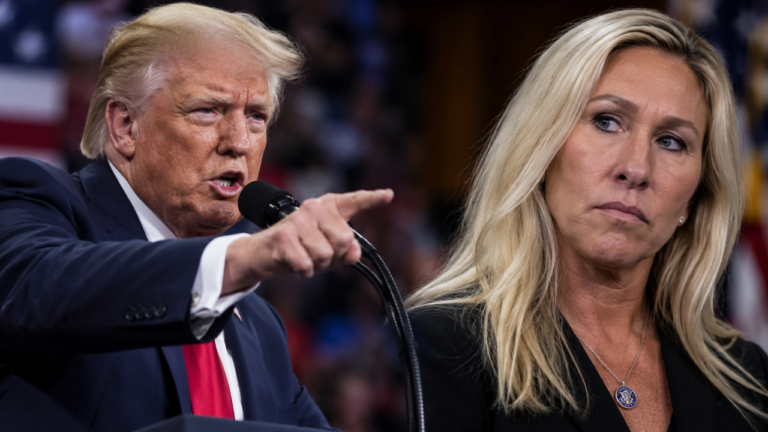
Donald Trump traveled to Georgia to rally support for Republican candidates ahead of the midterm elections. But his remarks about helping the state have provoked a furious response from someone who once ranked among his most loyal defenders: former Republican congresswoman Marjorie Taylor Greene.
And Greene’s response was anything but subtle.
In a post on X, Greene blasted Trump after a clip circulated from his Saturday rally in Perry, Georgia, where he suggested that his willingness to respond to requests for help could depend on which politicians were making them.
“He has no idea how bad he is doing in Georgia,” Greene wrote.
“And to threaten our state that he would refuse to help the good people of Georgia just because he doesn’t like who calls him shows how much he really doesn’t care.”
Then she delivered a warning that went beyond the controversy surrounding his remarks.
“Trump has become a curse to Republican candidates, and it will be worse in ‘28.”
The extraordinary criticism came after Trump used his Georgia rally to promote Republican Senate candidate Mike Collins and gubernatorial candidate Rick Jackson.
While praising the candidates, Trump described how much he enjoys helping Republican allies who contact him with requests for their constituents.
“These congressmen are so good, and they call me, and it’s, you know, it’s — I love to help them,” Trump told the crowd.
But then he explained that his attitude changes when the person calling is someone he dislikes.
“When other people call me, I’m terrible. I’m just terrible.”
Trump went on to act out a hypothetical phone call involving a politician he derisively referred to as “Pee-wee Herman,” a nickname he has used in attacks involving Democratic Senator Jon Ossoff.
In Trump’s imagined exchange, an aide informs him that the caller needs money for Georgia.
The president’s response was blunt.
“I don’t give a damn what he wants,” Trump declared. “I’m not in.”
Those words immediately raised questions about whether Trump was suggesting that his personal relationships with elected officials could influence how he responds to requests for federal assistance.
There is an important distinction: Trump did not announce an actual suspension of federal funding or identify a specific aid request he had denied. His remarks were part of a hypothetical exchange at a political rally.
But Greene interpreted the message as a threat to ordinary Georgians.
Her criticism centered on the idea that federal assistance should not depend on whether the president likes the elected official asking for it.
Georgia residents, including those who vote for Democrats, are still American citizens whom the federal government is supposed to serve.
For Greene, Trump’s remarks appeared to cross a political line.
The confrontation is particularly striking given her history.
Greene spent years as one of Trump’s most aggressive defenders in Congress, championing his political movement and attacking his Democratic opponents.
But the former congresswoman has increasingly broken with Trump, and her latest comments show just how far that relationship has deteriorated.
Rather than defending his rally appearance, Greene argued that his involvement could actively hurt the Republican candidates he was trying to help.
Her description of Trump as a “curse” is especially pointed with the November 3 midterms approaching.
Republicans are trying to hold competitive seats, while Democrats are looking for opportunities to turn dissatisfaction with the administration into electoral gains.
Georgia remains one of the country’s most closely watched political battlegrounds, with major races that could influence the national balance of power.
Trump’s appearance in Perry was intended to energize Republican voters and strengthen the candidates he endorsed.
Instead, it produced a public rebuke from a former MAGA ally who knows Georgia Republican politics firsthand.
The White House’s position on Greene’s criticism was not established in the reporting available for this story.
And there is no evidence from the rally remarks alone that the administration has formally withheld assistance from Georgia because of the party affiliation of its elected officials.
Still, the political implications are difficult to ignore.
Trump was asking Georgians to elect Republicans because they would have a direct line to the White House.
Greene heard something different: a president suggesting that political loyalty could influence whether he is willing to help.
And with Election Day approaching, her warning to Republican candidates was unmistakable.
The man they are counting on to help them win, she argues, may be making their job harder.
About the Author