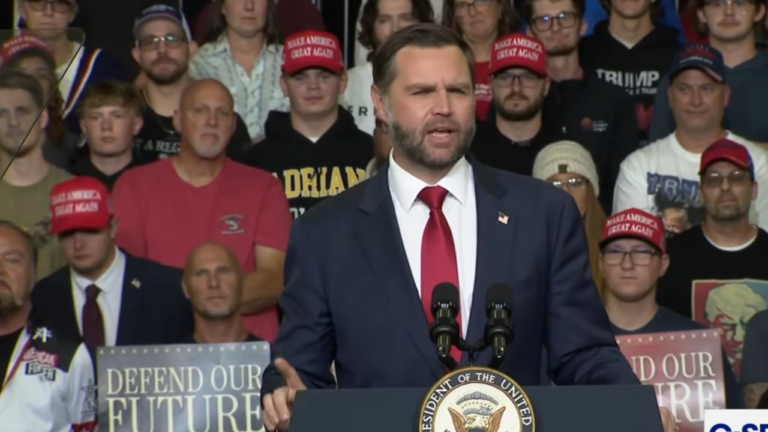
Vice President JD Vance traveled to Michigan on Thursday to campaign for Republican Senate candidate Mike Rogers. But his appearance in Monroe quickly turned into a deeply personal attack on Rogers’ Democratic opponent, Abdul El-Sayed.
And the vice president’s choice of words was anything but subtle.
“You deserve better than a little weasel who should shut his mouth and show a little gratitude to the country that gave him everything,” Vance told the crowd.
The remarks came as Vance attempted to portray the Senate contest as a battle between gratitude and grievance, suggesting that El-Sayed, a Muslim American of Egyptian descent, was insufficiently appreciative of the country he hopes to serve.
At one point, Vance speculated that El-Sayed resented certain American traditions because he viewed them as “too white or too proud or too American.”
It was a striking accusation from a sitting vice president, particularly against a candidate whose campaign has focused heavily on health care affordability, economic inequality, and reducing the influence of money in politics.
El-Sayed, a physician and former Detroit health director, is running on a progressive platform that includes Medicare for All. His campaign slogan is “Money out of politics. Money in your pockets. Medicare for All.”
Yet Vance’s message was that El-Sayed should be grateful rather than critical.
The rhetoric also came against a backdrop of attacks on El-Sayed’s Muslim identity. Rogers has repeatedly raised allegations involving the Muslim Brotherhood, despite reporting from Bridge Michigan finding no evidence of ties between El-Sayed and the organization.
At Thursday’s rally, Rogers again made accusations about El-Sayed and the Muslim Brotherhood while describing his Democratic opponent as an extreme and dangerous candidate.
Vance’s remarks raise a troubling question: Why should an American running for elected office have to prove his gratitude before being allowed to criticize the government?
Disagreeing with the country’s political leadership is not evidence of disloyalty. It is a fundamental part of American democracy.
But in Monroe, the vice president chose to frame his opponent’s criticism as resentment, question his patriotism, and tell him to keep quiet.
For voters deciding who should represent Michigan in the Senate, that language may reveal as much about the Republican campaign as it does about the candidate Vance was attacking.
About the Author