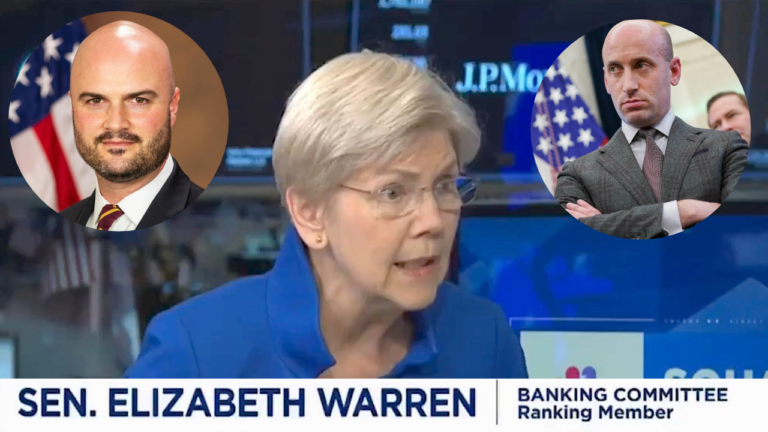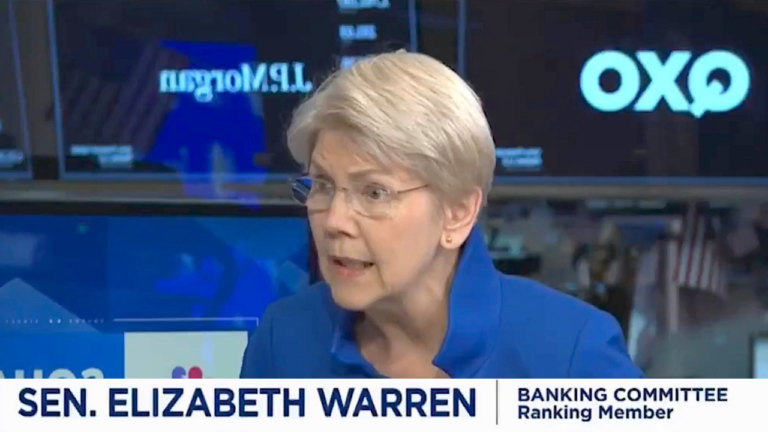
Senator Elizabeth Warren confronted CNBC anchor Sara Eisen during a heated television exchange over President Donald Trump’s emergency powers, pushing back against the suggestion that a Senate vote challenging his authority would ultimately make little difference.
The Massachusetts Democrat, a former Harvard Law School professor, used the interview to explain the constitutional limits on presidential power and the role Congress plays in determining how that power can be exercised.
The confrontation began when Warren discussed a Senate vote challenging the emergency declaration Trump had used to justify expanded executive authority.
Warren welcomed the development as an important sign that lawmakers were willing to challenge the administration.
“First crack in the wall,” Warren said. “We got four Republicans who crossed the aisle that gave us a majority.”
But Eisen questioned the practical significance of the vote.
“But it ultimately doesn’t matter,” the CNBC anchor responded.
Warren immediately challenged that assessment.
“What do you mean it ultimately doesn’t matter? This is the law.”
Eisen continued by arguing that the vote had not changed Trump’s policy and that the president still possessed the authority to act.
Warren rejected the idea that presidential emergency powers existed independently of congressional oversight.
“Well, no. He does not. That’s the whole point,” Warren replied. “He does not have the authority if Congress does not let him keep this authority. We can take this away. He has declared an emergency. That’s what gives him the authority. Otherwise it belongs to Congress.”
The disagreement centered on an important constitutional distinction: the difference between a president exercising authority delegated by Congress and possessing unlimited power to act without legislative restrictions.
Emergency declarations can activate special statutory powers, but those powers remain subject to the legal framework established by Congress.
A Senate vote alone does not necessarily terminate an emergency declaration. Under the National Emergencies Act, ending a declaration through a congressional resolution generally requires approval by both chambers and either presidential approval or sufficient votes to override a veto.
Warren’s broader argument was that Congress retains the constitutional authority to legislate and place limits on executive power.
As the interview continued, she criticized the idea that presidential declarations should automatically settle questions of legality.
“Instead of just mouthing off about what you think is happening, actually present some evidence,” Warren said. “Let’s let the other side come in and question that evidence. But you don’t just get to lip off and say, and therefore the king gets to wave his magic wand and say, off with your head.”
The exchange then shifted to federal spending and the government’s authority to determine how taxpayer money is distributed.
Eisen questioned whether the administration had discretion over where federal funds should go.
Warren responded with a colorful analogy.
“Do you think they have a big bushel basket of money and they just say, you, good-looking, you don’t have money. You, not so good-looking, you’re gonna have to go hungry for a while. That’s not how it works.”
She then turned to a direct explanation of the separation of powers.
“Let’s just do Con Law 101,” Warren said. “Congress writes those laws and allocates that money. The administration’s job is to enforce those laws and spend that money the way the law tells them. And if they fail to do that, part three is the courts are the ones who step in and enforce the law.”
Her explanation outlined the respective responsibilities of the legislative, executive and judicial branches of the federal government.
Congress passes laws and authorizes federal spending. The executive branch implements those laws, while federal courts resolve legal disputes and determine whether government actions comply with the Constitution and applicable statutes.
The disagreement also reflected a broader debate about the scope of executive authority during Trump’s second administration.
Trump has repeatedly relied on executive actions and emergency powers to advance administration policies, prompting disputes over whether particular measures fall within the authority granted to the presidency.
Supporters of expansive executive authority argue that presidents need sufficient flexibility to respond to emergencies and carry out their constitutional responsibilities.
Critics, including Warren, contend that such powers must remain subject to meaningful congressional oversight and judicial review.
The exchange with Eisen brought those competing views into focus.
Eisen emphasized the immediate practical effect of the Senate vote, while Warren focused on Congress’s legal authority to challenge or restrict the president.
Their disagreement demonstrated how questions about executive power can involve both the constitutional rules governing government action and the political realities of enforcing those rules.
For Warren, the central issue was whether Congress would exercise its responsibilities rather than accept the administration’s interpretation of presidential authority.
And her message throughout the interview was that the American constitutional system does not place the president above the laws enacted by Congress.
About the Author