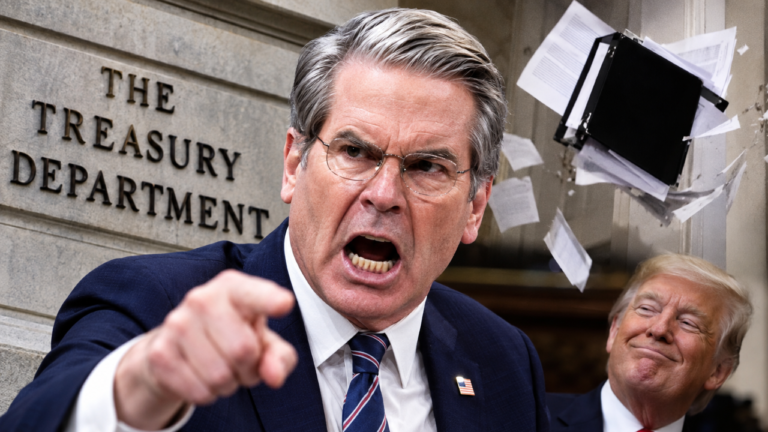
Donald Trump has given himself an “A+” for his administration’s handling of the American economy.
But when CNN’s Kaitlan Collins confronted Vice President JD Vance with the numbers behind that glowing self-assessment, the conversation exposed a fundamental tension in the White House’s economic message.
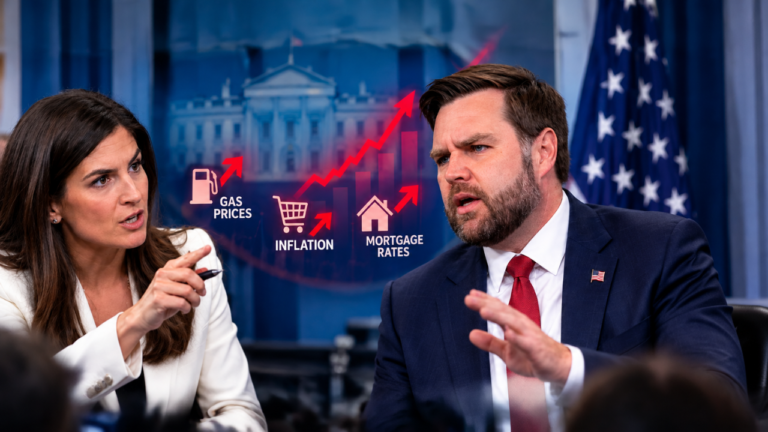
Americans are dealing with higher gasoline prices, persistent inflation, and expensive mortgages. Trump, meanwhile, insists his administration deserves top marks.
Collins wanted to know how those two realities fit together.
And Vance’s response focused heavily on what the administration says will happen next — rather than what Americans are experiencing right now.
Kaitlan Collins Puts Vance on the Spot
During a Thursday news conference, Collins challenged the vice president over Trump’s remarkable economic self-assessment.
With inflation, mortgage rates, and gasoline prices higher than when Trump returned to office, she asked why the administration deserved an A+.
It was a straightforward question about the gap between the president’s rhetoric and the economic pressures facing millions of Americans.
Vance did not directly challenge the figures Collins cited.
Instead, he argued that the administration had inherited what he described as the worst inflation crisis in 48 years.
He then shifted to the administration’s economic agenda, pointing to what he claimed was $19 trillion in new investment and a resurgence in American manufacturing.
Factories, Vance argued, take time to build. Workers take time to hire. The economic benefits of those investments, he suggested, will become clearer in the years ahead.
That was the central problem with his answer.
Collins was asking about the economy Americans are living in today. Vance was defending an economy the administration says it is building for tomorrow.
The Numbers Behind Trump’s A+
The economic data provide important context for Collins’s question.
When Trump took office in January 2025, annual consumer-price inflation stood at 3.0%, according to the Bureau of Labor Statistics.
By August 2026, the latest available official report showed inflation at 3.4%.
Inflation had declined to 2.4% in February before rising sharply amid the economic disruptions associated with the conflict involving Iran.
Those figures do not mean every economic indicator has deteriorated under Trump. But they do challenge the simplicity of his A+ assessment.
The administration has emphasized investment announcements, industrial expansion, and policies intended to strengthen domestic production.
Yet an investment announcement does not immediately lower the price of groceries. A proposed factory does not automatically make a mortgage more affordable.
And promises of future economic growth do little to change the amount families must spend at the gas pump this week.
Gas Prices Add to the Pressure
Gasoline prices have become another significant challenge for the administration.
According to figures cited by Mediaite from AAA, the national average for regular gasoline was approximately $4.40 per gallon around the time of Collins’s exchange with Vance.
Before the February military strikes on Iran, gasoline had been averaging less than $3 per gallon.
The subsequent conflict and disruptions to energy markets have contributed to rising fuel costs.
For Americans who commute to work, operate small businesses, or depend on their vehicles every day, those increases represent an immediate financial burden.
They also complicate the White House’s argument that its economic policies are already delivering exceptional results.
Trump Celebrates. Vance Asks for More Time.
There is another revealing aspect of this exchange.
Trump has repeatedly described his economic record in glowing terms, presenting his administration as a major success.
Vance has adopted a somewhat different emphasis.
While defending the president’s policies, he has acknowledged that economic improvements take time and that Americans remain frustrated by affordability pressures.
The White House maintains that Trump and Vance are advancing the same economic agenda.
But their public explanations highlight a distinction between celebrating accomplishments and asking voters to wait for promised benefits.
That distinction matters when the president is awarding himself the highest possible grade.
Collins Asked About Today. Vance Talked About Tomorrow.
The exchange was not about a complicated economic theory or an obscure government statistic.
It was about a basic question of accountability.
If the president believes his economic performance deserves an A+, how should Americans reconcile that assessment with the costs they encounter in everyday life?
Vance offered an explanation built around investment, manufacturing, and future growth.
Those are legitimate subjects for evaluating economic policy.
But they do not eliminate the question Collins raised about current prices and affordability.
The administration can argue that its policies will deliver better results over time. It can point to investments and defend its long-term economic strategy.
What it cannot do is make the existing affordability debate disappear simply by assigning itself an excellent grade.
Kaitlan Collins asked JD Vance to defend Trump’s A+ economy in the present. His answer was largely about the future. And that gap is precisely why the question matters.
About the Author