Donald Trump’s Treasury secretary Scott Bessent has become one of the most influential figures in the administration.
But behind the scenes, a sweeping investigation by The Wall Street Journal describes a very different side of the man overseeing America’s finances.
According to interviews with more than 30 current and former officials, associates and others familiar with his tenure, Bessent has repeatedly clashed with staff, erupted during meetings and contributed to an atmosphere of tension inside the Treasury Department.
And some of the reported incidents are extraordinary.
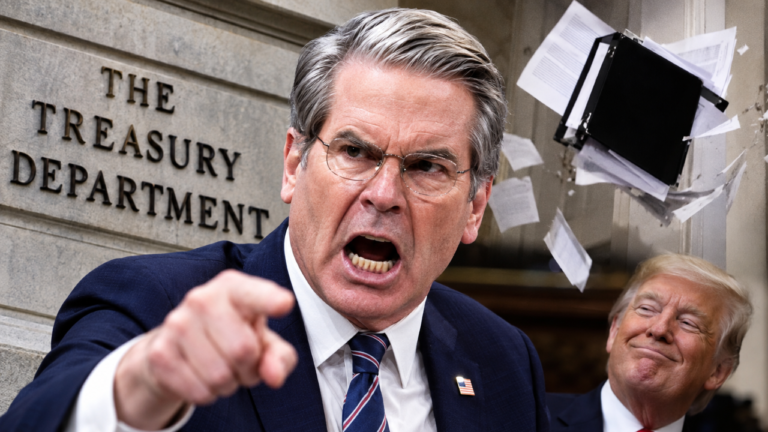
In one episode, Bessent allegedly became so furious about the organization of his daily briefing materials that he picked up a binder filled with papers and threw it against a wall.
Bessent flatly denies that happened.
But the Journal’s investigation describes a much broader pattern of confrontations involving both junior employees and some of the administration’s most senior officials.
One particularly heated episode reportedly unfolded in January, after Trump directed Bessent to investigate allegations of fraud involving Minnesota’s Somali community.
Bessent believed Treasury undersecretary John Hurley wasn’t moving quickly enough.
According to people familiar with the meeting, the secretary confronted Hurley in front of other aides, shouting and using profanity so loudly that employees working nearby could hear the confrontation.
Hurley subsequently left Treasury to become the U.S. ambassador to the Organization for Economic Cooperation and Development.
Hurley has publicly defended Bessent, describing him as a capable and committed member of Trump’s administration.
But the confrontation was far from the only personnel issue described in the investigation.
By the end of August, seven Senate-confirmed Treasury officials had departed. At comparable points in the previous four administrations, the number ranged from zero to two.
The Journal reported that Bessent’s behavior contributed to several departures, sometimes becoming the central reason officials decided to leave.
Some employees reportedly began checking with colleagues about the secretary’s mood before approaching him. Others exchanged advice about how to avoid confrontations when he was angry.
His reputation also reportedly complicated efforts to recruit replacements for important positions.
And the clashes haven’t been limited to Treasury employees.
Bessent reportedly became involved in a heated confrontation with Elon Musk in the West Wing during a disagreement involving the Internal Revenue Service. The two men had to be separated.
He also reportedly threatened Federal Housing Finance Agency Director Bill Pulte during a private dinner in September 2025.
But perhaps the strangest allegation in the Journal’s report concerns an encounter at a Washington restaurant.
In December, protesters from the activist group Code Pink confronted Bessent while he was dining, criticizing the Trump administration’s economic sanctions.
According to the restaurant owner and another diner, Bessent became angry with the owner for failing to remove the demonstrators.
Then, in an extraordinary reported moment, he spat into his own food before leaving.
The incident adds an unusual public dimension to allegations that have largely centered on his conduct behind closed doors.
Meanwhile, Trump has reportedly embraced Bessent’s combative reputation.
The president has praised his Treasury secretary’s influence and encouraged him to take on increasingly important economic responsibilities.
During an April event in Nevada, Trump even joked about the transformation.
“I created a monster,” the president said.
That remark has taken on a new significance following the Journal’s account.
Bessent’s defenders, however, reject the suggestion that his demanding approach represents a management failure.
A Treasury spokesman said the secretary approaches his responsibilities with urgency and holds the department to high standards.
The White House also praised the professionalism and accountability it says Bessent has brought to Treasury.
And Bessent himself has now responded publicly.
Appearing Wednesday night on Fox News with Laura Ingraham, he rejected the binder allegation outright.
“Absolutely not,” he said when asked whether he had ever thrown a binder at a wall.
He then attacked the newspaper behind the investigation.
“The Wall Street Journal is a shadow of its former self,” Bessent declared.
The secretary also disputed the picture of widespread dissatisfaction, claiming that the report placed too much emphasis on a small number of unhappy former employees.
He described himself as a demanding but fair boss and pointed to the long hours Treasury staff are working as the administration handles major economic and international challenges.
Those challenges are substantial.
Bessent is helping oversee Trump’s economic agenda amid concerns about inflation, government borrowing costs, federal debt and the economic consequences of the war with Iran.
The Journal’s investigation also examined the administration’s progress toward the ambitious economic targets Bessent promoted when he entered office.
His so-called 3-3-3 agenda called for stronger economic growth, a sharply reduced federal deficit and a major expansion of American oil production.
According to the newspaper’s analysis, those goals remain largely unmet.
The White House nevertheless continues to stand behind Bessent, and Trump has given no indication that the allegations have weakened his confidence in the Treasury secretary.
The dispute now presents two sharply different portraits of the same official.
The administration describes an effective, demanding leader working under enormous pressure.
The Journal’s reporting describes a department struggling with turnover, internal confrontations and employees who sometimes fear approaching their boss.
And with the secretary now publicly challenging the investigation, the controversy has moved beyond anonymous accounts of what happens inside Treasury.
It has become a very public argument about how one of the most powerful officials in the Trump administration runs his department — and what kind of workplace the administration considers acceptable.
About the Author