
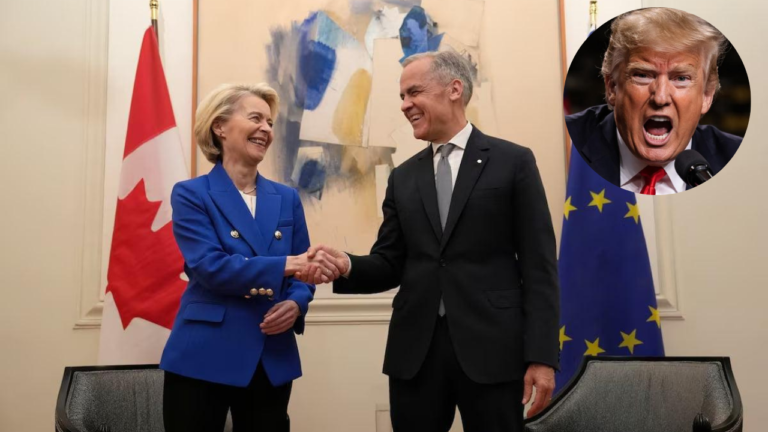
Canada’s rapidly changing relationship with the United States has taken another extraordinary turn, with European Commission President Ursula von der Leyen proposing an unprecedented new relationship that could make Canada the European Union’s first-ever “associate member.”
The proposal was delivered with Canadian Prime Minister Mark Carney sitting nearby during von der Leyen’s State of the European Union address in Strasbourg.
“I would like to work with you on opening the door for Canada being the first associate member of the EU,” von der Leyen told Carney.
European lawmakers responded with enthusiastic applause.
It was a remarkable moment between two longtime Western partners — and another sign of just how quickly Canada’s international relationships are evolving amid its escalating tensions with President Donald Trump.
The proposed arrangement would not make Canada a full member of the European Union.
In fact, “associate membership” does not currently exist as a formal status under EU treaties. Von der Leyen is effectively proposing the creation of something new, and exactly what rights, obligations and economic benefits it would eventually include remains to be negotiated.
But both sides are already making clear that their ambitions extend far beyond their existing trade relationship.
Canada and the European Union currently operate under CETA, their comprehensive free-trade agreement. Von der Leyen is proposing that the two sides build beyond that framework toward what she described as an “Alliance for the Future.”
The areas under discussion are sweeping.
Canada and Europe are looking at deeper cooperation in critical minerals, defense production, artificial intelligence and computing, energy security, space, financial services and digital trade.
Von der Leyen stressed that the emerging partnership should not be interpreted simply as an alliance directed against another country.
“This is a partnership not against anyone else, but for our common strength,” she said.
But the deteriorating relationship between Ottawa and Washington forms an unavoidable backdrop.
Trump’s tariffs, economic demands and repeated remarks about Canada becoming America’s “51st state” have helped push Carney’s government toward reducing Canada’s heavy dependence on the United States and developing deeper relationships elsewhere.
Roughly 70% of Canadian exports currently go to the United States, making the American market enormously important to Canada’s economy.
Carney has increasingly argued that Canada needs greater strategic autonomy.
And on Thursday, addressing the European Parliament himself, the Canadian prime minister enthusiastically embraced the broader vision behind von der Leyen’s proposal.
“Europe and Canada are each strong. Europe and Canada are even stronger together,” Carney said.
He emphasized that Canada was not trying to build another superpower bloc to compete with Washington and Beijing.
Instead, he said Canada wanted resilience so that no country could control its markets, undermine its sovereignty or threaten its democratic institutions.
Carney also made clear that Canada is not seeking full EU membership.
Even the precise label for the new relationship appears less important to him than what the two sides ultimately agree to do together.
But the message from Ottawa was unmistakable: Canada intends to decide for itself which international partnerships it pursues.
That became particularly significant after Trump responded to von der Leyen’s proposal with another tariff threat.
Trump said that if he considered Canada’s potential associate relationship with Europe a “hostile act,” his administration could impose very serious tariffs or halt some categories of trade with Europe.
“If it’s a good intention, that’s fine,” Trump told reporters. “If it’s a bad intention, we’ll put very heavy tariffs on Europe.”
European officials pushed back.
The European Commission reiterated that the proposal was not directed against the United States or anyone else, while French Europe Minister Benjamin Haddad argued that Washington does not get to determine Europe’s geopolitical choices.
Carney was similarly firm when reporters asked about Trump’s reaction.
He said Canadians would not allow another country to dictate their culture or determine whom Canada is permitted to make international agreements with.
For now, enormous questions remain.
Von der Leyen’s “associate member” concept would need to be developed into something concrete, and Reuters reported that EU diplomats themselves have raised questions about exactly what the unprecedented status would mean. Any proposal would also need political support from EU member states.
That makes it far too early to describe Canada as an EU associate member — much less to predict precisely how such an arrangement would reshape trade between Canada, Europe and the United States.
But the political significance of the proposal is already clear.
The president of the European Commission publicly opened the door to an unprecedented relationship with America’s closest northern neighbor.
Canada’s prime minister welcomed the ambition behind it.
And the American president responded by threatening additional economic consequences if he decides the relationship is hostile to the United States.
Whatever final form the Canada-EU alliance takes, a relationship that would have sounded extraordinary only a short time ago is now being openly negotiated at the highest levels of government.
About the Author


I am an American and I stand with Canada, because the USA, elected a brainless idiot as its Leader. TRUMPIE is also a bully, and doesn’t
know a lot about anything, other than causing problems with whoever he can. Trump want everyone to do as this Idiot wants. Hang in there Canada we love you.