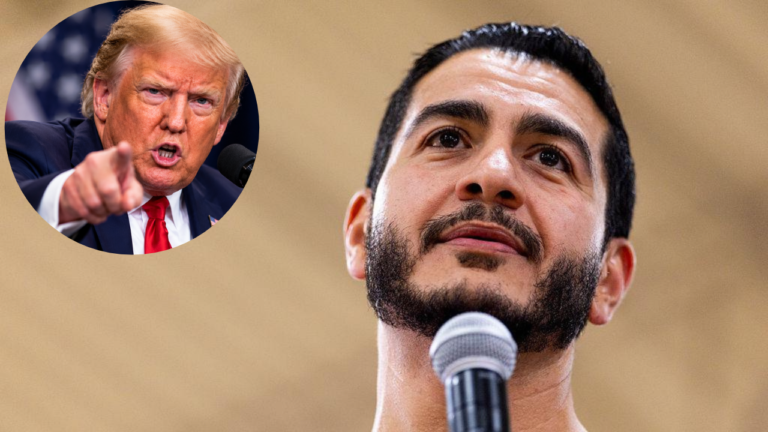
Michigan Democratic Senate candidate Abdul El-Sayed turned President Donald Trump’s repeated remarks about his name into a joke about grocery prices during a campaign rally, drawing laughter as he addressed the president’s latest nickname for him.
Speaking to supporters in the final days before the November 3 election, El-Sayed criticized Trump and Vice President JD Vance for focusing on his name and Muslim identity rather than the economic concerns facing Michigan voters.
El-Sayed said Trump seemed unable to settle on what to call him, alternating between Abdul and Muhammad before introducing a new nickname: “Abdul Ramadan.”
Ramadan is the Islamic holy month during which Muslims fast from dawn until sunset. El-Sayed used that reference to make a point about the rising cost of food.
He joked that grocery prices had become so expensive that Trump’s answer might simply be to have Americans fast instead of buying food.
The remark drew laughter from the audience as El-Sayed imagined people explaining that they were skipping meals because they could not afford groceries.
But the exchange was about more than a joke.
Trump has repeatedly singled out El-Sayed during campaign appearances, referring to his Muslim identity and questioning whether he should be allowed to serve in the Senate.
During an October 27 appearance, Trump called him “Abdul Ramadan” and suggested that the Michigan Democrat should be subjected to a metal detector test before entering the Senate.
El-Sayed responded to that suggestion with another challenge: he would agree to go through a metal detector if Trump agreed to take a lie detector test.
He proposed asking the president about Jeffrey Epstein and the outcome of the 2020 election.
The exchanges have become a recurring feature of Michigan’s Senate contest, where El-Sayed is facing Republican Mike Rogers.
El-Sayed has argued that the personal remarks are an attempt to divert attention from the administration’s economic and foreign policies, including the war with Iran, tariffs and healthcare.
He has also emphasized that his name and religious background should not determine whether voters consider him qualified to represent Michigan.
In another campaign appearance, El-Sayed offered a final response to Trump’s repeated difficulty with his name.
He said he was not particularly concerned about whether the president ever learned to pronounce it correctly. What mattered, he argued, was whether Trump would eventually have to address him as “Senator.”
With Election Day approaching, the dispute has become part of a larger argument over identity, political rhetoric and the issues voters expect their elected officials to address.
About the Author