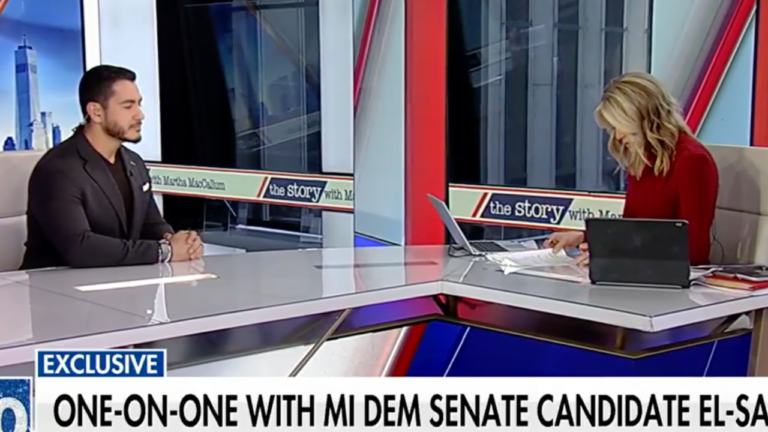
Michigan Democratic Senate candidate Abdul El-Sayed went into Fox News on Monday and found himself in an extended, contentious debate with host Martha MacCallum over terrorism, the Iran war and whether America’s repeated military interventions have actually made the country safer.
And at several points, El-Sayed stopped simply answering questions and began challenging the premise behind them.
The nearly 12-minute interview on The Story began with MacCallum pressing El-Sayed over previous comments about terrorism.
El-Sayed was unequivocal that victims of terrorism are never responsible for the attacks against them.
“The victim is never at fault, and terrorism is wrong no matter who perpetrates the terrorism, who it is perpetrated against,” he said.
But El-Sayed then broadened the conversation to American foreign policy — particularly the ongoing war with Iran.
“Why are we fighting this war, to what end?” he asked. “Who benefits from it? Why did we do this? What are we paying for it?”
MacCallum pushed back, arguing that Iran had posed a major threat in the region.
El-Sayed responded by pointing to the Obama-era Iran nuclear agreement and arguing that Donald Trump’s decision to abandon that agreement helped create the conditions that eventually led to another war.
Then he challenged the underlying argument directly.
Does more war actually make Americans safer?
That question became the center of the increasingly heated exchange.
El-Sayed pointed to the enormous financial and human costs of America’s wars and invoked Iraq as an example of an intervention whose consequences lasted for decades.
“We spent trillions of dollars,” he said.
MacCallum repeatedly challenged him on what the United States should have done instead to protect its national security.
But El-Sayed kept returning to Iraq and Iran.
“Can you answer my question?” he asked at one point as the two talked over one another.
He argued that Americans had already paid for previous wars through lost lives and enormous government expenditures — and were now paying again through higher energy and grocery costs associated with the current conflict.
MacCallum countered by bringing up Afghanistan and the September 11 attacks.
El-Sayed agreed that the United States had been attacked, but emphasized that his argument was about Iraq — a separate war launched afterward.
The conversation then returned to Iran.
MacCallum insisted that she was not advocating for more war, but arguing that the United States has an obligation to defend its national security.
El-Sayed challenged her again.
His question was straightforward: Does another war ultimately create fewer threats to the United States — or more?
“We’re in a situation right now where we could have chosen peace,” El-Sayed said elsewhere in the interview. “And instead we chose war.”
He connected the conflict directly to the economic argument at the center of his Michigan Senate campaign, pointing to energy prices and the disruption of oil and gas movement through the Strait of Hormuz.
For El-Sayed, that is the political connection between foreign policy and kitchen-table economics.
He argued that Michigan voters — including some who supported Trump because of his “America First” promise — expected fewer overseas conflicts, not another prolonged war.
The appearance was notable for another reason.
El-Sayed wasn’t making that case on MSNBC or before a friendly Democratic audience.
He was making it directly to Fox News viewers while MacCallum challenged him in real time.
And the interview apparently attracted attention well beyond Fox’s audience.
A day later, Trump himself publicly attacked Fox News over its coverage of Senate races and specifically complained about the network giving airtime to El-Sayed.
That creates an unusual political sequence: a Democratic Senate candidate went onto Fox, openly challenged the network’s host over the Iran war — and by the following day, the president was publicly complaining that Fox had put him on television in the first place.
About the Author