Donald Trump’s presidential pardon power has created something most Americans probably never imagined: a lucrative world of consultants and political operatives charging enormous sums to people desperate to get their cases in front of the president.
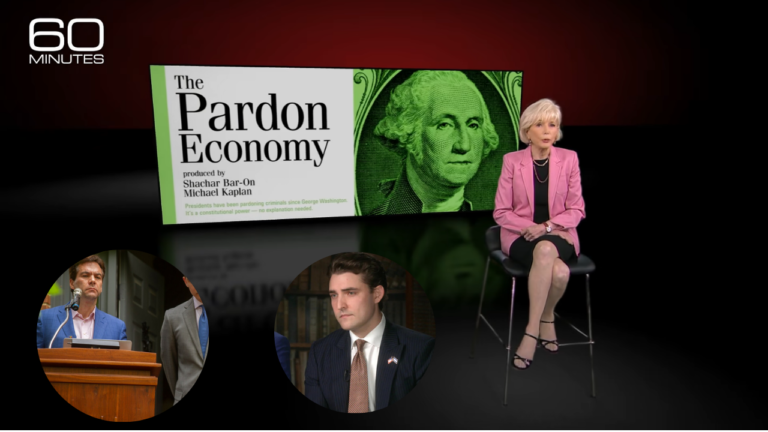
Now “60 Minutes” has taken a hidden camera directly inside that world.
And what its reporters captured is remarkable.
The CBS News program went undercover to investigate the growing business surrounding Trump pardons, documenting political operatives pitching convicted felons on strategies they claimed could help get their cases before the president.
One proposed price?
$300,000.
And incredibly, that wasn’t even the biggest number uncovered by the investigation.
(Watch The Video Below)
‘We Pressure Him From All Directions’
At the center of the hidden-camera portion of the investigation were conservative political operatives Jack Burkman and Jacob Wohl.
The pair have been involved in Republican politics for years and previously pleaded guilty in Ohio to telecommunications fraud stemming from a robocall operation that targeted predominantly Black neighborhoods ahead of the 2020 election.
For its investigation, “60 Minutes” worked with Ammon Covino, a convicted felon who had previously sought clemency through the traditional Justice Department process.
Covino approached Burkman and Wohl as someone interested in getting a presidential pardon.
The cameras were rolling.
According to CBS, the pair described a strategy designed to get Covino’s case noticed by people around Trump and ultimately by the president himself.
At one point, Burkman described the approach bluntly.
The idea, he explained, was essentially to put pressure on Trump “from all directions.”
Then came the price.
$300,000.
So What Does $300,000 Buy?
This is where the story gets even more extraordinary.
The pitch wasn’t that Burkman or Wohl personally possessed the legal power to grant a pardon. They obviously don’t. Under the Constitution, that authority belongs to the president for federal offenses.
Instead, the money was supposed to fund an influence campaign designed to get Covino’s name and case in front of Trump.
According to the “60 Minutes” investigation, the proposed strategy could involve paying for access to events, bringing influencers into the effort and generating enough attention around the case that it would eventually reach people close to the president.
Covino said the pitch included attending events at Mar-a-Lago and purchasing tickets to political fundraisers.
The underlying message was simple:
Spend enough money building attention and access around your case, and perhaps the right people will notice.
But “60 Minutes” discovered that $300,000 was far from the ceiling.
CBS reported finding pardon brokers seeking fees reaching as high as $3 million.
(Watch The Video Below)
Then ‘60 Minutes’ Found Someone Who Actually Paid
The undercover encounter could have been dismissed as nothing more than an expensive sales pitch.
Then CBS spoke with rapper Boosie Badazz, whose legal name is Torence Hatch.
His story took the investigation to another level.
Boosie told Lesley Stahl that he paid $600,000 upfront to Burkman’s firm as part of an effort to obtain a Trump pardon.
Six hundred thousand dollars.
According to Boosie’s account, he came away believing that if he paid the money, he would ultimately receive the pardon he wanted.
It didn’t happen.
Trump did not pardon him.
Boosie subsequently sought the return of $300,000, while Burkman’s firm disputed his version of their agreement and denied that it had guaranteed him a pardon.
That distinction matters.
There is no evidence presented by “60 Minutes” that Donald Trump personally received any of this money, nor did the investigation establish that Trump authorized Burkman, Wohl or anyone else to sell pardons on his behalf.
But that’s precisely what makes the broader system uncovered by CBS so fascinating.
People appear willing to spend extraordinary amounts simply for the possibility of getting their case close enough to Trump’s orbit to be noticed.
The White House Says Don’t Believe the Brokers
Trump’s own pardon operation pushed back sharply against the idea that expensive middlemen are necessary.
Ed Martin, Trump’s pardon attorney, told “60 Minutes” that people seeking clemency don’t need to spend enormous amounts of money on consultants claiming special access.
Martin dismissed some people operating in the pardon business as “snake oil salesmen.”
The White House has also rejected suggestions that paying politically connected intermediaries guarantees access to Trump or a favorable clemency decision.
And that’s an important piece of this story.
“60 Minutes” did not catch Trump selling pardons.
It caught people operating around the political ecosystem surrounding his pardon power charging staggering amounts while claiming they could help clients get noticed.
Those are two very different things.
But the second one raises plenty of questions on its own.
A Pardon Economy Has Emerged
(Watch The Video Below)
Presidential pardons have always attracted lawyers and lobbyists.
What’s unusual about the world documented by “60 Minutes” is the sheer amount of money now circulating around the possibility of getting Trump’s attention.
For an ordinary American seeking clemency through the Justice Department, the process involves paperwork, review and waiting.
For wealthy applicants, another route appears to have emerged alongside it:
Hire people who claim they know how to get noticed.
Buy access to events.
Generate political pressure.
Recruit influential voices.
Get the case into Trump’s orbit.
And hope the president eventually sees it.
Whether any particular strategy actually works is another question entirely.
Boosie’s experience demonstrates the obvious risk.
He says he paid $600,000.
He still didn’t get his pardon.
And the Cameras Were Rolling
That’s ultimately what makes the “60 Minutes” investigation so powerful.
This isn’t based solely on anonymous sources describing what happens behind closed doors.
CBS put someone inside the process.
Hidden cameras captured the pitch.
Americans can hear political operatives describe how they believed a pardon campaign could be built — and hear the enormous price attached to it.
Again, none of this proves Trump is personally selling pardons or taking money in exchange for clemency.
But it does reveal an extraordinary marketplace that has developed around one of the most sweeping powers of the presidency.
When access to a president becomes valuable enough, people will inevitably try to sell the belief that they possess it.
And according to what “60 Minutes” uncovered, that belief can carry a price tag of hundreds of thousands — even millions — of dollars.
The question for anyone considering paying it is much simpler:
Are they buying influence — or just an extraordinarily expensive promise?
Source: CBS News / 60 Minutes — full investigation and transcript
About the Author