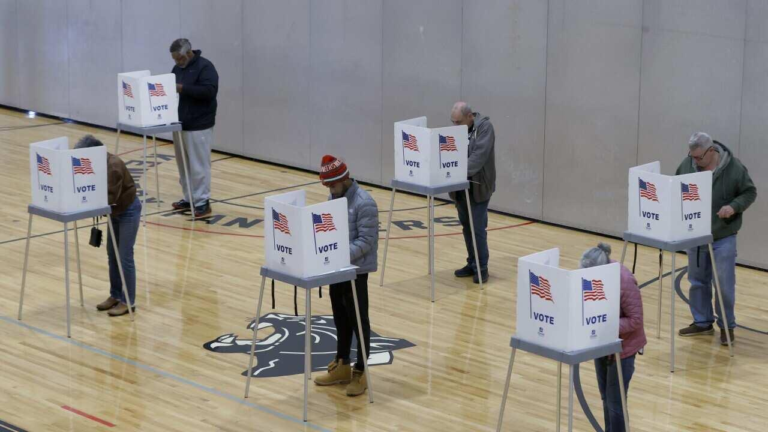
A congressional election forecasting model developed by researchers affiliated with Harvard University has produced striking projections for both chambers of Congress as Americans vote in the November 3, 2026, midterm elections.
The ElectIt model, developed by Danny Ebanks, Jonathan N. Katz and Gary King, estimated a 96.2% probability of Democrats winning control of the House of Representatives and a 78.6% probability of Democrats securing a Senate majority in its election-eve snapshot.
The forecast projected approximately 242 Democratic seats in the House and 53 in the Senate, compared with the 218 House seats and 51 Senate seats generally required for outright majorities.
Those figures are statistical projections, not actual election returns.
The House estimate would represent a substantial change from Republican control, while the Senate projection would represent a shift in a chamber where Republicans entered the election holding a majority.
The researchers used a statistical framework called LogisTiCC, which draws on historical election outcomes, incumbency, candidate characteristics and polling information to estimate possible results.
Their project provides multiple forecasting approaches, including a model based on information available before the campaign, one incorporating national polling, and another incorporating district- and state-level surveys.
The researchers also emphasized the importance of uncertainty when interpreting their forecasts.
Even an outcome assigned a relatively small probability can occur. Their House projection, for example, did not eliminate the possibility of Republicans retaining control.
To illustrate the size of that remaining possibility, the researchers compared a Republican House victory with rolling a particular number on a twenty-sided die.
The model also examines how polling errors could alter the results.
In one scenario, if national polling proved largely accurate, the researchers described a House outcome of roughly 240 Democratic seats and a Senate result in the low 50s.
In another, a polling error favoring Republicans would produce a narrower House result while making the Senate considerably more competitive.
A larger polling error could produce an outcome substantially different from the central forecast.
That uncertainty matters because election forecasts are not measurements of votes already cast. They are estimates generated from available evidence and assumptions about how voters will behave.
The forecast has attracted attention because control of Congress will determine which party holds key committee leadership positions and oversight powers.
A Democratic House majority would allow Democratic lawmakers to lead House committees and potentially initiate investigations into executive-branch decisions, government spending and the financial activities of administration officials.
Control of the Senate would also affect committee leadership, nominations and the legislative agenda.
However, winning a congressional majority would not automatically compel the release of every government document, establish wrongdoing by administration officials or guarantee the passage of legislation.
Congressional investigations require legal procedures, while legislation generally must pass both chambers and be presented to the president, subject to constitutional exceptions.
The ElectIt forecast therefore provides one detailed statistical assessment of the congressional landscape rather than a definitive account of what Election Day will produce.
Its projections can be compared with polling, other forecasting models and, ultimately, certified election results.
The researchers have made their methods and underlying data publicly available, allowing observers to examine the assumptions behind the estimates.
As votes are counted across the country, the central question will shift from what statistical models projected to what voters actually decided.
About the Author