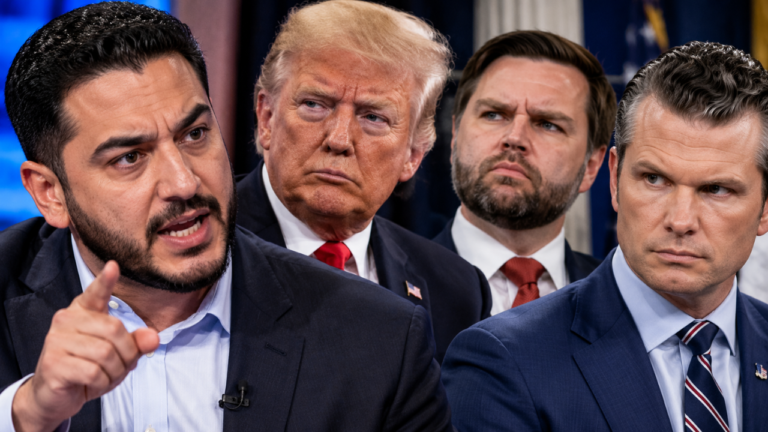
Michigan Democratic Senate candidate Abdul El-Sayed delivered a blistering assessment of Donald Trump and his administration during an interview with comedian Hasan Minhaj, attacking the president’s intelligence, Vice President JD Vance’s character and Defense Secretary Pete Hegseth’s leadership.
El-Sayed, a physician and former public health official, argued that some of the most powerful people in Washington rely on bullying and intimidation to compensate for their own weaknesses.
And he did not hold back when the conversation turned to Trump.
“Donald Trump is an idiot,” El-Sayed told Minhaj.
He acknowledged that Trump possesses one particular political talent: an extraordinary ability to command public attention. But he argued that the president’s success at attracting attention should not be mistaken for intelligence or competence.
“Whatever you think about him, he has one genius, which is the genius of getting attention, which is because, you know, his dad never gave him enough,” El-Sayed said.
He went on to describe Trump as a privileged figure whose wealth and upbringing allowed him to turn a desire for attention into a political strategy.
“And so he, because he was a nepo baby, because he had resources, realized quickly that he just craved attention and then used the bullying tactics that he uses right now to get it,” El-Sayed continued.
Then came his blunt conclusion.
“But the man is an idiot. I mean, just when it comes down to it, like just a fool.”
The criticism was El-Sayed’s personal assessment, rather than an objective finding about Trump’s intelligence or psychological motivations.
But the Michigan Democrat was far from finished.
Turning to JD Vance, El-Sayed offered a different criticism, arguing that the vice president’s problem was not a lack of intelligence but a willingness to subordinate himself to Trump.
“JD Vance is a smart person, but he has no actual soul and he has no actual charisma,” El-Sayed said.
“And so his thing is just to suck up to the strongest person in the room to do their bidding.”
The remarks were especially pointed given Vance’s own political history.
Before becoming one of Trump’s most prominent allies, Vance was publicly critical of the man he would eventually serve as vice president. His transformation from Trump critic to loyal defender has remained a recurring target for Democrats.
El-Sayed’s argument was that Vance’s political choices reflect a willingness to accommodate power rather than challenge it.
He also singled out Defense Secretary Pete Hegseth, describing him as one of the “mini fool bullies” surrounding Trump.
El-Sayed characterized the administration’s leadership as a “whole coterie of the dumbest people or the most cowardly people,” suggesting that the qualities rewarded within Trump’s circle are loyalty and intimidation rather than independent judgment.
The broader point of his criticism was about the use of fear in politics.
El-Sayed argued that powerful figures often appear intimidating only because others are reluctant to challenge them.
“If you ever stood up to a bully, you realize that they’re very fragile,” he said.
“Once you get past the immediate bullying and the fear that they strike in people,” he continued, their influence begins to weaken.
He also made clear that he sees confronting that behavior as a responsibility rather than an invitation to intimidate others.
“I’m not looking to bully anybody, but if you’re walking around bullying people and you are causing them harm as a function of it, I’m going to show up and I’m going to do exactly what you do to everybody else.”
The exchange came during El-Sayed’s campaign for Michigan’s U.S. Senate seat, where his outspoken progressive politics have made him a prominent voice in the Democratic contest.
His comments also followed a sharp attack from Vance, who had recently described El-Sayed as “a little bit of a psychopath” while campaigning in Michigan for Republican Senate candidate Mike Rogers.
That confrontation added another layer to El-Sayed’s remarks about the vice president and the administration’s political culture.
For El-Sayed, the issue was not simply whether Trump, Vance or Hegseth deserved the insults he directed at them.
He was making a broader argument about leadership — that people who project strength through threats and personal attacks may be concealing weaknesses that become apparent when someone challenges them.
Trump has long presented himself as a decisive leader who surrounds himself with talented people. El-Sayed offered an entirely different picture, portraying an administration in which deference to the president matters more than courage or independent thinking.
His language was deliberately provocative, and his assessments of the three officials remain political opinions rather than established facts.
But the interview left little doubt about his message.
El-Sayed believes Trump’s political power depends heavily on the willingness of others to be intimidated.
And he wants Americans to stop giving that intimidation the power he says it does not deserve.
About the Author