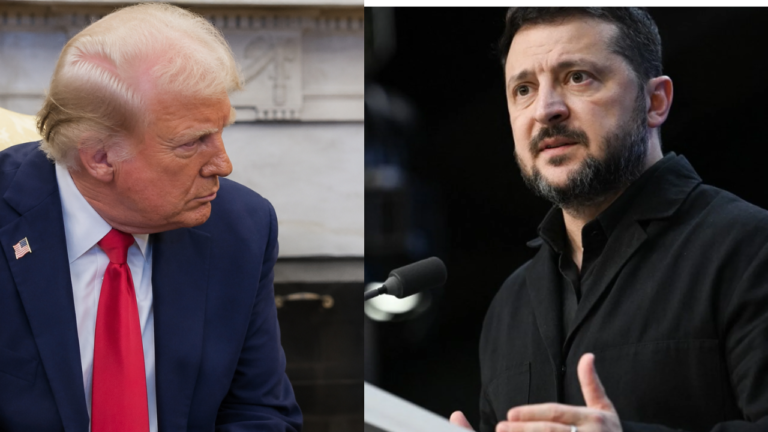
Ukrainian President Volodymyr Zelensky has revealed that he presented Washington with three possible ways to persuade Ukraine to halt its attacks on Russian oil refineries — but says the United States has delivered none of them.
And his explanation for why Ukrainian strikes are continuing was unmistakable.
“We are fighting for our lives.”
In an interview reported by the Kyiv Post, Zelensky described growing tensions over Ukraine’s campaign against Russian energy infrastructure, a strategy intended to weaken Moscow’s ability to finance its war.
Donald Trump has pressured Ukraine to stop attacking Russian refineries amid concerns about global energy prices and the broader economic consequences of the conflict.
But Zelensky argues that asking Ukraine to stop striking Russian targets without providing meaningful protection against Russian attacks would leave his country dangerously exposed.
He outlined three alternatives.
The first was an energy truce.
Under that arrangement, Russia would stop attacking Ukraine’s power infrastructure, and Ukraine would suspend its strikes against Russian energy facilities.
“That is fair,” Zelensky said.
The proposal reflects a central Ukrainian objection to calls for restraint: Kyiv does not believe it should unilaterally stop attacking Russian infrastructure while Moscow continues targeting Ukraine’s electricity supply.
The second proposal involved expanding Starlink coverage over Russian territory to help Ukrainian forces identify and strike ballistic missile launchers.
Zelensky said the Trump administration had indicated that Elon Musk did not want to provide the necessary coverage.
That account has not been independently confirmed by Musk, and it remains unclear what technical, operational or policy restrictions would apply.
The third option was more direct: provide Ukraine with additional missiles for its American-made Patriot air defense systems.
Unlike the Starlink proposal, Zelensky argued, this option would not depend on either Musk or Russian President Vladimir Putin.
Patriot interceptors are particularly important to Ukraine’s defenses against ballistic missiles, which can be difficult to stop with other systems.
But Ukraine has struggled to secure enough interceptors as demand for advanced air defense weapons has increased across multiple conflicts.
According to Zelensky, none of the three requested measures had been delivered.
“Ukraine had received none of the three proposed forms of support,” he said, explaining why Kyiv had not agreed to halt its refinery campaign.
“That is why the reaction is what it is. We are fighting for our lives.”
The Ukrainian president also challenged the argument that his country’s attacks were primarily responsible for higher global fuel prices.
He said Russia accounted for only a small share of global diesel exports and argued that the broader market had other sources of supply.
That claim should be treated as Zelensky’s economic argument rather than a definitive assessment of the attacks’ market impact. Oil and refined-product prices depend on several factors, including shipping disruptions, supply expectations and regional refinery capacity.
The disagreement comes as Trump’s administration faces questions about its approach to Moscow and the future of Western sanctions.
Zelensky warned against lifting sanctions on Russia merely to persuade Putin to participate in negotiations.
Sanctions, he argued, were imposed in response to Russian aggression, not as a reward for agreeing to talks.
He cautioned that removing restrictions prematurely could leave Ukraine without leverage, especially after the substantial diplomatic effort required to establish successive sanctions packages.
“I do not want us to find ourselves without any leverage,” he said.
His warning comes amid criticism of Washington’s decisions to ease certain restrictions affecting Russian energy trade.
For Ukraine, the concern is straightforward: If sanctions are relaxed before Russia makes meaningful concessions, Moscow could receive economic benefits without changing its military strategy.
Meanwhile, diplomatic contacts have continued.
According to the Kyiv Post account, an American delegation traveled to St. Petersburg after discussions in Oslo and subsequently briefed Ukrainian officials.
A broader meeting involving Ukraine, the United States, the European Union and NATO was also being planned in Brussels.
But the dispute over refinery strikes underscores how difficult those negotiations remain.
Washington is seeking ways to reduce the economic consequences of the conflict and encourage a negotiated settlement.
Kyiv insists that any reduction in Ukrainian military pressure must be accompanied by concrete protections against Russian attacks.
Zelensky’s account presents the administration with a difficult question: If Washington wants Ukraine to stop striking Russian energy facilities, what will it provide to protect Ukrainian cities and infrastructure in return?
The White House had not provided a response to the specific claims in the interview at the time of the original report.
And although Zelensky says none of his three proposed measures has been delivered, that does not establish that Trump personally rejected each one.
The distinction matters.
What is clear is that Ukraine’s president is publicly challenging the idea that his country should make a unilateral concession while Russian attacks continue.
He has offered Washington three possible paths toward reducing those strikes.
Until one produces a meaningful result, Zelensky’s message is that Ukraine intends to keep defending itself — including by targeting the infrastructure that helps sustain Russia’s war.
H/T: Kyiv Post
About the Author