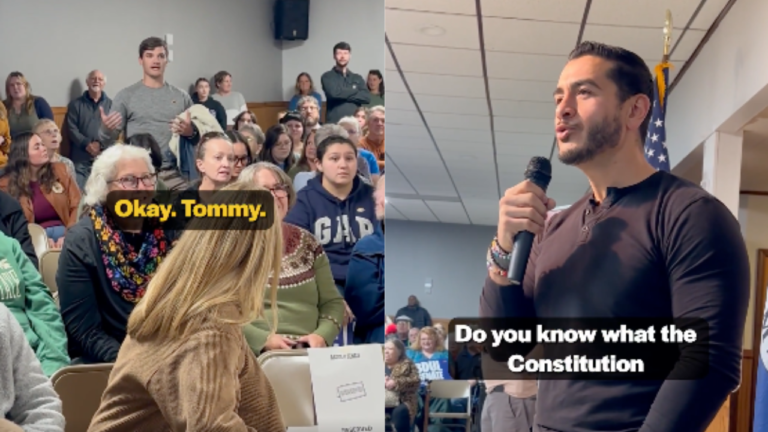
Michigan Democratic Senate candidate Abdul El-Sayed turned a hostile question about his Muslim faith into a powerful defense of the Constitution at a campaign town hall Saturday — and the confrontation became even more revealing when the man questioning him was identified as a former Republican Senate staffer.
The exchange began when a man who introduced himself as Tommy demanded to know whether El-Sayed would disavow the Muslim Brotherhood.
El-Sayed didn’t hesitate.
“Yeah, absolutely,” he answered.
But rather than allowing the exchange to end there, the Democratic candidate wanted to know why the question had been directed at him in the first place.
“Do you assume that I wouldn’t?” El-Sayed asked.
“Yes,” Tommy replied.
“Why not?”
“Because I have not heard you disavow them yet,” the man answered.
El-Sayed immediately turned the question around, asking whether Tommy himself had ever been required to make the same declaration.
Then he addressed what he saw as the underlying assumption: that his Muslim identity made his loyalty to the United States suspect.
He challenged the man to explain why he believed a Muslim candidate might place religious allegiance above the American Constitution.
The confrontation soon became a history lesson.
El-Sayed reminded the audience of John F. Kennedy’s 1960 presidential campaign, when the future president faced questions about whether his Catholic faith would make him answerable to the Pope rather than the American people.
Kennedy rejected that premise, arguing that his religious identity did not diminish his commitment to the Constitution.
El-Sayed drew a direct parallel to the suspicion he was facing.
(WATCH THE VIDEO BELOW)
He explained that the Constitution protects the freedom of Americans to practice their religion — or no religion at all — and that his own oath as a senator would be to that Constitution.
The Democratic candidate then challenged Tommy over whether he supported imposing religious doctrine through American law.
The exchange was already attracting widespread attention when another detail emerged.
Independent journalist Marisa Kabas identified Tommy as Thomas Teepell, a former operations director for Republican Sen. Josh Hawley.
Teepell is also the son of Republican strategist Timmy Teepell, who worked closely with former Louisiana Gov. Bobby Jindal and helped build Hawley’s political career.
That background changed the context of the confrontation. The man challenging a Democratic candidate over his religious loyalties was not simply an unidentified voter with a spontaneous question. He had professional ties to Republican politics.
There is no publicly established evidence, however, that Teepell was paid or formally directed to confront El-Sayed at the event.
The controversy then spread beyond the campaign.
CBS News chief legal correspondent Jan Crawford publicly praised Tommy’s questioning and criticized El-Sayed’s response in a social media post.
Her reaction drew immediate criticism from journalists and observers who argued that she had taken sides in a politically charged confrontation involving religious prejudice.
Crawford subsequently deleted the post and issued an apology, acknowledging that it had violated CBS News standards.
The episode has unfolded amid a bitter Michigan Senate campaign in which El-Sayed’s religion has become a recurring political target.
Republican critics have sought to connect him to the Muslim Brotherhood, while El-Sayed has rejected allegations of organizational ties.
The town hall video shows him explicitly disavowing the group before challenging the assumption that a Muslim American must continually prove his loyalty.
That distinction matters.
El-Sayed was not refusing to answer a question about extremism. He answered it directly. What he refused to accept was the suggestion that his religion alone justified a special test of his patriotism.
And by invoking Kennedy, he placed the exchange within a much longer American struggle over whether religious minorities can seek public office without being treated as outsiders.
For a Democratic candidate hoping to become the nation’s first Muslim U.S. senator, the moment was about more than winning an argument at a campaign event.
It was about insisting that the same Constitution protecting his opponent’s religious freedom also protects his own.
This is Tommy. Tommy had a question about my allegiances. Listen to the end to hear about his. https://t.co/p09eMtsh0x
— Dr. Abdul El-Sayed (@AbdulElSayed) October 18, 2026
About the Author