Donald Trump has spent years insisting that nobody attracts crowds quite like he does. His campaign rallies are legendary, his supporters are overflowing into the streets, and the enthusiasm surrounding his political movement is supposedly unmatched.
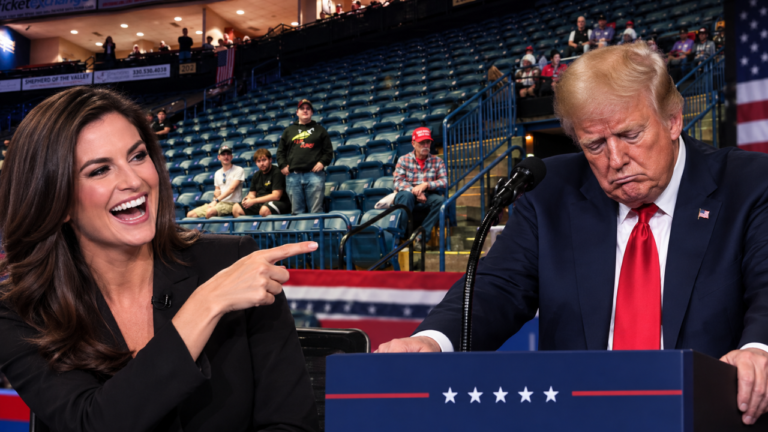
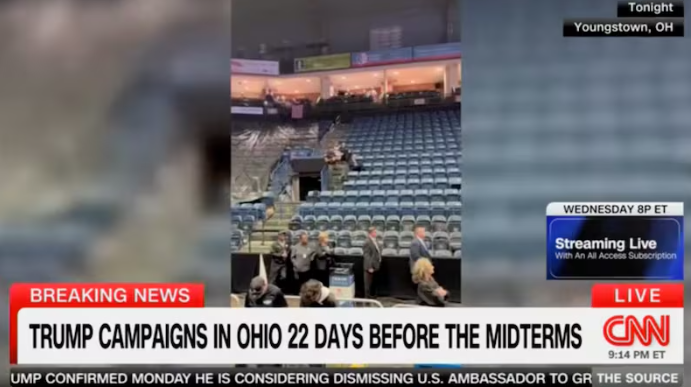
But when CNN’s Kaitlan Collins showed viewers what was happening inside Trump’s latest Ohio rally, the pictures told a more complicated story.
And the White House was not pleased.
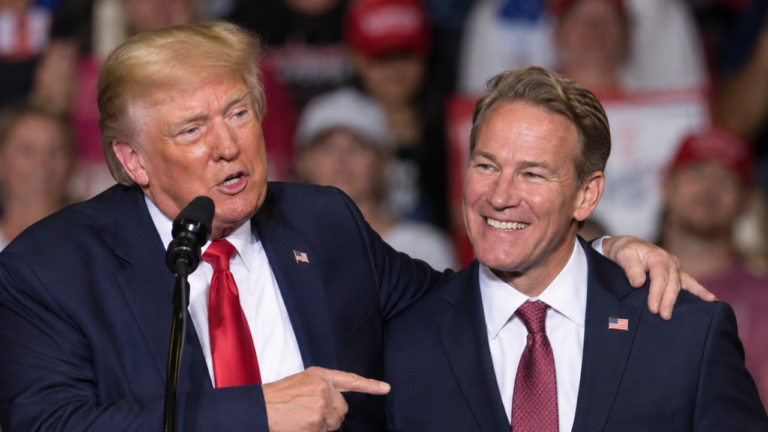
Trump traveled to Youngstown, Ohio, on Monday to campaign for Republican Sen. Jon Husted and gubernatorial candidate Vivek Ramaswamy ahead of the November 3 midterm elections. The appearance at the Covelli Center was intended to energize Republican voters in a state where the Senate and governor’s races have become fiercely contested.
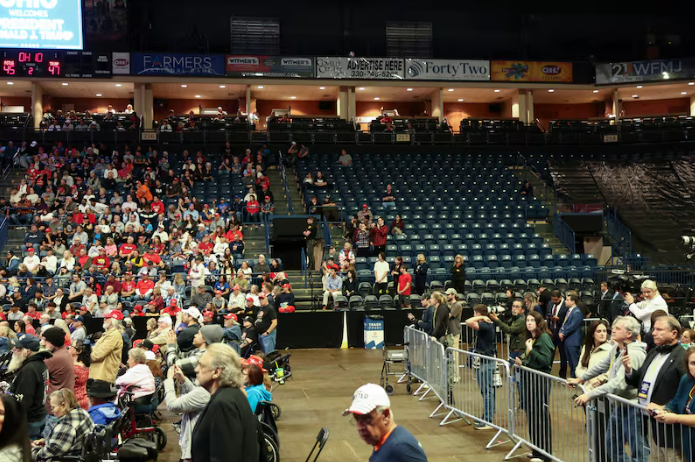
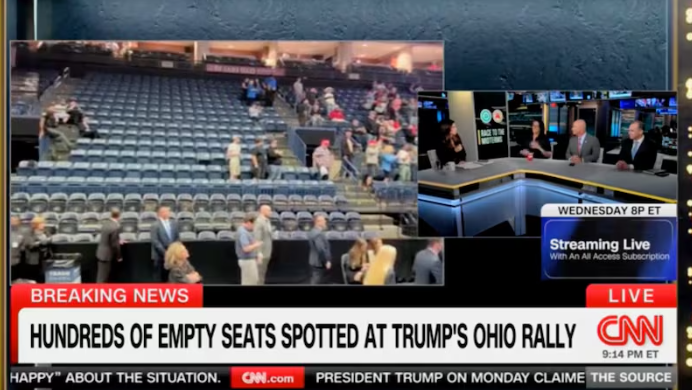
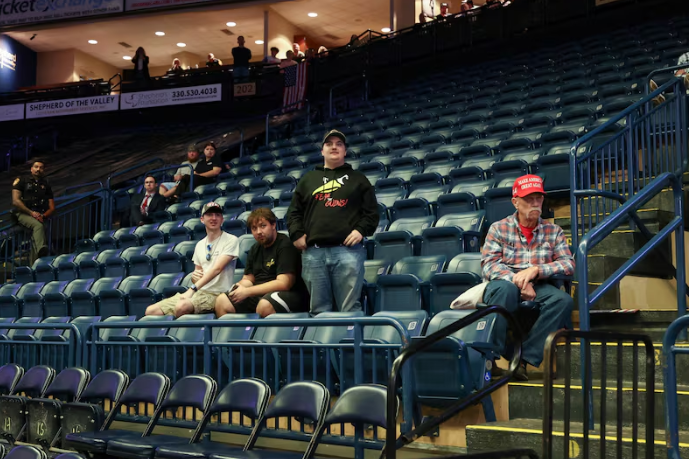
Instead, television cameras captured rows of empty seats, sparsely populated sections, and upper levels with little or no audience.
Collins highlighted the footage during CNN’s coverage, raising questions about the contrast between Trump’s repeated boasts about his rally crowds and the attendance visible inside the arena.
Local television station WFMJ reported that roughly one-quarter of the arena’s seats were covered with tarps and that approximately two-thirds of the available seats were occupied.
The Washington Post separately documented largely empty upper sections, with photographs showing portions of the arena that had attracted few spectators.
That made the scene particularly striking because of what Trump had been saying just a day earlier.
On Truth Social, the president had celebrated the power of his campaign appearances, describing his rallies as “legendary” and crediting them with generating Republican enthusiasm.
The president also suggested that supporters had been eagerly waiting for him to return to the campaign trail.
But in Youngstown, the arena was visibly short of capacity.
Collins did not claim that the footage alone proved Trump’s political support was collapsing. She acknowledged that attendance at a single event cannot establish whether enthusiasm for a political figure has declined.
What she questioned was the gap between Trump’s sweeping claims about massive crowds and the actual scenes recorded by CNN’s cameras.
Democratic strategist Karen Finney, appearing with Collins, argued that Trump was attempting to recreate the atmosphere of his earlier presidential campaigns, when images of packed arenas and enormous crowds became central to his political brand.
The discussion quickly attracted attention.
Then the White House responded.
On Tuesday, the White House-affiliated Rapid Response 47 account attacked Collins on X after The Daily Beast published a report about her coverage.
The account claimed that the supposedly vacant seats had obstructed views because of large press platforms positioned in front of them.
It accused Collins of spreading fake news and insisted that she, rather than Trump, was the person who should be embarrassed.
The administration’s explanation was that at least some of the empty sections were not suitable for spectators because television equipment interfered with the view of the stage.
CNN pushed back.
During its subsequent reporting, the network acknowledged the White House’s claim about the press platforms and an American flag, but said its own observations showed that seats near the platforms were not obstructed.
The dispute transformed a straightforward observation about rally attendance into a public confrontation between the White House and one of the president’s most recognizable television critics.
And it came at a politically sensitive moment.
Trump has long treated crowd size as a measure of political strength. Throughout his campaigns, he has frequently celebrated the scale of his audiences, disputed unfavorable attendance reports, and portrayed his rallies as evidence of extraordinary public enthusiasm.
That history makes footage of empty seats especially likely to attract scrutiny.
But the Youngstown story extends beyond the television images.
The Washington Post reported that some former Trump supporters in Ohio were questioning whether the president’s economic priorities still reflected their concerns.
In interviews around the rally, residents described worries about rising living expenses, electricity costs, and the administration’s enthusiasm for artificial intelligence data centers.
Trump has promoted large technology investments as evidence that his economic policies are revitalizing American manufacturing.
Some Ohio residents, however, have questioned whether those projects will provide the kind of long-term industrial jobs their communities need.
That tension matters in Youngstown, a city with a deep manufacturing history and a political identity shaped by decades of industrial decline.
Trump’s promises to restore manufacturing helped him build support in communities like this one. His return to Youngstown was intended to reinforce that connection.
Instead, some of the coverage focused on the empty seats, the economic frustrations of local voters, and the White House’s dispute with CNN.
The attendance figures do require context.
Not every seat in the arena was made available for the event, and the White House maintains that some empty sections had obstructed views. A single rally also cannot establish the overall size of Trump’s political base or predict how Ohio voters will cast their ballots.
Still, the photographs and television footage document something narrower and unmistakable: significant portions of the venue were unoccupied during an event the president had promoted as part of his highly successful return to the campaign trail.
And when Collins drew attention to that contrast, the administration responded by attacking the messenger.
The controversy also arrives as Republicans prepare for a consequential midterm election, with Husted facing former Democratic Sen. Sherrod Brown in a closely watched contest.
For Husted, the rally was supposed to provide an opportunity to emphasize Republican priorities and benefit from the president’s appearance.
Instead, one of the most discussed stories emerging from Youngstown concerned the crowd itself.
The episode illustrates how Trump’s longstanding emphasis on crowd size can turn an ordinary attendance question into a national political dispute.
CNN showed the seats. Local journalists documented the attendance. The White House offered its explanation. CNN challenged that explanation.
And Kaitlan Collins once again found herself at the center of a confrontation over what the cameras showed and how the president’s administration wanted those images interpreted.
Trump can continue describing his rallies as legendary.
But the footage from Youngstown remains part of the public record — along with the White House’s unusually sharp response to the journalist who brought it to national attention.
About the Author