Donald Trump went to Ohio to help a Republican senator win an election. Instead, the president delivered one of the strangest endorsements of the midterm campaign, openly describing how he had examined the senator’s body, studied him from head to toe, and paid particular attention to his backside.
Yes, the president actually said that. Onstage. Into a microphone. In front of a crowd of voters.
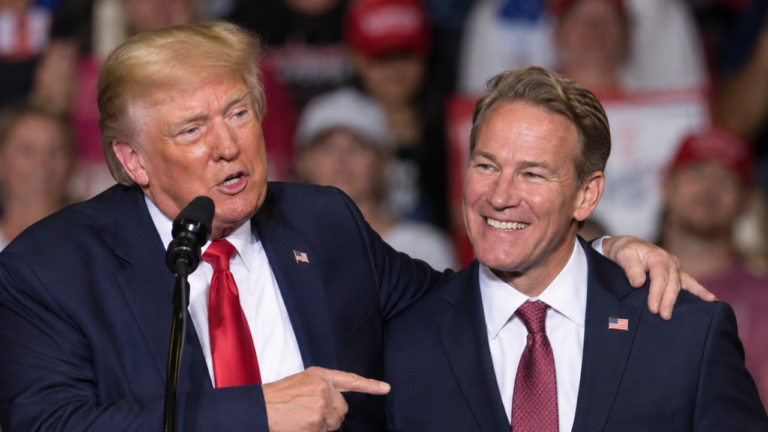
The bizarre moment unfolded Monday evening in Youngstown, Ohio, where Trump was campaigning for Republican Sen. Jon Husted, who faces a competitive challenge from former Democratic Sen. Sherrod Brown.
With Republicans fighting to maintain control of Congress in November, Trump had plenty of political ground to cover. Ohio voters are confronting concerns about the economy, the cost of living, and the future of manufacturing jobs.
But apparently, the president had something else on his mind: Jon Husted’s physique.
Trump began by telling the audience that he had recently discovered Husted was an accomplished college football player. Former NFL coach Jon Gruden, who played alongside Husted at the University of Dayton, had apparently informed Trump about the senator’s athletic background.
That could have been the beginning of a perfectly ordinary campaign compliment.
It wasn’t.
Trump explained that the revelation had inspired him to take a closer look at the 59-year-old Republican.
“I don’t do this with men very often,” Trump told the crowd, before explaining that he had begun examining Husted’s body because he hadn’t realized the senator was such a talented athlete.
Then came the line that transformed an already peculiar endorsement into something considerably more uncomfortable.
“I looked at his ass,” Trump declared.
The crowd laughed.
Trump wasn’t finished. He continued describing his inspection of Husted’s physique before turning his attention to the senator’s hands, which he compared to claws.
For anyone expecting a discussion about Ohio’s economic future, this was quite a detour.
The president of the United States had effectively turned a campaign rally for a sitting senator into a public evaluation of the candidate’s physical attributes.
And the spectacle became even stranger when Trump returned to the subject later in the speech.
After discussing a submarine manufacturing project, the president again directed attention toward Husted’s appearance, telling the audience to admire the senator’s jawline.
Trump explained that he had never studied Husted so closely before, but now found himself examining him in an effort to understand what had made him such a successful football player.
At another point, he described Husted as being almost like a piece of steel, joking that he had hurt his own hand while patting the senator on the back.
The entire sequence was extraordinary, even by the standards of a president whose rallies frequently wander into unexpected territory.
And the reaction wasn’t confined to Trump’s political opponents.
Newsmax host Rob Schmitt appeared visibly puzzled after the network aired the remarks. Back in the studio, Schmitt suggested that Trump had been talking about Jon Gruden, the former football coach.
But Trump had plainly been describing Jon Husted.
The confusion was almost as revealing as the original remarks. Even a host on a strongly pro-Trump network seemed unsure what to make of the president’s unusual discussion of a Republican senator’s anatomy.
CNN also highlighted the moment during its Tuesday coverage, juxtaposing Trump’s comments with the economic issues dominating voters’ concerns ahead of the midterms.
That contrast gets to the heart of the political problem.
Husted is fighting to hold a Senate seat that Republicans cannot afford to take for granted. Brown, the former Democratic senator seeking a return to Washington, has made the contest competitive in a state Trump carried comfortably in previous presidential elections.
The stakes are serious. The Republican Party is asking voters to entrust it with continued control of Congress, while many Americans remain deeply concerned about household expenses and economic security.
And what did the president choose to emphasize while campaigning for one of his party’s Senate candidates?
The man’s backside.
There is, of course, nothing inherently wrong with complimenting someone’s athletic achievements. Husted’s football career is a legitimate part of his biography, and Trump was clearly attempting to praise him.
But there is a considerable difference between acknowledging a candidate’s sporting accomplishments and publicly describing an inspection of his body in graphic terms.
The president crossed that line with remarkable enthusiasm.
Nor was this the first time Trump had become unusually fascinated by a male athlete’s physical appearance.
Earlier this year, he publicly praised New York Giants quarterback Jaxson Dart’s looks and muscular legs, turning another appearance into a discussion of a man’s physique.
Taken together, the remarks suggest that Trump’s tendency to evaluate public figures through their physical appearance extends well beyond his familiar attacks on political opponents.
But Monday’s performance was especially striking because of the setting.
This wasn’t a casual conversation behind closed doors. It was a presidential campaign appearance intended to help a Republican win one of the most consequential Senate races of the election cycle.
And instead of keeping the focus on voters’ concerns, Trump gave the audience an unsolicited account of exactly how closely he had been examining the candidate.
The moment will undoubtedly provide material for late-night comedians and political commentators. But it also illustrates something more consequential about the Republican campaign: even when Trump is supposed to be helping another candidate, his unpredictable remarks can become the entire story.
Husted came to the rally looking for a presidential endorsement that would strengthen his campaign.
He got that endorsement.
He also got a nationally televised description of his backside.
And with Election Day approaching, Democrats could hardly have asked for a more unusual distraction from the message Republicans were trying to deliver.
About the Author