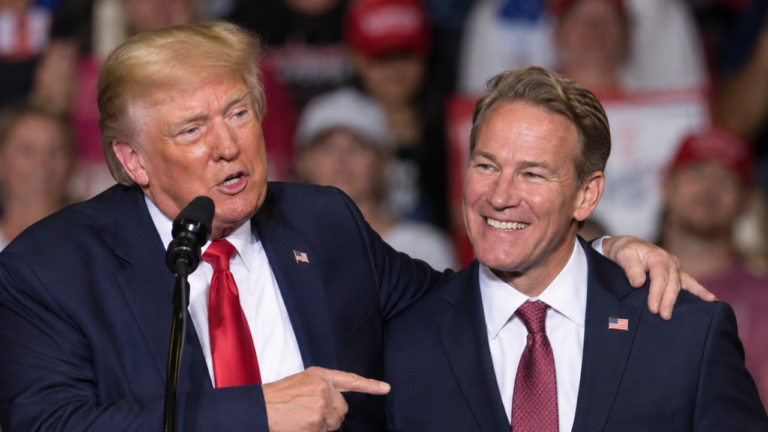
Donald Trump traveled to Ohio to help Republican Senator Jon Husted in his closely watched reelection campaign against former Democratic Senator Sherrod Brown. But instead of keeping his remarks focused on the economy, the election, or his party’s legislative agenda, the president turned to an unusually personal subject: Husted’s physique.
The president’s description of his fellow Republican was strikingly detailed, turning what began as praise for Husted’s athletic background into a discussion of the senator’s body.
According to remarks reported from the Youngstown rally, Trump told the audience that he had taken a particularly close look at Husted after learning about his athletic accomplishments.
“I don’t do this with men very often,” Trump said, before describing how he had begun examining the senator’s body.
It was an unexpected introduction to an endorsement speech.
Trump continued by describing how he had looked Husted up and down, apparently attempting to explain why the senator’s appearance had impressed him.
Then came the line that made the exchange especially unusual.
“I looked at his ass,” Trump said.
The president went on to discuss Husted’s hands, describing them as resembling claws, before returning to his assessment of the senator’s athletic abilities.
The remarks were apparently intended as a compliment. Trump was trying to convey that Husted looked like someone who had once excelled at sports, even though the senator did not regularly boast about his athletic past.
But the way the president chose to deliver that compliment was far removed from the usual language of a political endorsement.
Rather than highlighting Husted’s legislative record or policy priorities, Trump spent part of his time discussing the senator’s physical features in front of a campaign audience.
The moment was especially conspicuous because of the stakes surrounding Husted’s election.
Ohio has become one of the major battlegrounds in the fight for control of the Senate. Husted, a former lieutenant governor who was appointed to fill the vacancy created when JD Vance became vice president, is seeking a full term against Brown, a three-term former senator attempting a political comeback.
Trump’s appearance was intended to reinforce Republican support for Husted and encourage turnout ahead of the November 3 midterm elections.
But the president’s attention to the senator’s body briefly displaced the political message that had brought him to Ohio.
Husted’s athletic background is genuine. He played college football at the University of Dayton, where he was a member of the school’s 1980 Division III national championship team.
That history provided the context for Trump’s comments.
The president appeared to be impressed by Husted’s former sporting career and was attempting to praise him for it.
Nevertheless, the details he volunteered made the exchange stand out.
Trump has frequently departed from prepared political messaging at campaign rallies, moving between policy arguments, personal observations, jokes, and extended stories about people appearing alongside him.
His supporters often regard those unscripted moments as part of his appeal.
Critics, meanwhile, have questioned whether such digressions distract from substantive issues facing voters.
In Ohio, those issues are substantial.
The Senate contest between Husted and Brown has featured disputes over manufacturing jobs, tariffs, energy prices, and the rapid expansion of data centers across the state.
Husted has promoted legislation addressing the electricity costs associated with large technology facilities. Brown has challenged his record on the issue, arguing that Ohio households should not be left paying for infrastructure serving major technology companies.
The candidates have also sparred over their records on employment, trade, and economic development.
Those policy disputes affect residents across the state, including workers concerned about manufacturing employment and households dealing with higher living costs.
Trump has tried to make the midterm elections a referendum on his administration’s economic record, arguing that Republican victories would preserve his agenda in Congress.
His Ohio appearances have been part of a broader effort to campaign for Republican candidates in competitive states.
But the Youngstown remarks illustrated how easily an appearance intended to promote a Senate candidate can shift into an entirely different conversation.
The president did eventually return to praising Husted’s athletic abilities.
He congratulated the senator after explaining that he had not previously appreciated the extent of his sporting accomplishments.
The underlying message was favorable toward Husted, not an attack on him.
And there is no evidence that the remarks establish anything about Trump’s sexual orientation, private intentions, or medical condition.
What makes the episode notable is the contrast between the seriousness of the campaign and the highly personal language Trump chose while attempting to compliment a Republican ally.
The senator is fighting to retain a seat that could prove important to the balance of power in Washington.
His opponent is a familiar political figure with a long history of winning statewide elections in Ohio.
And the president’s visit was supposed to help Republicans make their case to voters in the final weeks before Election Day.
Instead, one of the most attention-grabbing portions of the appearance concerned Husted’s body.
For Trump, the remarks may have been little more than an unconventional attempt at humor and praise.
For anyone expecting a conventional political endorsement, however, they were an unmistakable departure from the subject at hand.
The Ohio Senate election will ultimately be decided by voters weighing the candidates and the issues affecting their state.
But Trump’s comments offered another example of how his unscripted speaking style can become a story of its own — even when the politician he is discussing is someone he came to support.
About the Author