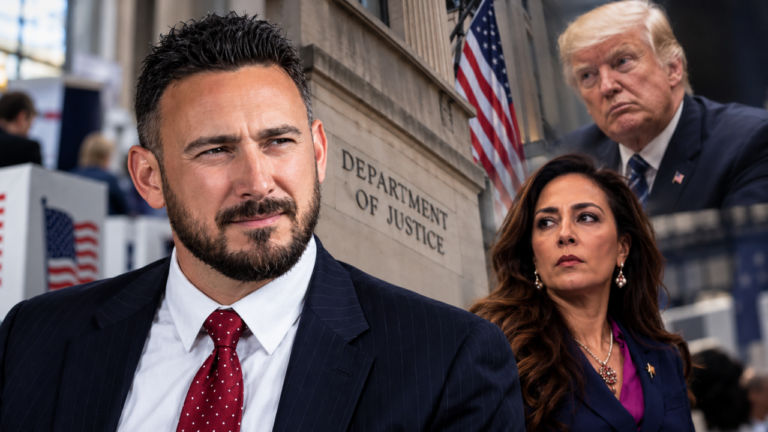
Donald Trump’s Justice Department says it wants to protect the integrity of American elections.
But newly uncovered government records have raised a remarkable question about one of the people it selected to help carry out that mission.
Why was a man who previously served jail time for illegally accessing government election websites assigned to monitor voting on behalf of the federal government?
According to an investigation published by Democracy Docket, David Michael Levin, a Florida attorney with a criminal history involving election-related computer systems, was officially listed among Justice Department personnel assigned to observe Arizona’s July 2026 primary election.
And unlike earlier reports that relied partly on photographs and video footage, the latest findings are supported by government correspondence and election-monitoring credentials.
The documents were obtained by the nonprofit organization Democracy Forward and reviewed by Democracy Docket.
They include a July 15 email from Justice Department attorney Anelise Powers to election officials in Maricopa County, Arizona.
The email identified 12 people who needed authorization letters for the department’s election-monitoring operation.
Levin was among them.
He was explicitly listed as one of the Justice Department observers helping with the monitoring effort in Maricopa County.
County election officials subsequently issued him an official observer credential.
That confirmation is significant because Levin’s past involvement with election systems was not exactly routine.
In 2016, Florida authorities arrested him on three felony charges related to unauthorized access to government computer systems.
Investigators alleged that Levin used a technique known as SQL injection to obtain usernames and passwords from the Lee County Supervisor of Elections website.
He then used an election official’s credentials to access restricted portions of the website with administrative privileges.
Investigators also identified activity involving the Florida Division of Elections website.
Levin eventually reached a plea agreement.
The original felony charges were reduced, and he pleaded guilty to two misdemeanors.
He served 20 days in jail and received two years of probation.
His case did not involve manipulating voting machines, changing ballots or altering vote totals.
But it did involve illegally accessing government election websites — the very kind of systems that election officials are responsible for protecting.
And now, a decade later, official records show that Levin participated in a federal election-monitoring operation.
The latest documents also shed light on an earlier incident that first brought his apparent Justice Department role to public attention.
In August, Levin was identified in footage outside a polling location in Minneapolis, Minnesota, alongside Justice Department attorney William F. Mohrman.
The video showed an election judge examining the federal personnel’s credentials amid a disagreement over where they were permitted to stand.
At the time, the Justice Department had not publicly clarified Levin’s precise position or responsibilities.
The newly uncovered Arizona documents provide stronger evidence of his participation in the department’s election-monitoring program.
They do not, however, establish whether he will be assigned to monitor voting in November.
That remains one of several unanswered questions.
The controversy has already attracted attention on Capitol Hill.
Democratic Senator Peter Welch of Vermont formally demanded information from Assistant Attorney General Harmeet Dhillon, who oversees the Justice Department’s Civil Rights Division.
Welch asked what standards the department uses when selecting election monitors, whether it has policies concerning applicants with election-related criminal convictions, and who approved Levin’s participation.
He also asked whether Levin would be involved in monitoring the November midterm elections.
Those questions are especially consequential given the scale of the department’s plans.
Justice Department officials have said they intend to deploy approximately 1,000 federal personnel to monitor voting during the 2026 midterms.
Federal election monitoring is not inherently unusual or improper.
The Justice Department has long sent personnel to polling locations to help assess compliance with federal voting-rights laws and identify potential violations.
The department says its monitoring activities are intended to protect access to voting and ensure that federal law is followed.
But the identity, qualifications and conduct of the people carrying out that work matter.
And Levin’s appointment has prompted questions about how the department screens individuals for sensitive election-related assignments.
The concerns extend beyond one attorney.
Separate reporting by Democracy Docket found that the Justice Department also assigned criminal prosecutors and an FBI official to monitor Arizona’s July primary.
The department defended its use of prosecutors, saying election monitors are subject to the same legal and ethical requirements and must not interfere with voting.
A Justice Department spokesperson said monitors are expected to observe possible violations of federal law and report their concerns for review.
The department’s stated position is that its personnel are there to observe elections, not disrupt them.
There is no evidence in the newly released records that Levin interfered with voting in Arizona or committed any new election-related offense.
Nor do the documents establish that his prior conviction automatically disqualified him from serving in a federal monitoring role.
What they establish is narrower — but still significant.
A man who previously pleaded guilty to illegally accessing government election websites was included in an official Justice Department election-monitoring operation.
And elected lawmakers are now demanding to know how that decision was made.
Representative Raja Krishnamoorthi of Illinois has also sought answers about Levin’s involvement and the department’s broader screening procedures.
The Justice Department has not publicly provided a full explanation of Levin’s selection or disclosed whether officials knew about his convictions before assigning him to election-monitoring duties.
Those unanswered questions come as the administration prepares to expand its federal presence around polling places for the November elections.
The department maintains that its mission is to protect voting rights and enforce federal law.
Critics argue that the credibility of that mission depends partly on the backgrounds and qualifications of the personnel entrusted with carrying it out.
And that is what makes the newly uncovered Arizona records so consequential.
This is no longer simply a question about whether a former election-system hacker was seen near a polling location.
The records show that he was formally included in a Justice Department monitoring operation.
The remaining questions are now directed squarely at the department itself:
Who approved his assignment?
What background checks were conducted?
And will he be given another election-monitoring role when Americans vote in November?
Until those questions are answered, the documents leave an important part of the administration’s election-monitoring program under scrutiny.
About the Author