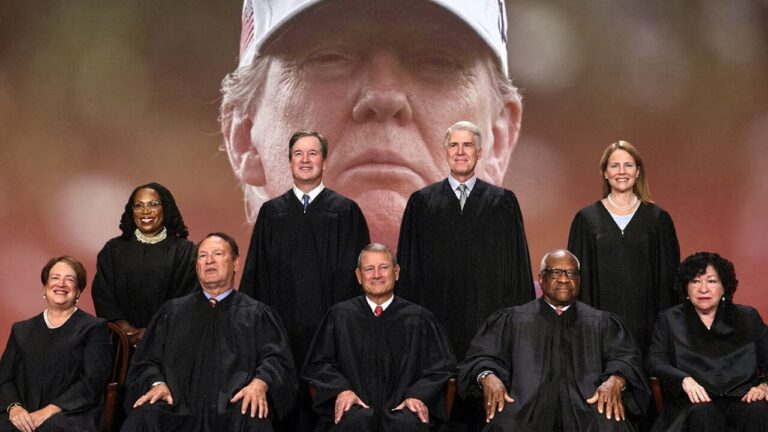
For generations, Americans thought of the Supreme Court as a quiet marble building where lawyers argued constitutional questions and justices quietly weighed precedent behind closed doors.
What is emerging now looks very different.
According to a detailed Politico report, the Supreme Court Police force is undergoing a significant transformation — one that would expand it from a relatively small protective unit into a far more militarized security operation.
The current force of roughly 200 officers is already responsible for protecting the justices, the Court building, and its immediate surroundings. But under the new plan, that footprint would expand dramatically, adding layers of tactical capability that resemble a federal protective agency rather than a traditional courthouse security detail.
The proposed upgrades include expanded armed patrol units, rapid-response teams, residential protection assignments for individual justices, armored vehicles, and specialized units trained in explosive detection and counter-surveillance. Security coverage would extend far beyond the Court itself, operating on a 24/7 basis across multiple locations tied to the justices.
As part of the expansion, the Court has launched a recruitment drive that is unusually polished and assertive for an institution known for its restraint. Promotional materials show officers in full tactical gear, armed patrols securing perimeters, and close protection teams escorting justices through secure environments.
The tagline reads: “The highest court. A higher calling.”
To critics, the imagery raises uncomfortable questions about how the judicial branch is evolving in the modern political climate — and whether the institution is beginning to resemble something closer to a fortified power center than a traditional court of law.
Court officials, however, point to a very real and escalating set of security concerns. In recent years, threats against Supreme Court justices have increased significantly, including the 2022 arrest of an armed individual outside Justice Brett Kavanaugh’s residence, as well as other reported attempts to intimidate or surveil members of the Court.
Supporters of the expansion argue that the judiciary cannot function if its members do not feel safe, especially in an era of intense political polarization where Supreme Court decisions routinely spark mass protests and national backlash.
But the move has also intensified scrutiny on the Court itself — not only for its security posture, but for its broader role in American governance.
In recent years, the Court has issued a series of landmark rulings that reshaped major areas of American life, including the overturning of Roe v. Wade, expansion of Second Amendment protections, limits on federal regulatory authority, and rulings affecting affirmative action and presidential immunity. Each decision has deepened partisan divides and contributed to growing public debate over the Court’s legitimacy and neutrality.
Now, some lawmakers are asking whether the institution’s expanding security footprint is a symptom of that very polarization — and whether an increasingly fortified Court risks becoming further removed from the public it serves.
What was once seen as the most restrained branch of government is now, in some eyes, beginning to look like one of its most heavily guarded.
About the Author