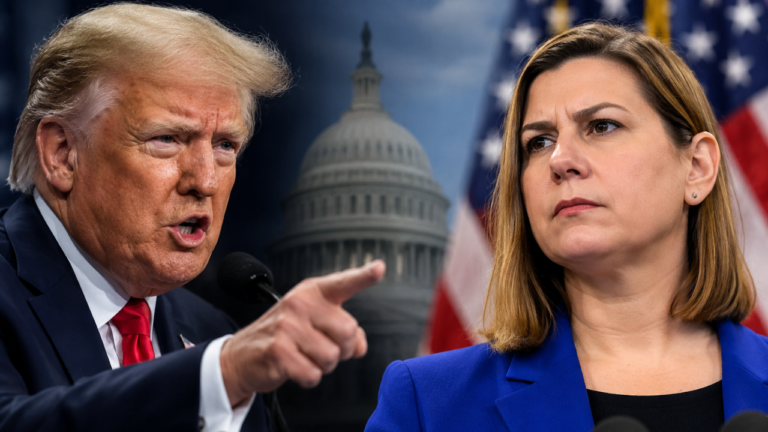
Sen. Elissa Slotkin is refusing to back down after President Donald Trump suggested she should be put on trial for speaking out about alleged corruption in his administration.
The Michigan Democrat delivered a pointed response in a video released Wednesday, accusing Trump of attempting to use the federal justice system to intimidate his political critics.
And she made clear that the prospect of another investigation would not silence her.
“Over the last few days, I’ve been the target of attacks from DC Republicans and right-wing media,” Slotkin said.
“It culminated in President Trump just a few hours ago in the Oval Office saying that I should be tried in court.”
According to Slotkin, the latest confrontation followed her criticism of what she described as corruption coming from the White House.
“This shouldn’t be complicated,” she said. “If you break the law or abuse taxpayer dollars, you should be held accountable, no matter who you are or who you work for.”
Trump’s call for a trial is not the first time Slotkin has faced the possibility of legal consequences over her public statements.
Earlier this year, federal prosecutors sought a criminal indictment against her in connection with allegations of sedition. Slotkin said a grand jury unanimously declined to indict her.
“If President Trump had his way, I’d be in prison,” she said, crediting the anonymous grand jurors who rejected the effort.
That experience, she argued, gave her reason to take the president’s latest remarks seriously.
“So I know from experience that when it comes to weaponizing the government, the president says what he means and he means what he says.”
Slotkin said she was prepared for Trump’s attorney general to pursue another investigation following his public comments.
She described the situation as extraordinary: a sitting president suggesting criminal proceedings against an elected official who had criticized his administration.
“A president from the Oval Office is weaponizing our justice system against an American who clearly gets under his skin,” she said.
“And if he can do it to me, he can do it to anyone.”
Slotkin also accused Trump and his allies of using threats and intimidation to distract Americans from economic problems and the war in Iran.
Those accusations are her political assessment, not findings established by a court.
But her central message was unmistakable.
She would not stop criticizing the administration because the president wanted her investigated.
“If I’ve learned one thing from this past year, it’s that you have to push back,” Slotkin said.
Then came the most confrontational moment of her response.
“So if the president wants to investigate and arrest me, and even worse, as so many authoritarian leaders do with their political adversaries, then do it.”
“It’s gotten predictable at this point. But I’m not going to be intimidated out of standing up for the rule of law and the country that has given me everything.”
The distinction matters: Trump publicly called for Slotkin to face trial, while Slotkin raised the possibility of arrest in her response. The president’s comments did not themselves constitute an arrest order or criminal charge.
Nevertheless, the exchange highlights a serious conflict over the boundaries between political criticism and the federal government’s prosecutorial power.
For Slotkin, the answer is simple.
If the president wants to investigate her again, she says he can try.
But he should not expect her to be quiet.
About the Author