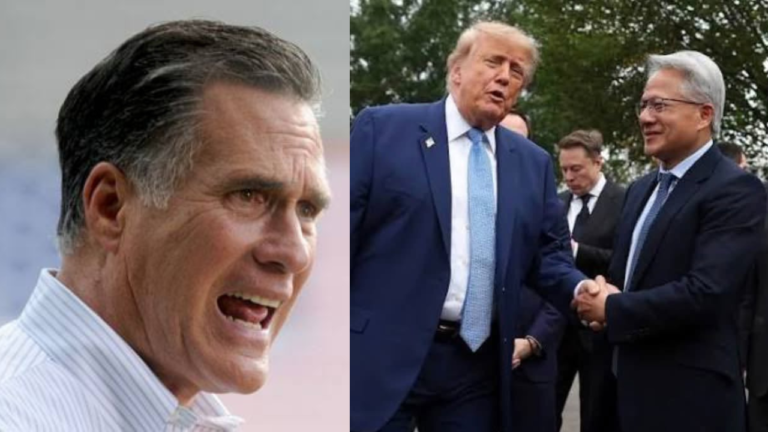
Former Republican presidential nominee Mitt Romney criticized the Trump administration on Tuesday, questioning its approach to artificial intelligence and national security following the controversial reinstatement of Nvidia CEO Jensen Huang.
Romney took to X to highlight what he sees as a fundamental contradiction in America’s efforts to maintain technological superiority over China.
“Let me get this straight: we rushed AI along without regulating safeguards in order to stay ahead of China and at the same time, we sold China the very chips they’d need to get ahead of us,” Romney wrote.
He concluded with a pointed remark:
“Smells of profit, corruption and perhaps worse.”
The former Utah senator’s comments came one day after Nvidia reinstated Huang as its chief executive officer following President Donald Trump’s personal intervention.
Huang had stepped down earlier this month after reports emerged that he had engaged in an extramarital affair with a former executive associated with Megaspeed, a company facing scrutiny over the diversion of advanced American computer chips to China.
U.S. officials reportedly suspected the woman of having connections to Chinese intelligence. Beijing has denied that she was a spy.
Megaspeed purchased billions of dollars’ worth of Nvidia chips, raising questions about whether American export restrictions had been circumvented.
On Monday, the Commerce Department placed the company on its trade blacklist amid mounting concerns about its activities.
Despite those concerns, Trump publicly defended Huang and acknowledged his involvement in convincing Nvidia’s board to restore him to his leadership position.
Trump maintained that the Justice Department had no evidence of unlawful conduct by Huang. However, subsequent remarks from Attorney General Todd Blanche left questions about the scope of any investigation unanswered.
Romney’s criticism focused on the apparent inconsistency between accelerating America’s artificial intelligence development to compete with China and allowing advanced American technology to reach Chinese companies.
His remarks also attracted attention because of their final words, “perhaps worse.”
Political commentator Molly Jong-Fast highlighted that passage, while Democratic Sen. Ruben Gallego of Arizona publicly expressed agreement with Romney’s assessment.
Romney did not specify what he meant by the phrase, nor did he explicitly accuse Trump or Huang of treason.
The controversy has generated concern among Republican lawmakers as well as Democrats.
Republican congressional committee chairmen have called for answers regarding the diversion of advanced Nvidia chips to China, emphasizing that Huang’s return to the company has not resolved outstanding national security questions.
Congressional hearings involving Huang are reportedly being planned for next week.
The controversy also comes as the Trump administration continues promoting rapid investment in artificial intelligence, arguing that maintaining America’s technological advantage over China is essential to national security.
The central question raised by Romney is whether the administration’s export policies are consistent with that objective.
With bipartisan scrutiny intensifying, lawmakers are seeking answers about the enforcement of semiconductor export restrictions, Nvidia’s business relationships and the circumstances surrounding Huang’s reinstatement.
For Romney, the contradiction between America’s stated technological ambitions and the reported flow of advanced chips to China is a reason for further scrutiny.
And his warning has added another prominent Republican voice to the growing congressional debate.
Let me get this straight: we rushed AI along without regulating safeguards in order to stay ahead of China and at the same time, we sold China the very chips they’d need to get ahead of us. Smells of profit, corruption and perhaps worse.
— Mitt Romney (@MittRomney) November 24, 2026
About the Author