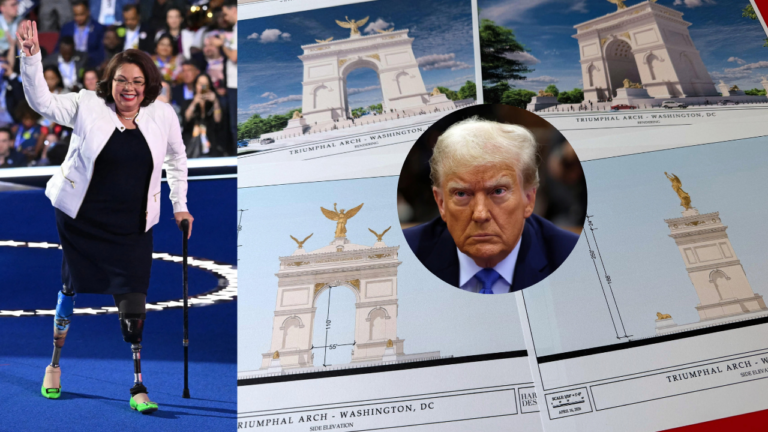
Sen. Tammy Duckworth has a message for the Trump administration about Donald Trump’s increasingly bizarre plan for a massive triumphal arch near Washington:
Stop it.
The Illinois Democrat and combat veteran is demanding that the Federal Aviation Administration and Pentagon reject Trump’s proposal to transform the planned 250-foot monument into what the president now calls a “top grade Military Complex.”
And Duckworth is pointing to a potentially serious problem that wasn’t part of the original aviation review.
Trump now wants drones operating from the structure.
The arch is planned near Arlington National Cemetery, close to Ronald Reagan Washington National Airport and one of the country’s most complicated pieces of airspace.
Last week, the FAA determined that the 250-foot structure itself would not pose a hazard to aircraft using Reagan National, subject to lighting and other conditions.
Then Trump changed the plan.
Days after that FAA determination, the president announced that, at what he described as the “strong request” of the U.S. military, the arch would double as a military facility.
Trump said it would have the ability to store and rapidly deploy “large numbers of drones.”
He also said snipers would be stationed on the roof and plaza areas and that the facility would store sniper ammunition.
There’s one rather important problem.
The FAA’s aviation-safety review didn’t evaluate drone operations at the site.
Reuters confirmed earlier this week that the agency’s determination concerned the physical structure — not Trump’s subsequently announced plan to operate military drones from it.
Now Duckworth wants answers.
In a letter to FAA Administrator Bryan Bedford and Defense Secretary Pete Hegseth obtained by CBS News, Duckworth demanded that the agencies “reject this foolhardy plan” and concentrate instead on improving the safety of Washington’s airspace.
For Duckworth, the issue is especially personal.
Before entering politics, she served as an Army helicopter pilot.
In 2004, the Black Hawk she was co-piloting in Iraq was struck by a rocket-propelled grenade. Duckworth lost both legs and suffered severe injuries to her right arm.
Now she serves as the ranking Democrat on the Senate Subcommittee on Aviation, Space, and Innovation.
And she’s raising her warning less than two years after another Army Black Hawk was involved in one of the worst U.S. aviation disasters in decades.
On January 29, 2025, an Army helicopter collided with an American Airlines regional jet near Reagan National Airport.
All 67 people aboard the two aircraft were killed.
The National Transportation Safety Board subsequently issued 52 safety recommendations.
According to CBS News, 35 were directed to the FAA.
Only three have been closed.
The NTSB said this month that FAA responses to 11 recommendations were unacceptable.
And all 13 recommendations directed at the Pentagon remain open.
Duckworth wants to know why federal agencies should be spending their attention on Trump’s arch while so much safety work following that disaster remains unfinished.
She called it particularly outrageous for federal officials to devote resources to another Trump project while those recommendations remain unresolved.
And Trump’s sudden decision to give the monument a military mission only deepened her concerns.
The president originally promoted the enormous structure as a triumphal arch modeled on famous monuments such as Paris’ Arc de Triomphe.
The project was already facing legal challenges and opposition from veterans and preservationists concerned about its size, location and effect on the historic landscape around Arlington National Cemetery.
Then, on Sunday, Trump unveiled the military justification.
The proposed arch would not simply commemorate America’s 250th anniversary.
It would house drones.
It would have snipers.
It would store ammunition.
And Trump said the transformation was necessary “for National Security purposes.”
The Pentagon did not provide Reuters with an independent explanation for why such a facility was needed at that location, saying it had nothing to add beyond Trump’s announcement.
Trump’s administration has increasingly relied on national-security arguments while defending some of his controversial projects.
Reuters reported this week that the administration has also invoked national security in defending the massive White House ballroom project and that a senior White House official described security arguments as useful when administration priorities encounter legal resistance.
The White House maintains that these projects contain legitimate security components and that Trump, as commander in chief, has authority to protect national security.
But with the arch, Duckworth is asking a much more concrete question:
What happens when you start launching drones next to a major airport?
She isn’t alone.
Democratic Rep. Don Beyer of Virginia raised the same issue earlier this week and argued that Trump’s new drone plan requires a fresh FAA safety analysis precisely because the agency’s previous determination did not contemplate drone operations.
That distinction matters.
The FAA has determined that the structure itself, under specified conditions, would not substantially interfere with Reagan National’s airspace.
It has not established that operating Trump’s proposed fleet of military drones from that same location would be safe.
And Duckworth argues that Washington already has a much more urgent aviation-safety problem demanding the government’s attention.
Sixty-seven people died in the skies near Reagan National last year.
Dozens of resulting safety recommendations remain unresolved.
Now Trump wants to put a 250-foot military complex near that same busy airspace — complete with drones, snipers and ammunition.
Duckworth’s response is considerably simpler:
Reject the “foolhardy plan” and fix the safety problems that already exist.
About the Author