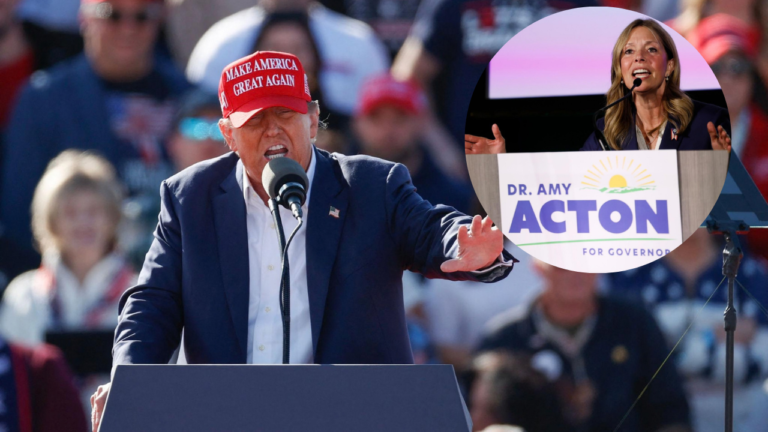
Donald Trump went to Ohio Saturday night to campaign for Republicans.
Then he delivered a remarkable warning about what voters could expect from the White House if they elect a Democrat as their next governor.
Speaking at a rally in Vandalia, Trump praised Ohio’s Republican leaders and described the relationship they currently have with his administration.
“They call me up. They need money. They need this. They need that,” Trump told the crowd.
Then he turned his attention to Democrat Amy Acton, who is running against Republican Vivek Ramaswamy for governor.
“But I’m not going to help her,” Trump said.
It was only six words.
But coming immediately after the president described Ohio Republicans calling him when the state needs money or other assistance, the message was difficult to miss.
Reuters reported that Trump was arguing that keeping Republicans in power would give Ohio officials a direct line to his administration and make it easier for the state to secure federal help. The news agency characterized his remarks as a warning that he would be less inclined to accommodate Democrats if they win key races.
That distinction matters.
Trump did not identify a specific federal program that he intended to cancel, nor did he announce a formal policy of withholding federal funding from an Acton administration.
What he did do was publicly connect political control of Ohio with his own willingness to help its leaders.
And he did it less than a month before voters decide whether Ramaswamy or Acton will become the state’s next governor.
The remark also came during a rally packed with explicit appeals for voters to elect Republicans.
“Just get out and vote,” Trump told the crowd.
“If you do that, we’re going to win, and we’re going to win big.”
Ohio is hosting two closely watched statewide races this November.
Ramaswamy is facing Acton in the governor’s race, while Republican Sen. Jon Husted is running against former Democratic Sen. Sherrod Brown.
Trump carried Ohio with more than 55 percent of the vote in the 2024 presidential election, according to Reuters, but the state has become a major midterm battleground amid concerns over prices, data centers and the economy.
The president’s comments about Acton also come just weeks after another campaign pitch explicitly tied a financial benefit to a Republican victory.
At the Republican midterm convention in September, Trump promised a $5,000 “Trump Dividend” to adult American citizens if Republicans retain control of Congress.
“If the Republicans win, you win with us and you get $5,000,” Trump said at the time.
Now Ohio voters have heard the other side of that political argument.
Trump described Republican officials calling him when they need money or assistance.
Then, when discussing the Democrat who could soon be running the state, the president offered a very different message:
“But I’m not going to help her.”
Federal resources are administered through laws, agencies and programs — not simply as personal favors from a president to politicians from his own party.
Exactly what Trump would or could refuse to provide an Acton administration remains unclear.
But with Election Day approaching, the president has now told Ohio voters something unusually direct about his own willingness to work with the person they choose as governor.
And he made his distinction along party lines.
About the Author