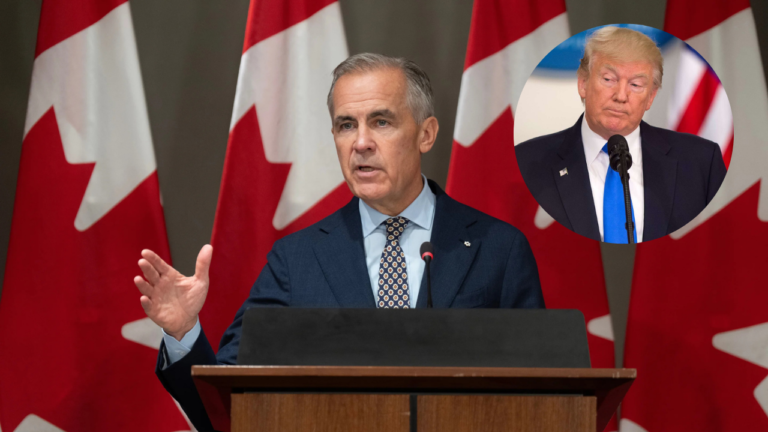
Canadian Prime Minister Mark Carney received quite the welcome in the European Parliament — complete with maple syrup, Celine Dion, Heated Rivalry and a pointed joke about Canada’s increasingly complicated relationship with the United States.
German Member of the European Parliament Damian Boeselager used his remarks during Carney’s visit to Strasbourg to turn what could have been a routine diplomatic speech into one of the more memorable moments of the session.
“Dear Prime Minister Carney, I’m really excited we are formalizing our long-distance relationship,” Boeselager began.
Then came the comparison.
“Our history has had its ups and downs, but hey, we recently had a bad breakup with the Brits, and you seem to be going through a rough patch with the US,” he said.
“So clearly, we are both open for something new.”
The “bad breakup” was a reference to Britain’s departure from the European Union through Brexit.
The Canadian “rough patch,” meanwhile, came as relations between Ottawa and Washington have deteriorated amid President Donald Trump’s trade policies and repeated clashes with Carney’s government.
But Boeselager was only getting started.
He proceeded to give Carney a tongue-in-cheek rundown of everything Europe apparently likes about Canada.
“And for us, choosing you, Canada, and Mr. Carney is quite easy,” he said.
“You have green hydrogen to keep us warm, you have maple syrup to keep us happy, and Heated Rivalry to keep us entertained.”
Then came the cultural inventory.
“You have poutine, the Mounties, Celine Dion, and Leonard Cohen and, of course, almost every famous Ryan or Justin I can think of.”
But beneath the jokes was a serious political message about the increasingly close relationship between Canada and Europe.
Boeselager praised what he described as Canada’s unusual ability to apologize before turning back toward the country’s confrontation with Trump.
“You have courage, Prime Minister, which you have shown by standing up against Trump’s gaslighting, something we still have yet to learn,” he said.
He then referenced one of Trump’s most controversial recurring remarks about America’s northern neighbor.
“And we know that Canada will never be the 51st state,” Boeselager said.
That could have been the punchline.
Instead, he kept going.
He acknowledged that Canada apparently isn’t about to become the European Union’s 28th full member either — although he made clear that Canada would be welcome.
Then he flipped the entire idea around.
“Maybe we could become the 11th province of Canada,” Boeselager joked.
And somehow he still wasn’t finished.
“Long live Lake Ontario,” he said, before closing with a reference to one of Celine Dion’s most famous songs: “Across the oceans, our hearts will go on.”
“Thank you.”
The lighthearted speech came during a much more consequential moment in Canada-European relations.
European Commission President Ursula von der Leyen has proposed opening the door to Canada becoming the European Union’s first “associate member.”
That does not mean Canada has been formally admitted to the EU, nor does such a status currently exist as a defined category under EU treaties.
Instead, Europe and Canada are discussing what an unprecedented deeper relationship could look like.
Von der Leyen has described the broader concept as an “Alliance for the Future,” with Canada and Europe exploring expanded cooperation across areas including critical minerals, energy, artificial intelligence, defense, digital trade and financial services.
Carney has welcomed the push for a deeper relationship while emphasizing that the substance of any future arrangement matters more than the specific label attached to it.
The diplomatic shift is taking place against the backdrop of a dramatic deterioration in Canada’s relationship with Washington.
Trump’s tariffs and his repeated comments about Canada becoming America’s “51st state” have become major points of friction between the two governments.
Trump has also reacted to the proposed EU-Canada relationship by warning that the United States could respond with additional tariffs if he considers the arrangement hostile to American interests.
European officials have rejected the suggestion that Washington should determine Europe’s relationships with other countries.
Boeselager’s speech took that much larger geopolitical dispute and distilled it into a few minutes of political comedy.
There was maple syrup.
There was poutine.
There was Celine Dion.
There was even Heated Rivalry.
But underneath all of it was a serious message: as Canada’s relationship with Washington goes through what Boeselager jokingly called a “rough patch,” Europe is making increasingly public overtures toward a much closer partnership with Ottawa.
And at least one European lawmaker appears more than ready to welcome them.
About the Author