Donald Trump is sending government payments to more than 20 million Americans just weeks before voters head to the polls in the midterm elections.
This time, the checks are aimed at Medicare recipients.
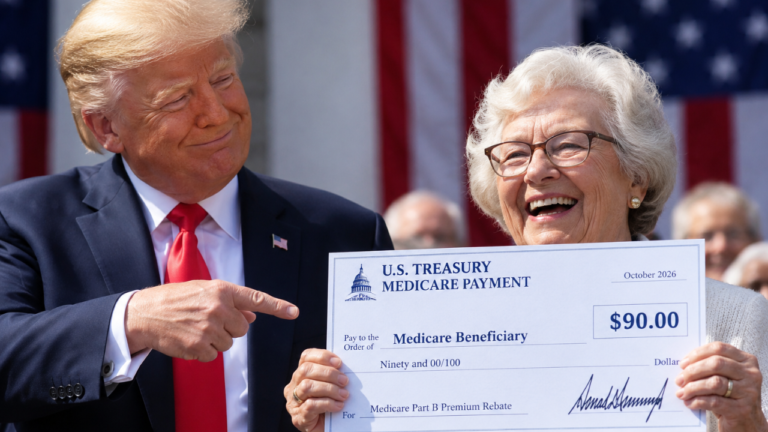
Trump announced late Friday that his administration will distribute one-time payments to eligible Medicare Part B beneficiaries to help offset the cost of their monthly premiums.
The president initially advertised them as “Checks” of “nearly $100.”
The actual amount is $90.
“I am pleased to announce that my Administration will, immediately, begin sending ‘Checks’ of nearly $100 to over 20 MILLION wonderful Seniors to help pay for their Medicare Part B premiums,” Trump wrote.
And then came the unusual part.
Trump said the money would come from the Medicare Improvement Fund — a government fund that he proceeded to describe as a pointless “Slush Fund.”
“This money will come from the Medicare Improvement Fund, a pointless ‘Slush Fund,’” Trump wrote.
But despite Trump’s description, the Medicare Improvement Fund isn’t simply an undefined pot of government cash.
Congress created the fund in 2008 to provide money for improvements to the original Medicare fee-for-service program.
According to the White House, Congress has allocated roughly $2 billion to the fund.
Now the Trump administration is using that money in a way no previous administration has: sending it directly to eligible Medicare beneficiaries as a premium rebate.
The Centers for Medicare and Medicaid Services says eligible recipients will receive a single $90 payment during October.
Most are expected to receive the money through direct deposit on or around October 8.
Others will receive a paper check from the U.S. Treasury later in the month.
But not every Medicare recipient qualifies.
The payments are primarily for eligible Medicare Part B beneficiaries.
People whose premiums are already being paid through Medicaid assistance aren’t eligible, nor are higher-income beneficiaries who pay an income-related adjustment to their monthly Medicare premiums.
The administration says more than 20 million people will ultimately receive the money.
And the timing is impossible to separate from the broader political context.
The payments are arriving roughly a month before the November 3 midterm elections, when control of Congress will be decided.
They’re also only the latest in a growing collection of checks, rebates and promised payments coming from Trump as that election approaches.
The administration has separately begun distributing $500 payments to nearly one million Americans who it says were overcharged fees connected to Affordable Care Act insurance plans.
And Trump has made an enormously larger promise for what could come next.
He has pledged a $5,000 “Trump Dividend” to every American adult if Republicans retain control of the House and Senate.
That proposal is not equivalent to the $90 Medicare payment.
The Medicare payments have an identified funding source and CMS has already published details explaining who qualifies and when the money should arrive.
The proposed $5,000 payments would require far more money — potentially more than $1 trillion — and face major questions about congressional authorization and their potential economic impact.
Trump nevertheless used Friday’s Medicare announcement to promote that much larger promise.
“Because I delivered on this very important issue for the American People,” Trump wrote, Americans “can also rest assured” that the $5,000 dividend would be distributed if Republicans win the midterms.
That explicitly linked an immediate government payment program with his party’s electoral fortunes.
The announcement reportedly surprised lawmakers in Washington.
The Washington Post reported that congressional offices in both parties were caught off guard by the move, while questions have also been raised about the administration’s authority to use the Medicare Improvement Fund for direct cash rebates.
The statutory language establishing the fund is broad, however.
Larry Levitt, executive vice president for health policy at KFF, told the Associated Press that the language gives an administration “substantial discretion.”
Congress itself has repeatedly moved money out of the fund over the years to finance other priorities.
So what seniors are receiving this month isn’t Trump’s proposed $5,000 dividend.
It isn’t a recurring Medicare benefit.
And despite Trump’s description, the official name isn’t a “slush fund.”
It’s a one-time $90 Medicare premium rebate being financed through an existing fund established by Congress nearly two decades ago.
For eligible recipients, the distinction may matter less than the deposit appearing in their bank accounts.
And unlike several much larger checks Trump has talked about sending Americans, these payments have something those promises don’t yet have:
A date.
For most eligible beneficiaries, CMS says the $90 should arrive on or around October 8.
About the Author