Donald Trump’s fight with the American press produced a remarkable split-screen at the White House Thursday morning.
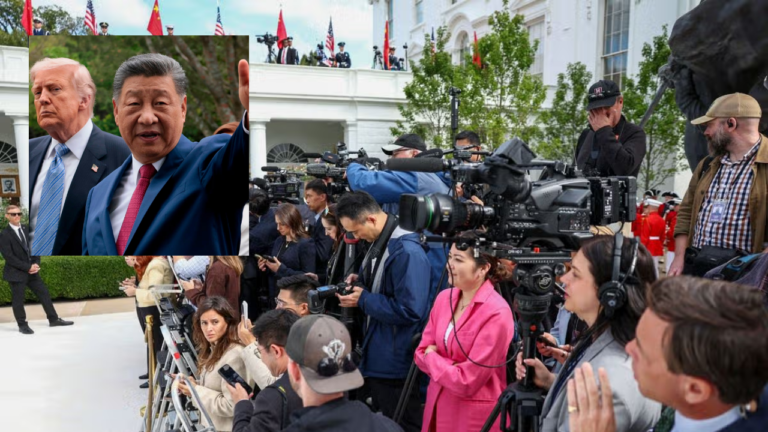
Chinese President Xi Jinping had arrived for a high-profile state visit.
The red carpet was out.
The ceremony was underway.
And members of Chinese state media were inside the White House grounds covering it.
But journalists from CNN, MS NOW and Politico were still struggling to get through the gates.
CNN’s Kaitlan Collins quickly highlighted the contrast.
“Despite the court order overnight, CNN, MS NOW and Politico reporters are still being blocked from entering the White House grounds today,” Collins wrote on X.
Then came the part that made the scene particularly striking:
“Yet for Xi’s visit, members of the Chinese state media are present.”
The timing was extraordinary.
Just hours earlier, U.S. District Judge Timothy Kelly had issued a temporary restraining order requiring the Trump administration to restore White House access to CNN, MS NOW and Politico.
Kelly concluded that the organizations were likely to succeed in showing that their credentials had been revoked without the due process required under the Constitution.
But Thursday morning, journalists from the three organizations reported continuing problems getting inside.
CNN senior White House reporter Betsy Klein said she repeatedly attempted to enter.
One CNN producer successfully entered around 6:30 a.m., according to CNN, but a photojournalist who tried shortly afterward was turned away and had his badge seized.
Klein herself tried again at 8 a.m. and 9 a.m. without success.
And all of this was happening while Xi’s arrival ceremony was getting underway behind her.
CNN, MS NOW and Politico went back to court seeking an emergency hearing.
But there was another layer to the spectacle.
While some American journalists were outside trying to regain their access, Chinese state media were already on the White House grounds.
CNN media analyst Brian Stelter described the situation on air after speaking with Collins:
“The Chinese communist state media are allowed on the White House grounds, but we are not.”
“And I think that says it all,” he added.
The contrast was especially notable because the major American television networks were already engaged in an extraordinary protest against Trump’s ban.
ABC, CBS, NBC and Fox had suspended their participation in the television press pool after CNN was removed from the rotation.
That meant a White House event seemingly designed for television — Xi’s ceremonial arrival, complete with presidential pageantry — unfolded without the usual live pool coverage from America’s five major television networks.
CNN reported Thursday morning that ABC was scheduled to provide the network pool camera for Xi’s arrival but did not do so as part of the solidarity action.
The Associated Press also declined to livestream the event to its clients.
Chinese state media, meanwhile, were present.
And the irony became even sharper later Thursday.
CNN White House correspondent Alayna Treene reported that, according to a source, Chinese officials themselves had raised concerns about the lack of American media coverage surrounding Xi’s visit.
When Dana Bash heard that detail on CNN, she burst out laughing.
“What you just said, that it was even the Chinese who were concerned about the American media not being in there,” Bash said.
“I mean, if that doesn’t tell you everything you need to know, I don’t know what does.”
There is an important update to the story.
The American outlets did not remain outside all day.
By around noon Thursday, CNN, MS NOW and Politico journalists were again being admitted to the White House grounds.
The administration said it had taken time to restore the disabled credentials following Kelly’s overnight ruling.
So this was not a permanent situation in which Chinese state media received access while the three American organizations remained banned.
But for several remarkable hours Thursday morning, the scene Collins described was real:
Xi Jinping was being welcomed to the White House.
Chinese state media were there to cover it.
And journalists from three major American news organizations that had just won a federal court order restoring their access were still outside trying to get back through the gates.
Collins didn’t need much commentary.
The contrast spoke loudly enough on its own.
About the Author