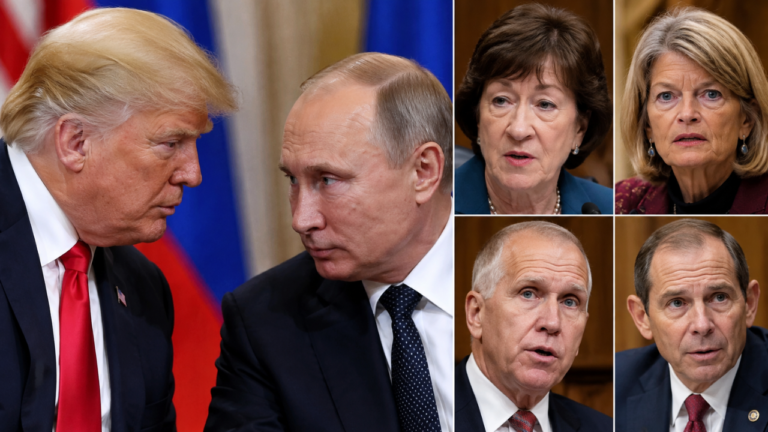
Donald Trump’s controversial agreement with Russian President Vladimir Putin has triggered a new rebellion inside his own party, with four Republican senators joining two Democrats in demanding that the White House immediately reverse its decision to purchase Russian diesel fuel.
The extraordinary bipartisan intervention came Sunday, just two days after Trump announced an agreement with Putin that would bring millions of tons of Russian diesel into American and global markets while temporarily easing sanctions intended to restrict Moscow’s ability to finance its war against Ukraine.
And the lawmakers are not simply questioning whether the agreement is wise.
They are challenging whether the administration has the legal authority to proceed.
Republican Senators Susan Collins of Maine, Lisa Murkowski of Alaska, Thom Tillis of North Carolina, and John Curtis of Utah joined Democratic Senators Jeanne Shaheen of New Hampshire and Richard Blumenthal of Connecticut in issuing a statement demanding an immediate change of course.
Their warning was unmistakable.
“The United States should not provide Putin with a financial lifeline while Russia continues to kill Ukrainian civilians,” the senators declared.
They called on the administration to reverse its decision, arguing that allowing Russian energy imports directly conflicts with restrictions Congress enacted following Moscow’s invasion of Ukraine.
The joint statement marks a significant escalation in the political backlash surrounding Trump’s agreement.
Until now, criticism from congressional Republicans had largely come through individual statements and television interviews.
Now four members of the president’s own party have formally joined Democrats in opposing the policy.
The controversy began Friday when Trump announced that he had reached an agreement with Putin during a telephone conversation.
According to the president, Russia would immediately supply more than 300,000 tons of diesel to American and global markets, followed by another 500,000 tons in November and an additional one million tons shortly afterward.
Trump also described plans for a further three million tons to become available within a relatively short period.
The White House presented the arrangement as an effort to relieve soaring fuel prices that have become an increasingly serious economic and political problem ahead of the November 3 midterm elections.
Diesel is particularly important to American trucking companies, farmers, manufacturers, and households that rely on heating oil.
Higher diesel prices can also increase transportation costs throughout the economy, adding pressure to businesses and consumers.
But the proposed solution has raised a fundamental question: why should the United States turn to Vladimir Putin for relief while Russia continues its military campaign against Ukraine?
That question has become especially urgent as Russian attacks continue to kill civilians.
The six senators argued that Congress had already established clear restrictions on Russian energy imports and that the administration had failed to adequately explain how its new arrangement could comply with those laws.
In their statement, the lawmakers said the White House had neither properly consulted Congress nor provided the statutory justification they believe is required.
They pointed specifically to restrictions adopted in 2022, when Congress moved to prevent American purchases of Russian energy from helping finance Moscow’s invasion.
The senators argued that Trump’s decision runs directly counter to that legislative intent.
Their criticism comes only weeks after Congress passed additional Russia sanctions legislation designed to increase economic pressure on Moscow.
That legislation, signed by Trump last month, was named in honor of the late Republican Senator Lindsey Graham, a prominent advocate of strong sanctions against Russia.
The contrast between that law and the administration’s latest energy arrangement has become a central point of contention.
Republican Senator Thom Tillis made the legal concern explicit during an appearance on NBC’s Meet the Press.
He said there was a legitimate basis for arguing that the president was not following the law if the administration proceeded with the diesel purchases.
Tillis also emphasized that Russia remains responsible for the invasion of Ukraine and has the ability to end the war by withdrawing from occupied Ukrainian territory.
His remarks were particularly significant because they came from a Republican senator rather than a member of the Democratic opposition.
And he is not alone.
Former Vice President Mike Pence has criticized the administration’s decision to ease restrictions on Russian energy, while Republican Representative Don Bacon has warned that supporting Putin’s wartime economy is morally wrong.
The criticism reflects a division within the Republican Party over how the United States should balance domestic economic concerns against its efforts to constrain Russia.
Trump’s supporters argue that the president must take aggressive steps to reduce energy prices, especially as American consumers face rising costs.
But critics contend that the administration risks weakening the very sanctions intended to pressure Putin into ending the war.
The dispute is unfolding against an increasingly complicated diplomatic backdrop.
On Saturday, Trump publicly suggested that Ukraine needed a new president, criticizing Volodymyr Zelenskyy over the lack of progress toward ending the conflict.
Then, on Sunday, Trump announced that Russia and Ukraine had agreed to an immediate ceasefire covering attacks on energy infrastructure.
But the announcement was not accompanied by a detailed agreement, and Moscow did not immediately confirm the arrangement.
Zelenskyy welcomed the possibility of such a ceasefire while emphasizing that Ukraine would be prepared to stop striking Russian energy facilities if Russia reciprocated.
The Ukrainian president has repeatedly argued that Moscow must demonstrate its willingness to end attacks rather than simply benefit from concessions.
For the six American senators, the proposed diesel purchases raise the possibility that Washington could provide Russia with additional revenue while its military operations continue.
The lawmakers also challenged the administration’s approach to congressional oversight.
Their statement argued that the president could not simply disregard existing restrictions without explaining the legal basis for doing so.
That argument has been disputed by the administration.
Treasury Secretary Scott Bessent defended the agreement during an appearance on Fox News, insisting that the White House possessed the necessary legal authority to proceed.
Bessent said the administration intended to use its existing powers and maintained that the arrangement would benefit Americans by helping reduce energy prices.
Republican Senator John Barrasso of Wyoming also defended Trump’s position, arguing that the president was attempting to balance difficult economic and foreign-policy considerations.
Barrasso emphasized the pressure facing farmers, truckers, and consumers while describing energy sanctions as a potential source of leverage in negotiations with Russia.
His comments underscored that Republican opposition to the agreement is not unanimous.
But the administration’s economic argument has also encountered skepticism from energy analysts.
Some experts have questioned whether the additional Russian diesel would be sufficient to produce a sustained reduction in American fuel prices.
Even if the agreement proceeds, the quantities and delivery schedules may limit its immediate impact on consumers.
That uncertainty adds another dimension to the controversy.
The White House is arguing that easing restrictions on Russian energy will help Americans struggling with high prices.
Its critics are warning that the arrangement could benefit Moscow without delivering the substantial economic relief the administration has promised.
And now those critics include four Republican senators willing to put their names alongside Democrats in a formal demand for reversal.
The political timing is difficult to ignore.
With the November midterms approaching, Republicans are attempting to defend their congressional majorities amid public frustration over the economy and the continuing consequences of the war involving Iran.
Fuel prices have become a particularly visible measure of those pressures.
Trump’s agreement with Putin was intended to address that problem.
Instead, it has opened another dispute over Russia policy, congressional authority, and the limits of presidential power.
The six senators have not announced that they will introduce legislation to block the agreement, and their statement does not itself prevent the administration from proceeding.
Nor has a court ruled that the arrangement violates federal law.
But the coordinated opposition represents a concrete political development that the White House cannot dismiss as criticism coming exclusively from Democrats.
Four Republican senators have now joined their Democratic colleagues in arguing that Trump’s agreement with Putin should be reversed.
Their warning is straightforward: the United States should not ease the financial pressure on Russia while its war against Ukraine continues.
And with the administration defending its decision, the confrontation has created another test of how far congressional Republicans are prepared to challenge the president over his relationship with Moscow.
About the Author